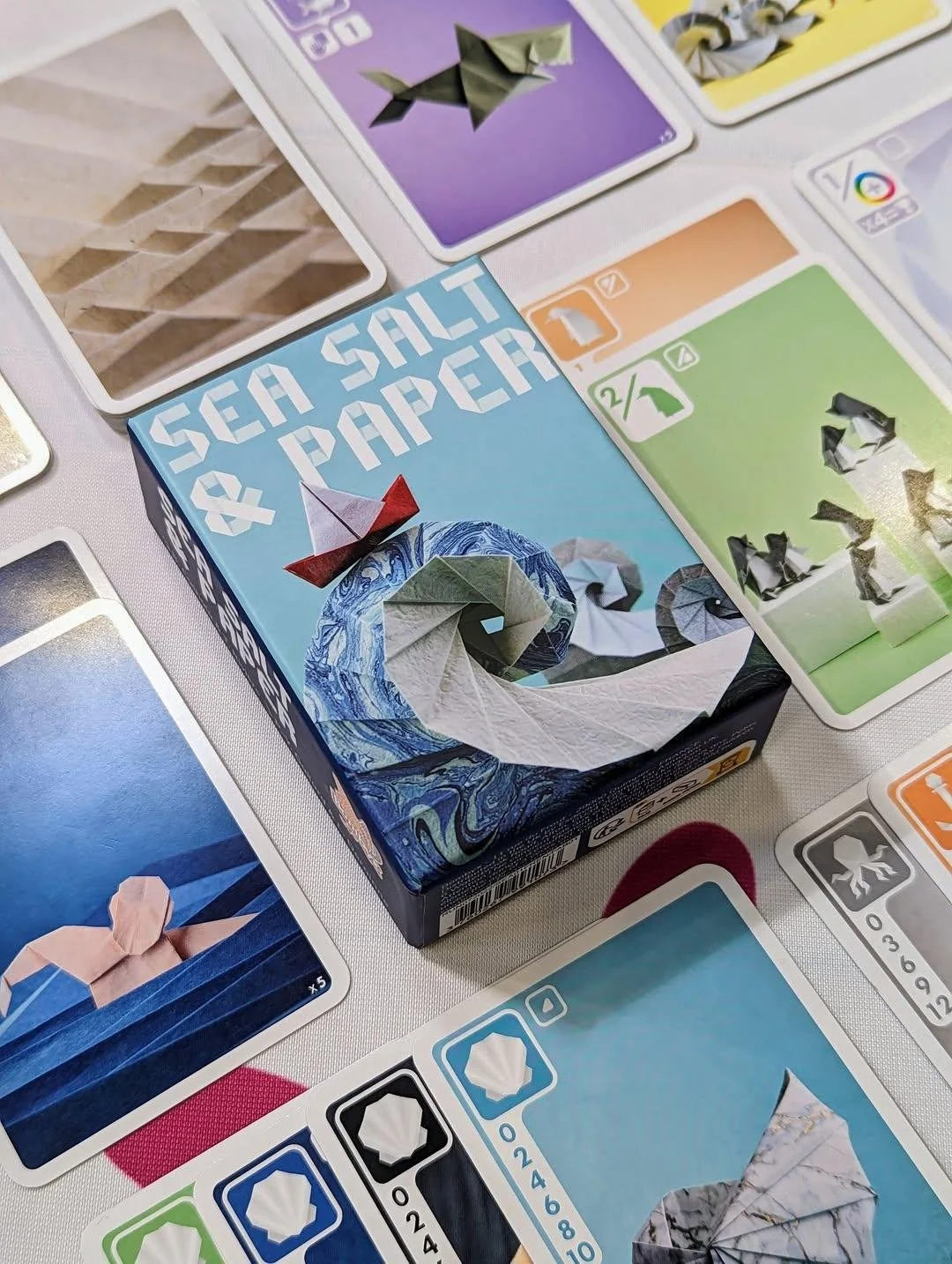
I have shuffled this little deck more times than I can count, on trains, on a kitchen table, twice in an airport, and yes, even on my bed having breakfast there with my girlfriend, don’t judge. So here is the verdict before the pretty pictures soften you up.
Sea Salt & Paper looks like a gentle origami daydream (it’ll make you wonder how hard is it to fold paper into a cool shark) and plays like a knife fight in a phone booth. The art whispers cozy. The scoring does not. That gap is the whole reason this game is worth a real review instead of a polite shrug.
Why Sea Salt & Paper Feels Meaner Than It Looks
The origami fish are smiling. You are not, because someone just sharked your fourth mermaid.
The tension lives in three places, and none of them are obvious from the box. First, your hand is never safe. As long as the swimmer and shark cards are in the deck, every fat hand of unplayed sets is a target, so the moment you look comfortable is the moment you are most exposed. Second, those two discard piles are a quiet duel all on their own.
You always have three choices when you take a card, the deck and the two pile tops, which means you are not just drafting for yourself, you are deciding what to leave behind for your opponent. Bury a card they want by discarding on top of it.
Dangle a card to bait them in the direction you want them facing. It is a small thing that creates a surprising amount of mind games.
Third, and this is the engine of the whole game, ending the round is a weapon, not a formality. Saying “Stop” the instant you hit 7 can deny your opponent the bigger play they were setting up.
Waiting one turn too long can let them say the other word and take you apart. Which brings us to the rule this entire review is built around.
Sea Salt & Paper Strategy: Why Last Chance Is a Trap, Not a Comeback
Here is the rule everyone argues about, and most of the arguing happens because the official rulebook breezes past the part that matters.
When you end a round, you say “Stop” or “Last Chance.” Stop is safe: everyone scores their cards, the round is over, no drama. Last Chance is the bet. You are wagering that after every opponent takes one final turn, your hand is still the highest. Win that bet, equal or higher, and you score your cards plus a color bonus while your opponents score only their color bonus. Lose it, even by a single point, and you score only your color bonus while everyone else scores their full hands.
Read that again, because it is brutal. The loser of a Last Chance does not lose a few points. They lose almost everything they built that round. The official rulebook states this consequence in one flat clause, “their opponents only score their color bonus,” and then moves on as if it just told you the weather. The worked example in the book even uses the gentle version, where the loser still walks away with a small color bonus and nobody feels robbed. The actual feel-bad case, the one where you call Last Chance, lose by a point, and watch your entire round evaporate, never gets demonstrated.
So new players walk straight into it. The common assumption is that Last Chance is a catch-up move you call when you are behind. It is the opposite. Calling it from behind and losing only widens the gap, because you forfeit your hand and they bank theirs. In practice the snowball is savage: one player wins an early Last Chance, opens a lead of fifteen or twenty points before the second round is done, and the math from there is close to hopeless. For a game with this much smiling sea life on the cards, the scoring is shockingly merciless.
Is that a design flaw? I go back and forth, and I have landed on this. The punitive swing is intentional and it is the source of all the real tension, the reason “Stop” is interesting at all. But it is badly taught, and a rule this sharp needed a worked example of the painful case and a sentence of warning. The mechanic is a feature. The rulebook’s silence about it is the defect. Treat Last Chance as a closing move for when you are already ahead and want to twist the knife, not a prayer when you are losing, and the game opens up.
Sea Salt & Paper Scoring: The Rules Everyone Gets Wrong
If your first game felt confusing, you are not slow, the scoring genuinely hides its tricky bits. These are the ones that trip up nearly every new table, straight from the rulebook.
Your color bonus does not score on a plain “Stop.” This is the big one. The largest group of a single color only pays out two ways: when you win a Last Chance, or through mermaid cards. End a normal round with “Stop” and that beautiful stack of nine blue cards is worth nothing on its own. People assume color always counts. It does not.
A tied Last Chance goes to the person who called it. Equal scores do not split or cancel. If you bet and you match your opponent exactly, you win the bet, which feels backwards until you remember the caller is taking the risk.
Mermaids count as white cards. This is the rule the rulebook tucks into a side note, and it changes your math. Each mermaid scores one point per card of your most common color, and a different color per mermaid, but the mermaids themselves are white, so they quietly pad your white group while doing it. Four mermaids on the table is an instant win, full stop, and yes, you can steal the fourth one with a shark to end the game on someone else’s turn. People have ruined friendships this way.
You cannot dig through the discard piles. The rulebook is explicit: no flipping through a pile to see what is buried. The only legal way to reach a card underneath is the two-crab effect, and even that only lets you into one pile. Plan around what you can actually see.
Is Sea Salt & Paper Worth It? Who Should Actually Buy It
If you want a small, gorgeous, genuinely tense game for two that fits in a coat pocket and sets up in ten seconds, this is one of the best in its class, and it earns a spot in the two-player rotation easily. It teaches in a single round, it travels better than almost anything, and the origami photography is the rare case where a publisher used real photos and made the game look more characterful, not less.
Two honest cautions. First, that Last Chance swing means your first game or two can feel lopsided and a little unfair while everyone learns what the words actually do, so push through the early sting before you judge it. Second, it lives at its best with two players. The box says up to four, and four works fine, but the head-to-head version is where the discard-pile mind games and the bluffing tension sharpen to a point. At higher counts the cards scatter and the control thins out, and the tight, deliberate duel that makes this game special goes a little soft.
Sea Salt & Paper is a cozy-looking object built around a cold-blooded little game, designed by Bruno Cathala and Théo Rivière with origami photography by Pierre-Yves Gallard. Beautiful, portable, and far nastier than it has any right to be, right up until someone calls Last Chance and the table goes quiet.