Strategy board games have a reputation for being inaccessible, and a lot of them earn it. Rulebooks that read like legal documents, setup times that eat into the evening, and a first session that functions mainly as a tutorial for the second one. That reputation isn’t entirely fair, but it shapes what people search for when they’re trying to get into the category: not just what’s good, but what’s good to start with.
The answer to that question matters more than most strategy game coverage acknowledges. Getting into strategy gaming through the wrong first game is a fast way to decide the whole category isn’t for you.
The gateway problem
The best strategy board games for adults who are newer to the format tend to share a specific quality: the rules are learnable in one sitting, but the decisions don’t feel trivial. That’s a narrow window. Too simple and there’s nothing to think about. Too complex and the game becomes homework before it becomes fun. If you’re not sure where your group sits on that spectrum, the family games category covers the lighter end and makes a reasonable starting point before stepping up.
Disney Villainous sits in that window in an unexpected way. On the surface it reads as a family game, and it works at that level, but the underlying design is genuinely strategic. Each villain operates as a separate puzzle with asymmetric rules and a distinct win condition, which means understanding your own character deeply enough to execute a plan while disrupting everyone else’s is the actual game. That’s a strategic skill set, dressed in accessible theming. For someone who wants real decisions without committing to a 200-page rulebook, it’s a more honest entry point than most games marketed as strategy titles.
The gateway question is worth taking seriously because the wrong first strategy game does real damage. A new player who bounces off something too heavy too early tends to write off the entire category rather than just that game. Starting with something that delivers genuine strategic decisions inside a manageable rules footprint is how the category builds its audience.
What strategy board games actually reward
The category covers a wide range. At one end you have games built almost entirely around resource management and long-term planning. At the other you have games where tactical decisions in the moment matter more than any overarching strategy. Most of the best strategy board games live somewhere in the middle, requiring both.
What they share is that losing feels instructive rather than arbitrary. In a well-designed strategy game you can usually trace the loss back to a specific decision, which is either satisfying or maddening depending on your temperament. That feedback loop is what makes strategy games for adults genuinely replayable in a way that luck-heavy games aren’t. You’re not just playing again; you’re testing a hypothesis about what you’d do differently.
There’s also a social dimension to strategy gaming that doesn’t get talked about enough. The best strategy board games create a shared language between the people who’ve played them. References to past games, running jokes about a particular blunder, the quiet satisfaction of watching someone fall into the same trap twice. That accumulation of shared history is part of what makes the category stick with people long after individual sessions are forgotten.
Hard board games vs. complex board games
These aren’t the same thing and the distinction is worth making. A hard board game is one where the decisions are genuinely difficult, where the optimal path isn’t obvious even to experienced players. A complex board game is one with a lot of interlocking rules and systems, which may or may not produce difficult decisions once you’ve learned them.
The most rewarding strategy board games tend to be hard without being needlessly complex. The rules exist to create interesting decisions, not to demonstrate that the designers thought about a lot of things. When complexity serves decision-making it’s an asset; when it’s just overhead, it’s a barrier that keeps people from getting to the actual game.
That’s the lens worth applying when evaluating anything in this category. How quickly can you get to a real decision? And when you get there, does it actually matter?
Strategy board games for adults who are coming from lighter games often underestimate how quickly they’ll adapt. The jump from a family game to a medium-weight strategy title is smaller than the box art and BGG ratings suggest. The main barrier is usually psychological: the assumption that heavier means harder to enjoy, rather than just harder to learn. Most people who push past that assumption find the category opens up faster than expected.
For evenings where you want everyone working toward the same goal rather than competing, cooperative games offer strategic depth in a different format.
What to look for in a strategy board game:
Decisions that feel meaningful from the first session
Loss states you can learn from rather than blame on luck
Rules complexity that serves the game rather than obscuring it
Enough replayability that the fifth game is more interesting than the first
Scales well to your usual player count without dead time
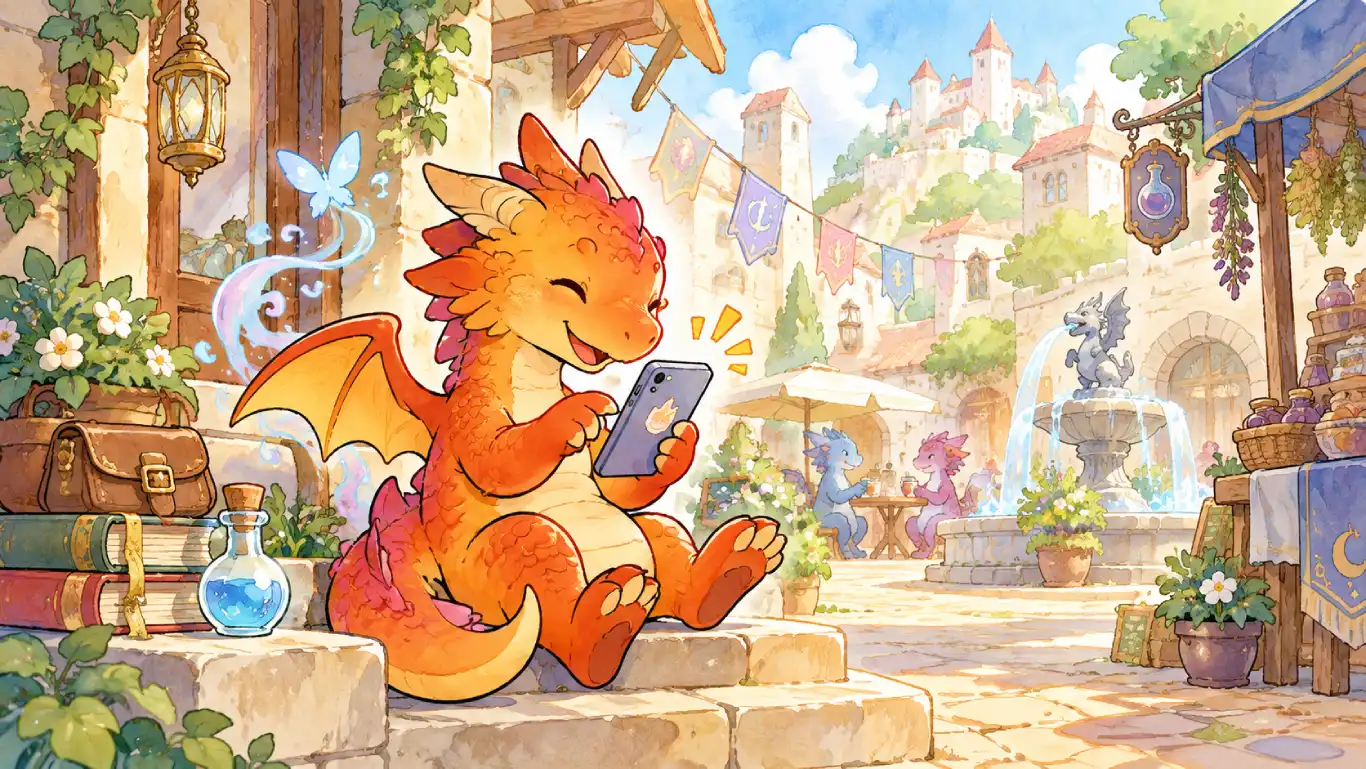
The dragons are adorable. The strategy runs shallower than the studio’s last game.
Monster Couch built the Wingspan video game, which is the digital board game I have sunk the most hours into by a wide margin, so I came to their Flamecraft adaptation already knowing what this team does to a tabletop game when they get their hands on it.
They rebuild it as a tiny, animated, hand-painted world rather than a flat menu of cards, and they score it like a lullaby. Flamecraft, the digital version now out on Steam, PS5, Xbox, and Switch, gets all of that treatment. What it does not get, because the box never had it to begin with, is much depth once you have seen the town a few times.
That is the honest shape of this one. It is the coziest game I have booted up in months, and it is also the one my group is most likely to solve.
What Monster Couch’s Digital Version Gets Right
The town is the star. Every shop is a little 3D diorama, the dragons have more personality than they have any business having at this size, and the soundtrack is the sort of thing you leave running after you have stopped playing. If you liked how the Wingspan app felt to sit inside, this feels the same way, warm and unhurried, built by people who clearly like the source material instead of just licensing it.
It plays fast, too. A full game lands around the hour mark, which makes it the thing you put on when a heavier game has collapsed because someone at the table fell asleep three quarters of the way through Caverna. Cross-play carries across PC, consoles, and Switch, so a group split across devices can still share a table. That flexibility is real, and it is the sort of thing the physical box simply cannot offer.
The rules teach themselves. You draw dragon cards, you place them on the town’s shops, and each dragon and shop hands you an action when you do: draw more dragons, collect goods, cash goods in for the reputation points that decide the winner. A handful of short tutorials and one full game is enough to have the whole loop down. Mastering it takes longer, but nobody is going to bounce off the on-ramp.
There’s a Free Demo, So You Can Actually Try It First
Here is the part the marketing buries and the part I care about most: there is a free demo on every platform, Steam included. It hands you a slice of the town, a few dragons, bot opponents, and local multiplayer for up to five, which is more than enough to know within one sitting whether the game clicks for you.
That matters because Flamecraft is a buy, not a rental, and the demo turns a blind purchase into an informed one. If you have been circling the physical box at forty-odd dollars, an hour with the free digital version tells you whether the cozy dragon shopkeeping loop is your thing before you commit to cardboard. This is the same logic behind trying any board game on a screen before buying it, which I got into at more length when Amazon Luna put King of Tokyo up for free. If that is the way you like to shop for games, the piece on the board games you can try digitally before buying is worth a read alongside this one.
Six Dragons, Six Actions, and Where the Ceiling Shows
Now the catch, and it is a structural one, not a porting complaint. Flamecraft runs on six dragon types tied to six goods: bread, meat, iron, crystal, plant, and potion. Every dragon of a color does the same thing every other dragon of that color does. That is elegant, and it is also a hard limit on how many genuinely different turns the game can hand you.
Compare it to the studio’s own Wingspan, where the deck runs into the hundreds of birds and nearly every one carries its own power, so the range of what you might do on a turn is effectively bottomless. Flamecraft is not trying to be that. It is a lighter, breezier thing, a gateway toward the Agricola and Caverna end of the hobby rather than a resident of it. But you feel the smaller menu.
My group will get good at this and then, I suspect, get to the bottom of it, because there are only so many optimal lines when everyone is drawing from the same six-action pool. The trip to that point will be pleasant. It will also be finite in a way Wingspan never was.
The AI Coasts, and There’s Still No Phone Version
Two smaller marks against it, both carried over faithfully from what this studio ships.
The bot opponents come in three difficulty levels and none of them will scare you. Same story as the Wingspan AI: fine as a warm body when you cannot get a group together, never a real threat once you understand the game. There is a solo story mode too, though if you are here for multiplayer the way I am, you will barely touch it.
And there is no mobile version. The whole thing is cross-play across PC, TV consoles, and Switch, which is genuinely convenient, but the absence of a phone build makes it less grab-anywhere than the Wingspan app, which lives in your pocket. For a game this light and this quick, phone is exactly where a lot of people would want it. That gap will probably close, but it is open right now, and it is the one omission that stings.
Is the Flamecraft Video Game Worth Buying?
Yes, with your eyes open. Monster Couch has made the prettiest, warmest version of Flamecraft that could exist, and if you want a cozy hour that asks little and gives back a lot of charm, this is an easy recommendation. Just know going in that the ceiling is lower than the studio’s last adaptation, the AI is scenery rather than a rival, and it is not on your phone yet. Play the free demo first. It is the whole review, compressed into one sitting, and it costs you nothing but an evening.
Most lists treat “strategy” as one flavor. It isn’t. Brass: Birmingham squeezes you slowly until you’re arguing with yourself over a single barrel of beer. Root makes you stare at the cat player, who hasn’t attacked in two turns, and wonder what she’s building toward.
Spirit Island hands you a clock and dares you to beat it. Same shelf label, completely different ways of making your palms damp.
So instead of ranking these one to sixteen, I sorted them by where the tension comes from, because that’s what decides whether a game becomes a regular at your table or gets played once and shelved.
My bar for what counts here is simple. Your decisions should decide the game more than the dice do, and a good player should beat a new one most of the time. That bar rules out Monopoly and most of Risk (more on those near the end). Everything below clears it, from a 40-minute bird game to a space opera that eats an entire Saturday.
The Sixteen Picks at a Glance
If you already know what kind of game you want, this table gets you there fastest. Everything in it sits in our wider strategy games category too.
Game
Type
Players
Play time
Wingspan
Engine builder
1-5
40-70 min
Ark Nova
Engine builder
1-4
90-150 min
Terraforming Mars
Engine builder
1-5
About 2 hours
Brass: Birmingham
Economic
2-4
60-120 min
Concordia
Economic
2-5
90-120 min
Power Grid
Economic, auction
2-6
About 2 hours
Root
Asymmetric area control
2-4
60-90 min
Dune: Imperium Uprising
Deck building, worker placement
1-4 (6 in teams)
60-120 min
Scythe
Engine builder, area control
1-5
90-115 min
7 Wonders Duel
Two-player
2
30 min
Twilight Struggle
Two-player
2
2-3 hours
War of the Ring
Two-player
2-4
3 hours or more
Spirit Island
Co-op
1-4
90-120 min
Pandemic Legacy: Season 1
Co-op campaign
2-4
About 1 hour per session
Twilight Imperium 4th Edition
Epic
3-6
4-8 hours
Diplomacy
Negotiation
7 (variants for fewer)
4 hours or more
Engine Builders: Cheap Early Turns, Expensive Late Ones
An engine builder starts you with almost nothing and asks you to invest in things that pay out later. The tension creeps in. For the first half hour everything feels generous, and then you look at the round tracker and realize you have four turns left and an engine that needs six to pay off.
Wingspan
Wingspan has a reputation as the relaxing bird game, and it earns maybe half of it. The art is lovely and nobody attacks anybody.
But you get eight actions in the first round, seven in the second, six in the third and five in the last, while every new bird costs more eggs to play. The engine gets pricier to run exactly as your turns disappear. That squeeze is the whole game.
Is it deep enough to earn a spot here? It’s the lightest game in this section, and I won’t pretend otherwise. What it does better than anything else here is teach new players what “engine” means without scaring them off. I get into the shrinking-clock problem and which expansions to add in my full writeup on Wingspan.
For couples, Wingspan Asia works as a standalone two-player box. If you’ve outgrown the base game, Wyrmspan swaps birds for dragons and adds cave excavation, a layer of planning that makes the whole thing noticeably crunchier.
Ark Nova is where you go when Wingspan starts feeling solved. You’re building a modern zoo: enclosures, animals, sponsors, conservation projects, 255 unique cards. On paper that’s too much. The action system keeps it sane.
You have five action cards in a row, each with a strength from one to five based on its slot. Play a card and it drops back to slot one, pushing everything else up. So the move you want right now is often the weak version of that move, and waiting a turn makes it stronger. Every turn becomes a small bet on patience.
Scoring runs on two tracks heading toward each other, appeal and conservation, and the game ends when yours cross. Expect two-plus hours at four players. I think it’s at its best with two, where turns come back around fast enough that you never lose the thread.
Terraforming Mars
Every player in Terraforming Mars is pushing three shared numbers (temperature, oxygen and ocean tiles), and the game ends once all three hit their maximums. That’s the part people underrate. Every time you raise the temperature, you’re scoring points and also shortening the game for everyone, including the person whose engine is still warming up.
There are 208 project cards, so no two games run alike. Play with the drafting variant from the rulebook. Without it, card luck swings too hard for a two-hour game. The components are functional at best and the first play will run long while everyone reads cards out loud. Neither of those stops it from being one of the most replayed boxes in my collection.
Economic Euros That Squeeze You Dry
Economic games don’t have big dramatic swings. They tighten a little each round, like a belt you keep having to notch. By the end you’re counting coins twice and still getting it wrong.
Brass: Birmingham
If I had to keep one game from this entire list, it would be Brass. You’re an industrialist in the English Midlands across two eras, canals then rail, building coal mines, ironworks, breweries and factories, and connecting them to markets.
The clever part is that you rarely produce everything yourself. Need coal for a factory? You can burn your rival’s coal, which flips their mine and scores them points. Every shortcut you take feeds someone else. Selling goods needs beer, beer comes from breweries, and half the time the nearest brewery belongs to the player you least want to help.
Turn order matters too. Whoever spent the least money in a round goes first in the next one, so being cheap buys you tempo. Toward the end of the rail era you’ll often have no idea who’s winning, and that uncertainty is what makes the last few turns so tense.
The downside is a real one. Players prone to overthinking will stall, and a first game runs close to three hours. The rulebook includes a shortened introductory version, but it strips out most of what makes Brass special.
Concordia
Concordia is the calm one in this section, and I mean that as praise. Everyone starts with the same hand of personality cards. You play one per turn and do what it says: move colonists, build houses, produce goods, buy new cards. When you want your cards back, you play the Tribune.
Scoring happens entirely at the end, through gods printed on the cards you collected, so you can win a game you thought you were losing. People call it luck-free. It isn’t quite. The card market refills from a shuffled deck and the city goods are randomized at setup. Still, luck matters less here than in almost any game on this list, and it plays well at two players.
Power Grid
Power Grid is an auction game wearing a spreadsheet. You bid on power plants, buy coal, oil, garbage and uranium from a shared market, and pay to connect cities. Money is tight enough that a single overbid can haunt you for three rounds.
The rule that makes it work is often explained backwards. Turn order is based on how many cities you’ve connected. The leader goes first in the auction, where going first is a disadvantage. Then the order reverses: the player in last place buys fuel first at the cheapest prices and builds first into the cheapest cities. The leader pays top price for everything. It’s an elegant brake on runaway wins, and it keeps the final round close more often than you’d expect.
Get the Recharged edition if you’re buying new, and budget time for arithmetic.
Area Control Games Where Every Border Is a Threat
Area control games put everyone on one crowded map. The tension is spatial. You can see the attack coming, you just can’t always stop it.
Root
Root looks like a children’s book and plays like a knife fight. Four factions share a woodland map, and each one runs on different rules. The Marquise de Cat builds an industrial empire. The Eyrie Dynasties follow a decree that grows every turn and collapses into turmoil the moment they can’t fulfill it. The Woodland Alliance spreads sympathy and sparks revolts. The Vagabond wanders around making deals and ruining everyone’s plans.
Teaching Root is like teaching four games at once. The first play is a rehearsal, full stop. Plan for it, then play again the same night if people are willing, because the second game is where it clicks. Someone wins at 30 points or by completing a dominance card, and the table has to police the leader, since nobody else will.
A word of warning on the Eyrie. Falling into turmoil twice in a row can wreck a new player’s game, so give that faction to someone who enjoys a puzzle that punishes mistakes.
Like the idea of every player chasing a different goal, but Root sounds like too much? Disney Villainous gives each player a villain with a unique win condition at a far lighter weight, and it handles two to six players.
Dune: Imperium Uprising
Dune: Imperium blends deck building with worker placement. Your cards decide which spaces on the board you can visit, and those spaces improve your deck. Uprising is the version I’d buy. It adds spies, contracts and sandworms that double your rewards in a conflict. More importantly, it pushes you into combat nearly every round, where the original let players sit out and build quietly.
Hidden intrigue cards mean you’re never fully sure you’ve won until the last one is played. It also has a six-player team mode, rare for a game this sharp.
Scythe
No game on this list starts more arguments than Scythe. It’s set in an alternate 1920s Eastern Europe full of giant mechs, it looks spectacular, and depending on who you ask it’s either a tense war game or a solitaire puzzle with plastic robots.
I’ve heard four versions of the case. One camp says it’s a race to execute a memorized opening, and experienced players know their full sequence of moves before turn one. Another insists it’s best at two players, because an opponent with nobody else to worry about will come at you and break that script.
A third points to the star system (the game ends the instant someone places a sixth star) as the thing that makes the final turns tense, since you’re always calculating whether you can grab one more before someone else ends it. The fourth calls it multiplayer solitaire with occasional fights.
They’re all a little right. My take: Scythe is a race dressed up as a war. Combat rarely happens, but the threat of it shapes every move. If you like efficiency puzzles with menace in the background, you’ll love it. If you want armies clashing every round, get Root instead.
Scythe and Wingspan share a publisher, and both land in my ranking of the best Stonemaier games, where I explain which of the two has aged better.
Head-to-Head: Games Built for Exactly Two Players
With just two players there’s nobody else to blame and nobody to gang up on the leader. It’s you, your opponent and every mistake laid bare.
7 Wonders Duel
Treat this as its own game rather than a shrunk-down 7 Wonders, and a better one at this count. Cards are laid out in a pyramid, some face down, and taking a card can reveal a new one for your opponent. You’re always thinking one move ahead of what you want to take.
There are three ways to win: push the military track into your opponent’s capital, collect six different science symbols, or have the most points when all three ages are done. Only one of those has to go right for you, and your opponent has to watch all three. Thirty minutes, and it fits in a coat pocket.
Twilight Struggle
The Cold War in about three hours. One player is the USA, the other the USSR, fighting for influence across the globe with a deck of historical event cards. The cruel twist is that many cards belong to your opponent’s side, and when you play one for its points, their event fires anyway. Every hand is damage control.
Push the DEFCON track to one on your own turn and you’ve started a nuclear war and lost. So you can’t be aggressive everywhere, all the time. It’s heavy, long and best with a regular opponent. If you have one, few games reward repeat play this much.
War of the Ring
The Lord of the Rings as a full war game: one side controls the Free Peoples, the other the Shadow armies of Sauron. The Free Peoples can win militarily, but their real hope is sneaking the Fellowship to Mount Doom while the Shadow player hunts it. The Shadow can win by conquering enough strongholds or by corrupting Frodo.
Two different wars on one board, running at once. It’s the most requested two-player game among people I know who play heavy games, and it deserves the praise. Two cautions. It runs three hours or more, and many experienced players find the base game favors the Shadow. The first two expansions are the usual fix.
Multiplayer Games That Shine With Two
Plenty of games on this list are at their best with two, even though the box says four. Brass, Ark Nova and Concordia all get tighter and faster with just two players. Before buying anything for two, check the player-count poll on BoardGameGeek. If more than roughly a third of votes say “not recommended” at two players, believe them.
Co-op Games That Turn the Board Into Your Opponent
Co-ops replace the rival across the table with a system trying to kill you. The tension comes from watching a clock you can’t stop.
Spirit Island
You’re spirits of an island, defending it from colonizing invaders. The invaders are predictable: they explore, build and ravage on a visible schedule. You can see exactly where the damage is coming next turn. The puzzle is that you can’t stop all of it, and every power card is either fast (it resolves before the invaders act) or slow (after), which decides whether you’re preventing damage or cleaning it up.
It’s the best co-op strategy game I know, with one real flaw. Games sometimes end with a whimper. One player clears the last towns with a fast power, the win triggers, and the final turn everyone planned for never happens. That doesn’t happen often, but it’s frustrating when it does.
If you want co-op for two in under 20 minutes, Sky Team has you landing a plane with a partner using dice and almost no talking. It’s far lighter than anything else in this section and one of the best-rated games on this site.
Pandemic Legacy: Season 1
Base Pandemic is a fine game with a known problem: one experienced player can end up making everyone’s decisions for them. The Legacy version is still vulnerable to that, but the campaign gives the table so much to argue about that nobody stays quiet for long.
You play through a year of months, 12 to 24 sessions depending on how often you fail, and the game changes permanently each time. Cities fall, rules are added, stickers go on the board forever. It’s one playthrough and done, and the story it builds is worth every cent of that trade.
Twilight Imperium and Diplomacy Take the Whole Day
Some games aren’t an evening, they’re an event. The tension here comes from investment: after six hours of building an empire, every vote and every betrayal feels enormous.
Twilight Imperium 4th Edition
Three to six players, a galaxy built from hex tiles, and a realistic playtime of six to eight hours for a first game. Each round you pick a strategy card that shapes your role, then expand, trade, fight and vote on galactic laws. First to ten victory points wins.
The rules aren’t the hard part. The table is. Treaties get broken, trades get renegotiated in the hallway, and the whole group will still be arguing about round four’s vote days later. Only buy it if you have a group that will commit a full day, more than once.
Diplomacy
No dice, no cards, no luck at all. Seven players negotiate, then write secret orders for their armies at the same moment. Everything rides on trust, and the moment of the game is the backstab you didn’t see coming. It will damage friendships, and that’s the point.
Catan, Ticket to Ride, Monopoly and Risk: Where the Classics Land
These four show up on every list, so here’s where each one falls against the bar I set at the top.
Catan is a strategy game with a dice problem. Opening placement and trading take real skill, and the robber punishes whoever’s leading. But a bad run of rolls can sink a good player. It’s still a great first step. I go through what separates good Catan players from lucky ones in my Catan strategy guide.
Ticket to Ride is lighter than anything in the main list and a brilliant gateway game. The destination tickets add real risk, since an unfinished route costs you its points. It gets thin at two players, when the board opens up and nobody gets blocked.
Monopoly fails the bar. Once the properties are bought, the game plays itself. Most families also skip the official rule that unbought property goes to auction, and add a Free Parking jackpot that isn’t in the rules. Together, those two changes are why Monopoly lasts forever.
Risk has more decisions than Monopoly, but dice decide every battle and turtling is usually the best play. If your group loves Risk, Small World or Root will feel like the game Risk was reaching for.
If you’re bringing new players up from these, start with my guide to strategy board games for beginners, which picks games that each teach one real skill.
Quick Answers: Best, Hardest and What Counts as Strategy
What is the best strategy board game right now?
For competitive play, Brass: Birmingham. It combines economic depth, player interaction and a tense finish better than anything else I’ve played. For co-op, Spirit Island. For two players, 7 Wonders Duel if you have half an hour, Twilight Struggle if you have an evening.
What is the hardest strategy board game ever made?
The Campaign for North Africa, a 1979 wargame with an estimated playtime of around 1,500 hours. It’s famous for a rule that makes Italian troops use extra water to cook pasta. Among games people still play regularly, Twilight Imperium 4 and Twilight Struggle are about as demanding as it gets.
What makes a board game a strategy game?
Your choices, not luck, decide the result, and a skilled player beats a new one most of the time. Almost every game has some strategy in it, but this label is for the ones where it outweighs everything else.
Are strategy board games good for two players?
Many are better at two. Dedicated duels like 7 Wonders Duel, Twilight Struggle and War of the Ring are built for it, and bigger games like Brass, Ark Nova and Concordia tighten up nicely with two.
Pick Your Pressure
Don’t choose by rating. Choose by the kind of sweat you want. A slow build you can plan around? Engine builders. A tightening budget? Brass or Power Grid. A rival you can see coming? Root. A clock ticking down? Spirit Island. Match the pressure to your group and the game will earn its spot at your table.
King of Tokyo’s free Amazon Luna launch got me sitting down and playing it, and it also got me digging into how many other board games let you try before you buy.
The honest answer on that second question is: fewer than the marketing around them suggests. A lot of “digital board game” coverage treats every app in the category as a free demo, and that’s just not true. Some really are. Some are a $20 purchase wearing a trial’s clothing.
I Spent an Evening With King of Tokyo’s Free Amazon Luna Video Game
It took about ten minutes to get an answer to the only question that mattered: do I still like this game with the table stripped away. I did. Getting there came with a few caveats worth knowing before you treat a ten-minute session the way I did.
The dice-rolling loop moves faster on a screen than it does at a table. No fumbling for the sixth die that rolled under the couch, no re-counting a monster’s health by hand, no forgetting that healing doesn’t work while you’re standing in Tokyo, because the game just won’t let you make that mistake.
If you’ve ever had a rules argument at a physical table over whether energy carries between turns or whether you can refuse to leave Tokyo, this version settles it instantly by enforcing the rules for you. That’s a real, underrated use case for a “trial” that has nothing to do with buying decisions at all: it’s a fast way to confirm a rule you’re fuzzy on.
Where it loses ground is exactly where you’d expect a cloud-streamed version of a physical game to lose ground. Amazon Luna runs everything on a remote server and streams the video back to your device, so there’s a beat of input lag between locking a die and seeing it register, small, but noticeable if your connection has any hiccups at all.
And touching a screen to “roll” six virtual dice just doesn’t hit the same as physically slamming a fistful of oversized claw-and-heart dice down in front of your friends. That gap isn’t a bug, it’s just what happens when you strip the table out of a tabletop game.
The bigger limitation is content, not presentation: this is the base game only. No unique monster powers, since those live in the Power Up expansion, which isn’t part of the free Luna version. Every monster plays identically, which is a real, already well-documented complaint about King of Tokyo’s base box, and the video game inherits it faithfully rather than fixing it.
So don’t mistake a flat ten minutes with six identical monsters for a fair read on where the game goes once someone at your table owns Power Up.
Getting a lobby together mattered too, since this is a party game, not something you play solo. That part was painless: no account needed beyond an existing Prime login, and the interface walks each player through their own options every turn instead of assuming everyone already knows what the icons mean.
Whether three or four people of mixed experience could actually start playing within a few minutes of deciding to try it, they could, and that matters more than whether the dice loop holds up alone.
The push-your-luck tension, stay in Tokyo and bank points or bail out and heal, held up even with the tactile stuff gone. That was the only question a free trial needed to answer, and it did. I won’t be going back to the video game itself now that I’ve made up my mind, but that was never the job it was built for.
Other Board Games You Can Try on Your Phone Before Buying
King of Tokyo isn’t the only board game with a digital option worth checking before you spend on cardboard, it’s just the only one on this list that’s free with no catch. Here’s how Catan, Wingspan, and Exploding Kittens compare.
Game
Free to try?
Pros
Cons
King of Tokyo
Free (Amazon Luna, Prime members)
Full ruleset, no download, no in-app purchase waiting behind it
Only the digital adaptation, and King of Tokyo’s last digital outing didn’t hold attention long
Catan
Free base game, expansions cost money
Real tutorial, real base game, cheap way to sample Seafarers or Cities & Knights before buying cardboard
Expansions unlock with in-app “Catan Gold,” so it’s cheap sampling, not a free trial of the full game
Wingspan
Not free ($19.99, no demo)
Full card pool including expansions for a fraction of the physical collection’s price
No way to try before paying, expansions are separate $9.99-$11.99 DLC on top
Exploding Kittens
Branded app isn’t free, real free routes exist elsewhere
Board Game Arena and Netflix both offer it at no added cost
Official app costs money, the free routes depend on already having Netflix or being fine playing on a third-party site
Catan: Free Base Game, Paid Everything Else
Catan Universe is a real free download, base game included, with a built-in tutorial. Where it stops being free is the expansion library: Seafarers, Cities & Knights, Rise of the Inkas, and Rivals for Catan all sit behind an in-app currency purchase. Still useful if you’re deciding whether Seafarers is worth $30 in cardboard, a few dollars to test it digitally first is a lower-risk way to find out. Just don’t expect trading with strangers or bots to feel anything like haggling with your friends across a table, that part of Catan doesn’t survive the translation.
Wingspan: Not a Trial, a $20 Bet
I want to correct the record on this one, since I’d have assumed the same thing before checking. The official Wingspan digital version from Monster Couch is a $19.99 purchase on every platform it’s on, no free demo exists anywhere I could find. The European, Oceania, and Asia expansions are separate DLC on top of that. What you get for the $20 is a well-reviewed adaptation that lets you sample the whole card pool, including expansions, for a fraction of what the physical collection costs. Legitimate reason to buy it. Just not the same pitch as “try before you buy,” and a site telling you otherwise hasn’t checked.
Exploding Kittens: Free, Just Not the App With Its Name on It
The official Exploding Kittens app itself costs money, and it bundles in real expansion content (Streaking Kittens, Barking Kittens, plus digital-exclusive Betrayal and Party decks) rather than gating them all separately. But if free is the requirement, Board Game Arena has it playable at no cost, and Netflix subscribers get a version included with their membership already. Neither of those is a reason to sign up for something you don’t already have, but if you’ve got Netflix anyway, that’s a free way to see if the card game clicks with your group before buying a $20 box.
So Which One Answers “Will I Like This?”
King of Tokyo, honestly. Zero cost, zero conditions, the cleanest test case of the four. Catan’s free base game is a close second. Wingspan and Exploding Kittens have real value in their digital versions, they’re just not free, budget for them like the purchase they are, not the trial they’re sometimes sold as.
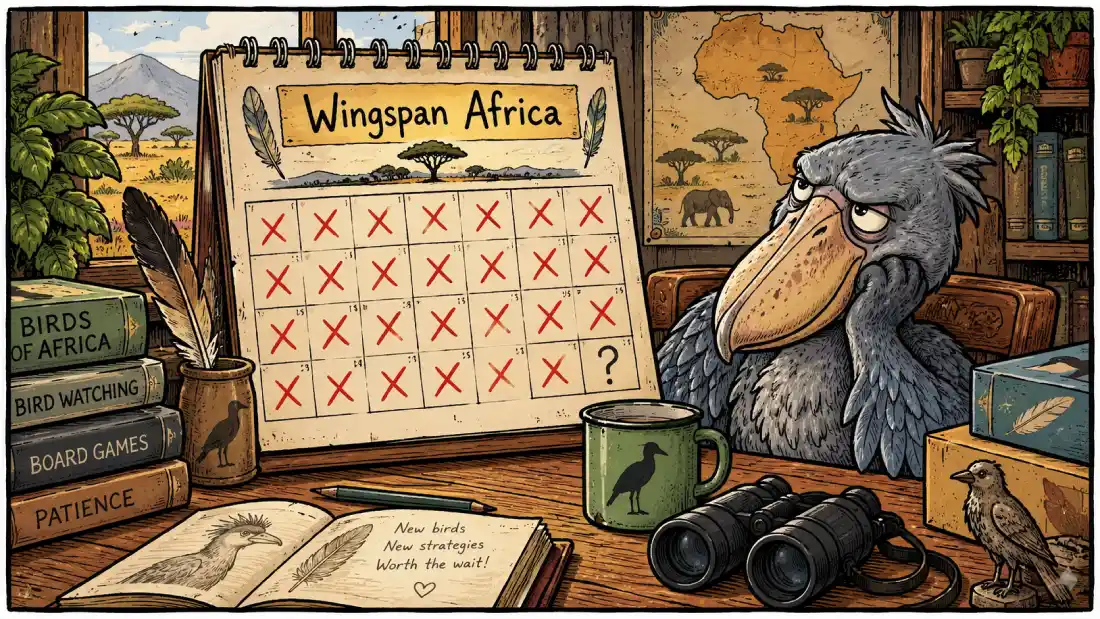
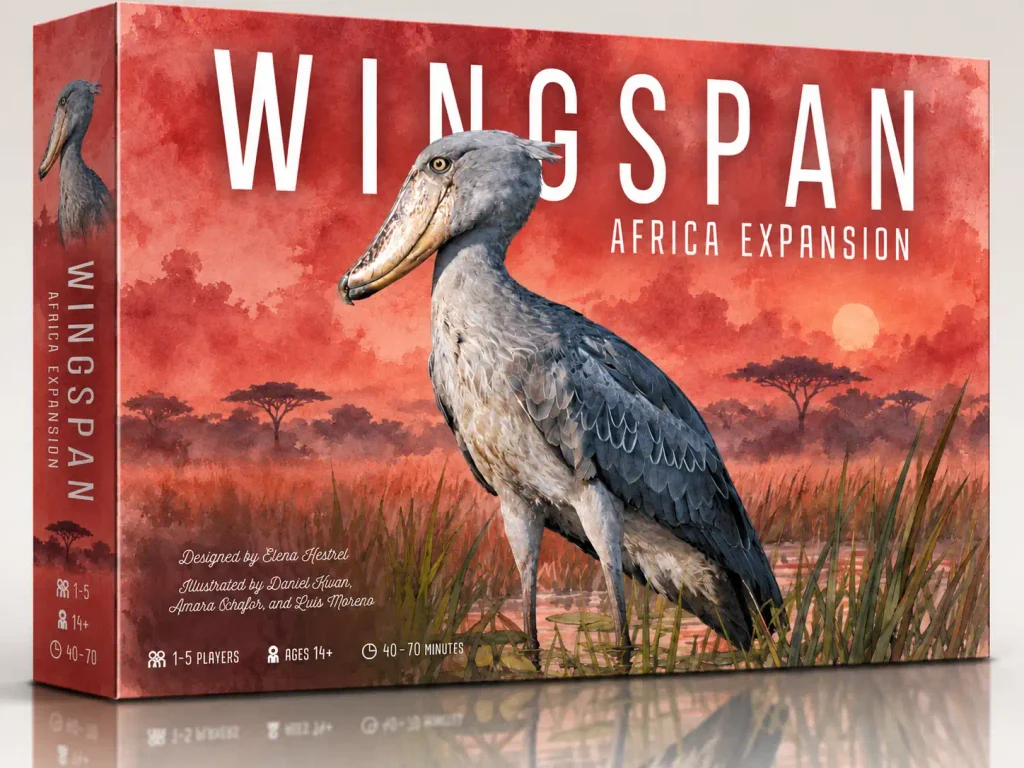
Here’s a fact that made me feel a little better about my own impatience: when Stonemaier Games asked its newsletter subscribers to vote on Wingspan’s next expansion after Americas, the result was an exact 50/50 split between Africa and the Arctic. Not close. Tied.
Co-founder Jamey Stegmaier confirmed it himself in the comments of the studio’s 2026 lineup announcement, and as of that announcement, neither one had a release date attached.
So somewhere out there is a spreadsheet with a coin sitting on it, and an entire continent’s worth of hornbills, rollers, and one deeply unfair flightless bird is stuck in limbo because a newsletter audience couldn’t commit.
I wasn’t going to just sit around. Wingspan’s card design is more formulaic than people give it credit for, once you’ve actually pulled apart what a hundred and seventy real cards do. Food cost tracks roughly with point value. Egg capacity tracks with nest type and body size. Power color tells you when in the turn structure a bird is supposed to matter. Once you know the pattern, you can build a card that would slot into the real deck without anyone flagging it as fan-made from the stats alone.
So that’s what I did. Four birds, four habitats, calibrated against real cards already in the box. Not concept art, not vague “wouldn’t it be cool if.” Actual stat blocks.
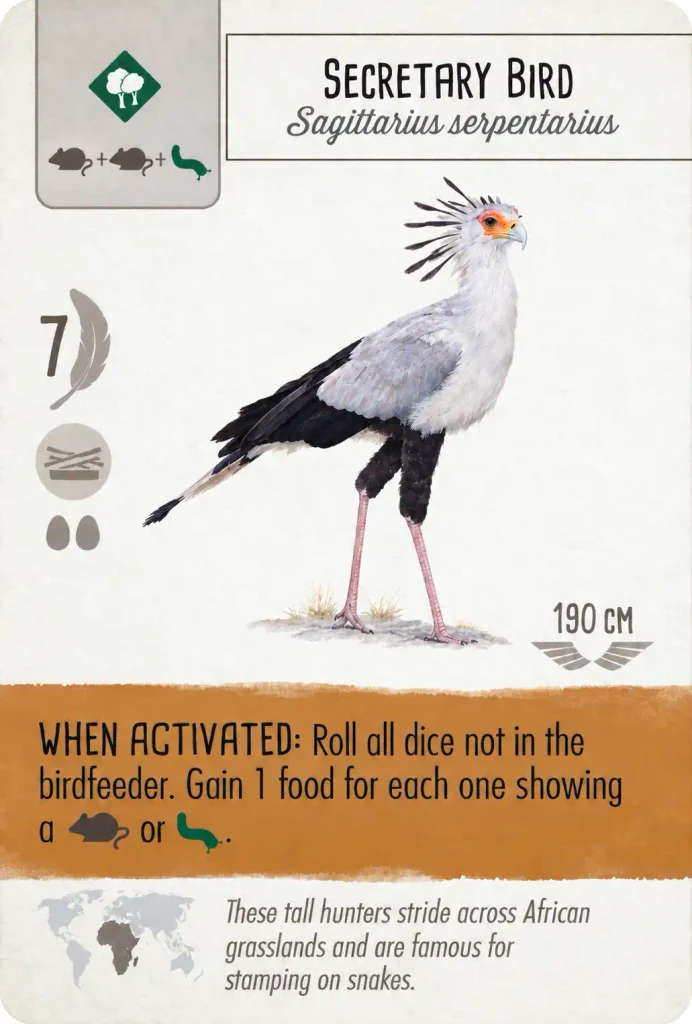
The Secretary Bird Walks Its Prey to Death
Most raptors in Wingspan hunt the way you’d expect a raptor to: from the air, from a perch, with talons. The Secretary Bird doesn’t. It’s a four-foot-tall grassland predator that hunts almost entirely on foot, and it kills snakes by stomping them, repeatedly, with enough force to break a spine. It looks like someone crossed an eagle with a heron and then gave it the temperament of a bouncer.
Points
Nest
Egg cap
Wingspan
Habitat
Predator
7
Platform
1
210 cm
Grassland
Yes
Cost: Rodent, Rodent, Invertebrate Brown, When Activated: Roll all dice not in the birdfeeder. Gain 1 food for each one showing invertebrate or rodent.
I built this one off Golden Eagle, which is an 8-point platform predator with a heavy rodent cost and a card-tuck power. The Secretary Bird trades that gamble for a flatter, more reliable dice payout, which is why it sits a point lower. It’s not the flashiest bird in this set. It’s just honest about what it does, which is more than I can say for half the raptors already in the base game.
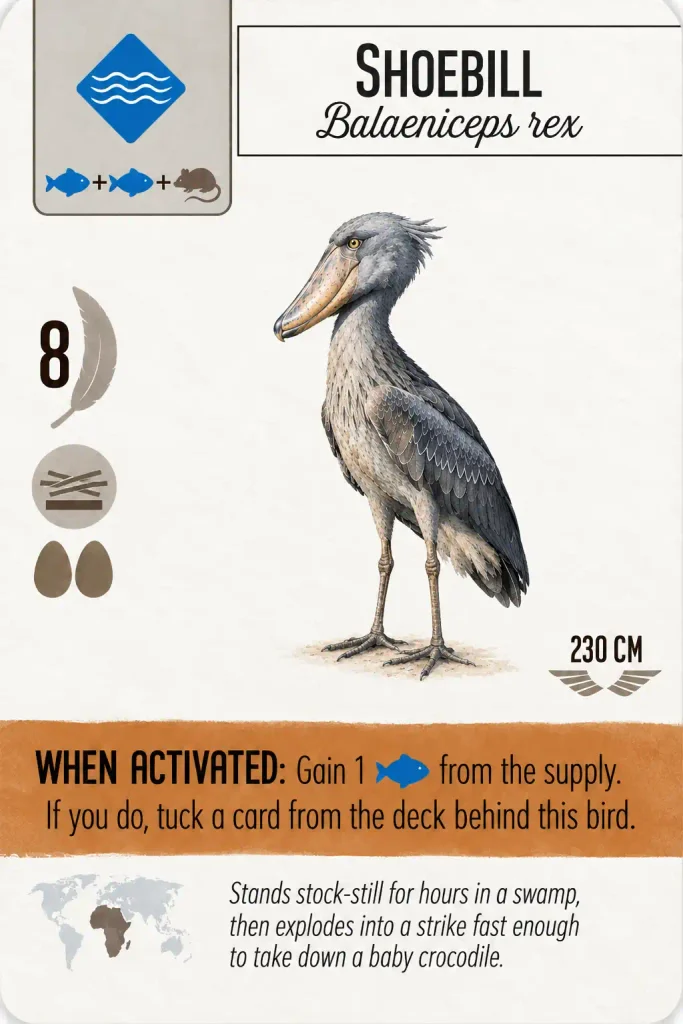
The Shoebill Is Built Like a Nightmare and Hunts Like One
The Shoebill stands stock-still in a swamp for hours, sometimes most of a day, waiting. Then it strikes fast enough to take down lungfish, eels, and on occasion a baby crocodile. It has a beak shaped like a Dutch clog and eyes that don’t blink so much as judge you. If any bird deserved to headline a wetland-heavy expansion, it’s this one.
Points
Nest
Egg cap
Wingspan
Habitat
Predator
8
Platform
2
230 cm
Wetland
Yes
Cost: Fish, Fish, Rodent Brown, When Activated: Gain 1 fish from the supply. If you do, tuck a card from the deck behind this bird.
Bald Eagle is the obvious comparison here: 9 points, platform nest, a fish-and-rodent cost, one flat gain-all-the-fish power.
The Shoebill’s power does two things at once, food and card advantage in a single activation, so it costs a point to keep it from just being a strictly better eagle. That’s the part people miss when they design fan cards. A cool animal doesn’t automatically earn a cool power. Sometimes the honest move is docking a point so the math still works.
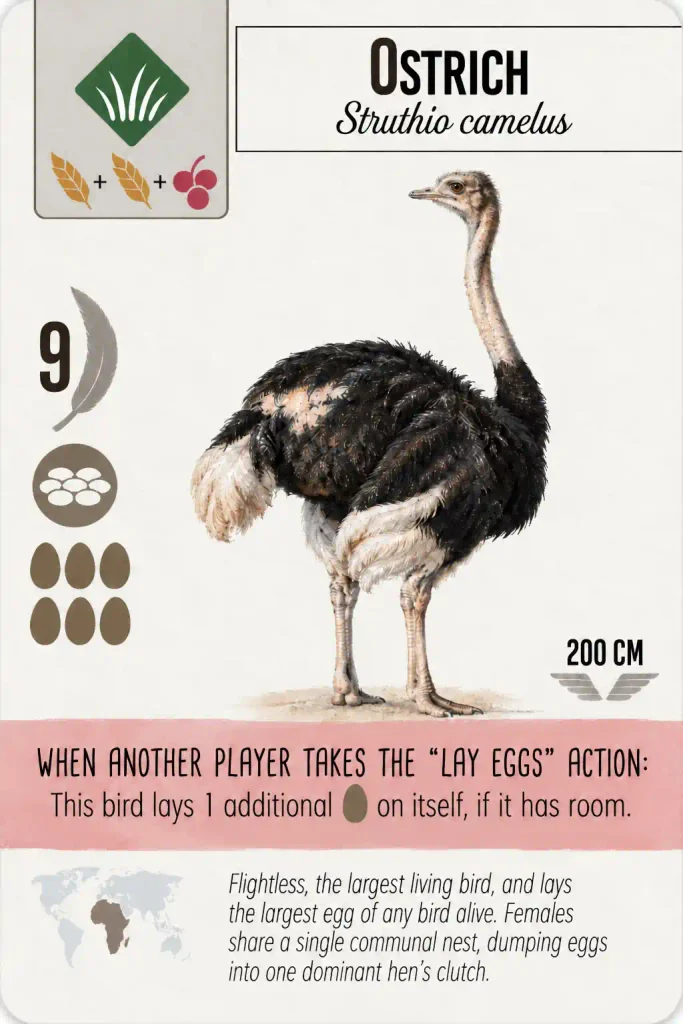
The Ostrich Is Just Really, Really Good at Laying Eggs
The Ostrich is the largest living bird, it can’t fly, and it lays the biggest egg of any bird on the planet, sometimes over three pounds. Females also share communal nests, dumping their eggs into one dominant hen’s clutch until a single nest holds dozens of eggs from multiple mothers. It’s less a bird and more an entire egg-laying operation with legs.
Points
Nest
Egg cap
Wingspan
Habitat
Predator
9
Ground
6
200 cm
Grassland
No
Cost: Seed, Seed, Fruit Pink, When another player takes the lay eggs action: This bird lays 1 additional egg on itself, if it has room.
An egg capacity of 6 would be the highest number in the base game, and I did that on purpose. This card isn’t clever. It doesn’t need to be.
The joke is baked into the stat line: everyone else’s birds lay eggs on their turn, this one lays eggs on everyone’s turn, because that’s genuinely what the species does in the wild. Wild Turkey is the closest existing comparison at 8 points and an egg cap of 5, and the Ostrich edges past it for the same reason it edges past every other ground nester in real life. It’s just built different.
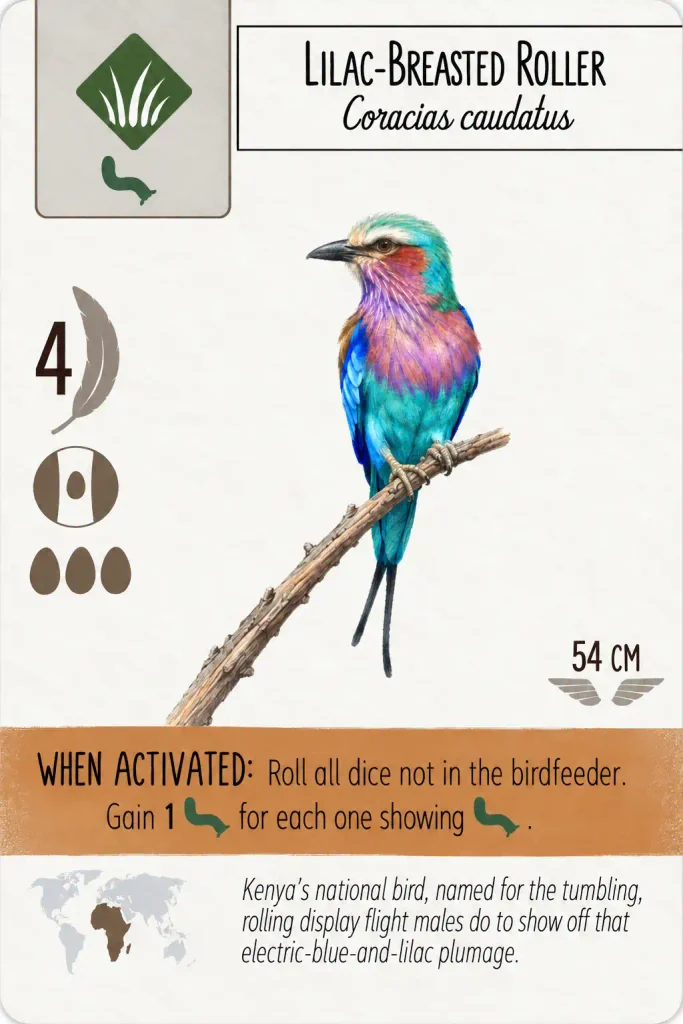
The Lilac-Breasted Roller Is Almost Too Colorful to Be Real
Kenya’s national bird gets its name from the tumbling, rolling display flight males perform to show off, and once you’ve seen the actual color combination, blue, green, lilac, and rust in stripes across one small body, you understand why. It’s the bird nobody believes is real until they’ve seen a photo.
Points
Nest
Egg cap
Wingspan
Habitat
Predator
4
Cavity
3
54 cm
Forest, Grassland
No
Cost: Invertebrate Brown, When Activated: Roll all dice not in the birdfeeder. Gain 1 invertebrate for each one showing invertebrate.
This is the filler card of the set, and I mean that as a compliment. Every real Wingspan deck needs cheap, low-commitment birds that keep a turn moving without demanding a strategy built around them.
Anhinga runs a similar dice mechanic in the actual game, just scaled up for a bigger bird with a bigger nest. The Roller is what that mechanic looks like shrunk down to a one-cost forest bird nobody’s going to build a whole engine around, and every good deck needs a few of those.
Where This Actually Goes
None of this is official, and Stonemaier hasn’t said a word about which continent wins the coin flip that never happened. But the fan community has been trading wish lists for years now, and the appetite for African species specifically, not just “more birds,” is loud enough that it’s clearly not going away.
If the real expansion ever ships, I’d bet money at least one of these four species makes the cut. The Secretary Bird and the Ostrich in particular feel less like predictions and more like inevitabilities. Until then, these four live here.
Just in case, we also created the box, consider it a little push to make this happen.
Updated September 28, 2026, with the campaign’s final results.
Flashgitz asked for $50,000 to turn its YouTube parody of Warhammer 40,000 into a board game. Kickstarter’s own badge on the page says it was funded in six minutes. When the campaign closed on September 25, the final tally was $9,561,616 from 26,090 backers, roughly 19,000% of the goal.
The campaign’s tagline never pretended to be anything else: “Crush aliens, plunder loot, and enslave children in this rip-roaring SPACE KING action game PACKED with minis and lore.” If that line makes you flinch a little and laugh anyway, you already understand the show.
If you don’t watch Flashgitz, here is the fast version. Tom and Don make an animated series called Space King, which takes 40k’s grimdark shtick (genetically engineered supersoldiers, an absent god-emperor everyone worships and nobody has seen, a galaxy of xenophobic murder machines who call it duty) and plays it completely straight while the soldiers behave like violent, easily distracted teenagers. The Captain wants to deploy genocide bombs because that is just what you do. Flashgitz will tell you, with a straight face, that none of this has anything to do with Warhammer. Nobody believes them, and that is the joke.
How a $50,000 Goal Became $9.5 Million
A $50,000 ask is modest for a miniatures-heavy board game, and the crowd cleared it before most people had finished reading the page. Around 5,400 backers showed up on day one and the total passed $2 million inside 24 hours. Then the campaign ran another three and a half weeks.
The average pledge settled around $367, which is what $9.56 million across 26,090 backers works out to. A typical impulse buy for a funny board game runs $30 to $50, so that number looks like miniatures-hobby spending, which is what this audience turned out to be. It also sits above the $299 price of the middle tier, so plenty of people bought the full box and stacked more on top.
Tier
Price
What it gets you
Final backers
Recruit
$99
The base game, $20 under eventual retail
4,857
Psycho Warrior
$299
Base game + War World, B-Positive, Psycho Warrior Pack, Weapon Pack, Space King Favor, Lore Book
17,624
Super Psycho Warrior
$699
Everything above plus a metal game box and a Tom & Don signed medal
2,260 (capped at 3,000)
Psycho Monster
$1,199
Everything above plus a custom audio line from a Space King character
156 (capped at 175)
Globulus Maximus
$7,777
Everything above plus your face turned into a Psycho-Warrior in a future episode
15 (sold out)
More than seven in ten backers who picked a reward tier landed on the $299 Psycho Warrior box, not the $99 base game. That is the real story in the numbers: this was never a crowd testing the water at the cheapest entry point, it decided early that it wanted the full stack. The Psycho Monster cap grew from the 75 slots it launched with to 175, which means a stretch goal or a manual bump made room for more people to pay $1,199 for a personalized audio line, and backers filled 156 of them. Globulus Maximus, the $7,777 tier that writes your likeness into a future episode, sold out its 15 slots.
The $299 tier also carries the stretch goals, which the campaign’s FAQ says were added to pledges automatically. The last two unlocks, at $6.25 million and $6.75 million, were new game modes rather than more plastic.
Crusades turns Space King into a linked campaign where your character carries progress, Favor cards and a growing pile of Psychosis abilities across sessions, with players free to drop in and out. Mission Modifiers add rule twists, and the example on the page, “Heroes and Heretics,” hands everyone a secret card that says either Loyal to Space King or Maybe We’re the Bad Guys, so the betrayal angle gets a hidden-role layer.
What’s in the Space King Board Game Box
Strip away the merch-drop energy and there is a real game design underneath, at least on paper. Two to four players take Psycho Warriors through five missions, working together to kill aliens and clear objectives while separately racking up points to become the Space King’s personal favorite, the same push-and-pull that makes the best semi-cooperative strategy games worth returning to.
That is a semi-cooperative structure. Everyone needs the team to survive, only one of you wins, and Tactics Cards let you help another player or sabotage them outright. A Command Deck runs enemy behavior so nobody is stuck babysitting the AI, and an Event Deck keeps missions from playing identically twice. Die in combat and you respawn instead of sitting out, which suits a game clearly betting on chaos over careful positioning.
The minis are the headline for a lot of backers. Psycho Warriors run around 50mm, standard enemies come in at roughly 36mm, and boss figures top out past 100mm.
Pre-painted and paintable versions both exist depending on tier. Jacen Sievers gets the designer credit, Edgar and Lander Ramos sculpted, Javier Navarro led the art, and Marta de Paz illustrated the Tactics Cards on her own, which tells you someone cared enough about that one subsystem to hire for it. The full rulebook was posted as a public download on the campaign page instead of sitting behind a pledge, which plenty of minis-first campaigns never bother with.
Space King vs Warhammer: Why the Parody Works
Games Workshop will not feel $9.5 million financially. What should needle them is what Space King is as satire.
It does not invent a joke about 40k from the outside. It plays the lore straight and lets you notice how insane it already is: an absent god-king worshipped without question, soldiers whose whole personality is genocide and loyalty, a universe with zero room for nuance. That is not exaggeration, it is the pitch itself, delivered without the seriousness Games Workshop usually wraps around it. The show works because it loves the source enough to know which buttons to push.
Whether the board game earns the same read is still open. A crowdfunded minis game backed by a comedy audience has a well-worn failure mode: gorgeous sculpts, thin rules, a box that photographs great and plays like an afterthought. Flashgitz’s own risk disclosure says the final product will differ from the prototypes shown on the page.
That is standard Kickstarter language, but read it as the honest version of my point: nobody, including the people making it, is promising the shelf copy plays exactly like the pitch. The instincts on paper are right, with betrayal built into a cooperative shell, respawns instead of elimination and a Command Deck doing the GM’s job. Execution is a different conversation, and it cannot happen until tables get to break the game.
Missed the Space King Campaign? What Happens Next
The campaign ended September 25. Flashgitz’s FAQ says you can still pledge afterward, with one catch: campaign pricing and campaign-only items do not carry over. Standard copies and expansions reach the Flashgitz store only after every backer reward ships, which the studio puts at early 2028.
Rewards themselves are pointed at December 2027, and shipping was not charged during the campaign. Flashgitz will collect shipping, tariffs and fees closer to fulfillment through a pledge manager, and has promised refunds to backers who cannot afford it if rates run more than 25% above its highest estimate.
Anyone who has backed a miniatures campaign knows that date is a starting point for negotiation. Scale makes it harder here, not easier. The studio planned for a $50,000 project and now has to manufacture and ship boxes of plastic for more than 26,000 people.
If you are already a Space King fan, you know whether $99 buys a fun night or guilt about unpainted plastic in a closet. If you missed the window and are not a fan of the show, waiting for reviews of real copies costs you very little. I would treat anything past the Psycho Monster tier as a donation to a YouTube channel you already like, not a board game purchase, and the fifteen people who bought the top tier probably know that too.
I will circle back once copies exist and people who are not already fans have had a table with it. Until then, the only thing confirmed is how much an audience will pay to own a piece of a joke it loves, and the answer was: $9,561,616.
Cephalofair just announced the thing nobody was asking for and everybody’s curious about anyway.
At Gen Con 2026, the studio unveiled Mercenaries Wanted, a game that takes the Gloomhaven universe and strips out the two things that define it: the dungeon crawling and the multi-year campaign commitment. What’s left is a 45-minute box about running the business that sends adventurers into those dungeons in the first place.
That’s a genuinely strange pivot for a company whose brand is built on legacy boxes so heavy they need their own shelf reinforcement. But it’s also not a random cash-in. Dennis Vögele, one of the lead designers on the original Gloomhaven team, is behind this one, and the premise has actual teeth: instead of playing a hero, you’re managing a rival mercenary outfit in the city of Casskia, competing against other players doing the same thing. You’re not descending into the dark. You’re the person profiting off the people who do.
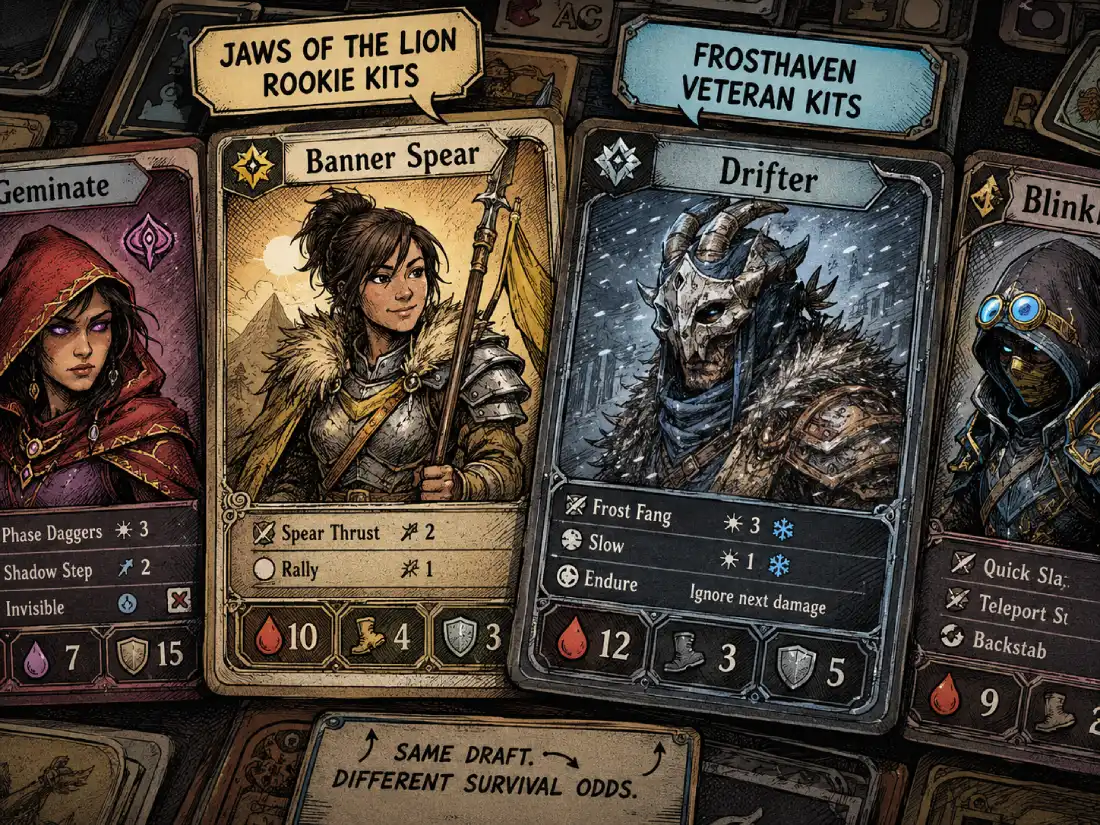
Cephalofair is explicitly framing this as two different pitches at once: an accessible on-ramp for people who never touched a legacy box, and a quick strategic side dish for veterans who already burned a hundred hours on Frosthaven’s campaign.
That’s a harder needle to thread than the press release makes it sound. The player who ground through Frosthaven’s late-game scenarios and the player who’s only ever cracked open the Jaws of the Lion starter set are not looking for the same 45 minutes.
The Pitch: Staffing Agency, Not Dungeon Crawl
The core loop, as Cephalofair describes it, has you recruiting, equipping, and deploying a rotating lineup of freelancers to complete open contracts for gold. You don’t control one hero across a campaign. You control a roster, and the roster is the whole game. That’s a meaningfully different kind of tension than “did I bring the right loadout for this scenario,” and it’s the part of the announcement worth paying attention to, because it means success is going to live or die on drafting combinations of mercenaries whose skills actually complement each other rather than optimizing a single build over dozens of sessions.
The mercenary pool is the fan-service hook: 61 characters pulled from across Gloomhaven, Jaws of the Lion, and Frosthaven, illustrated by Yanis Cardin, Phan Tuan Dat, Alexandr Elichev, and Phil Stone. If you’ve put time into any of those games, you’ll recognize faces on that roster, which is presumably the point. It also means the draft pool is genuinely uneven by design: a Jaws of the Lion starter build sitting next to one of Frosthaven’s grimmer late-game specialists is not a fair fight on paper, and how Cephalofair balances a rookie’s kit against a veteran’s kit is the actual design question here, not just how many portraits they crammed onto the box.
Whether 61 characters actually feel distinct in a 45-minute game, or whether most of them collapse into interchangeable stat blocks once you’re not spending an entire campaign learning their quirks, is exactly the kind of thing that won’t be answerable until people have actually played it.
Between missions, the game apparently gets its teeth into roster management directly: deciding who stays on the payroll, who gets promoted, and who gets cut to make room for new blood.
That’s a resource-and-personnel management layer bolted onto a Euro-style contract-fulfillment engine, which is a different genre entirely from anything Cephalofair has shipped before.
Rounds race toward fulfilling jobs for gold, and the whole thing closes out with a series of tournaments where your best, most-promoted mercenaries fight rival companies for what the announcement calls “ultimate fame and fortune.” So there’s still combat in here somewhere, it’s just been demoted from the main event to the finale.
Quick Facts
Designer
Dennis Vögele (Gloomhaven, original design team)
Players
1 to 6
Playtime
45 minutes
Setting
The city of Casskia
Character pool
61 mercenaries from Gloomhaven, Jaws of the Lion, and Frosthaven
Retail price
$24.99
Preorders open
September 2026
Hands-on preview
Essen SPIEL, October 2026
Official launch
December 4, 2026
Why the Price and the Runtime Are the Real Story
Two numbers here matter more than the theme does. First, $24.99 is a budget price for anything wearing the Gloomhaven name, and it reads like a deliberate move to catch people who bounced off the mainline games’ cost and time commitment.
Second, 45 minutes for up to six players is an aggressive claim, and it’s the one I’d want to see proven at a table before taking at face value. Plenty of “quick” competitive games with that many seats at the table quietly turn into ninety minutes once everyone’s actually thinking through their turns, and a drafting-and-contracts game with six people fighting over the same open jobs has real potential to bog down exactly there.
What Cephalofair is really doing with Mercenaries Wanted is testing whether its audience wants more Gloomhaven lore without more Gloomhaven homework. The franchise’s biggest asset has always been the sunk-cost pull of a persistent world and a box full of secrets you unlock over months.
This throws that model out entirely in favor of something you can teach and finish in one sitting. If it works, it’s a smart way to widen the funnel for people intimidated by the legacy boxes. If the 45-minute claim doesn’t hold up at six players, it’s going to feel like a solid Euro wearing borrowed IP. Either way, Essen in October should tell us a lot before anyone has to commit money in September.
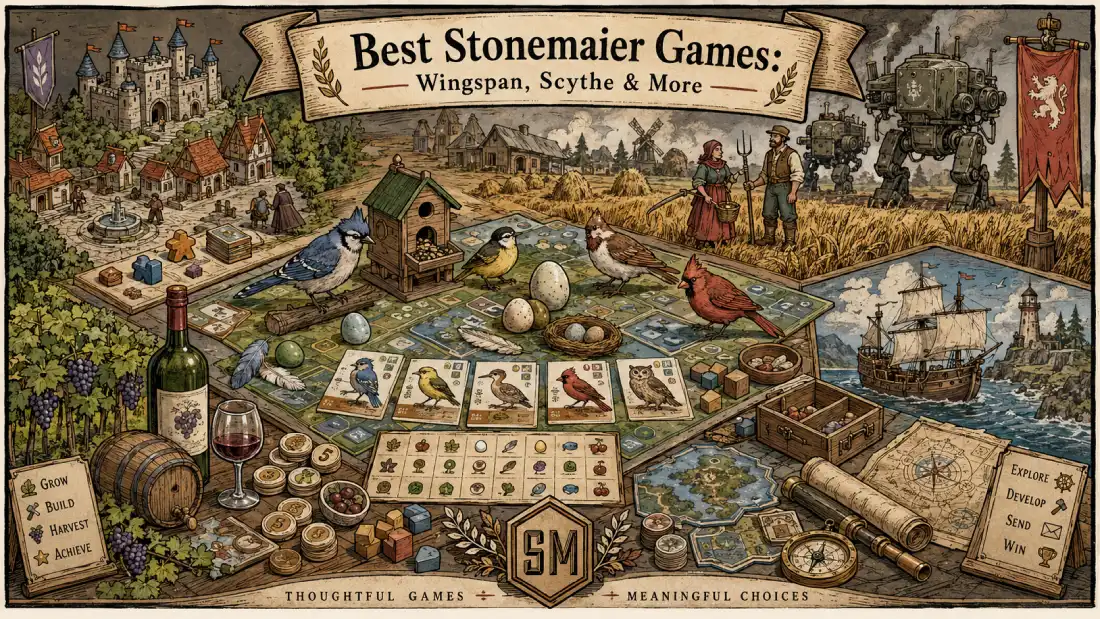
Stonemaier Games has released more than a dozen titles since 2015, and five of them account for most of the search interest, shelf space, and BoardGameGeek discussion the publisher gets: Wingspan, Scythe, Vantage, Tokaido, and Red Rising.
This ranking orders those five by how often people actually search for and play them, then breaks down what each one plays like, how long it takes, and who it fits best.
Stonemaier Games is an independent tabletop publisher founded by Jamey Stegmaier in 2015, known for high-production-value strategy games with strong solo modes and a design philosophy the company calls “player-first.” It publishes both in-house designs (Scythe, Wingspan, Vantage, Red Rising) and licensed or acquired titles from other studios (Tokaido).
How These Stonemaier Games Are Ranked
The order below is based on US search volume for each game’s core keyword, cross-checked against release date, player count, and playtime to explain why each one sits where it does. It is not a pure “best game” opinion ranking; a lower spot here can still mean a better game for a specific group size or complexity level, which the individual write-ups call out.
Wingspan is Stonemaier’s highest-volume search term by a wide margin and its best-known release. Designed by Elizabeth Hargrave and published in 2019, it is an engine-building card game where players attract birds to habitats on a personal player board, each with a unique power that chains into the next. It plays 1 to 5 (up to 7 with the Oceania expansion) in 40 to 70 minutes.
Wingspan won the 2019 Kennerspiel des Jahres, the 2020 American Tabletop Award for Strategy Game of the Year, and a long list of other international awards, and has sold more than 2.6 million copies worldwide as of early 2026.
Its complexity sits at medium-light, which is why it works equally well as a first “real” strategy game and as a low-friction choice for experienced groups. Three expansions (European, Oceania, and Asia) and a companion Wyrmspan spin-off have extended the line well past the base game.
Wingspan fits groups that want a game with genuine strategic depth but no combat, negotiation, or player elimination. It is a weaker choice for players who specifically want direct interaction between opponents, since turns mostly happen in parallel.
2. Scythe
Scythe is Jamey Stegmaier’s 2016 design and was Stonemaier’s flagship title until Wingspan overtook it in search volume and sales. It is an area-control and economic-engine game set in an alternate-history 1920s Eastern Europa, where five factions build up territory, resources, and mechs while largely avoiding direct combat until it becomes necessary.
It plays 1 to 5 out of the box, expandable to 7 with Invaders from Afar and Fenris expansions, in roughly 90 to 115 minutes.
The game won four Golden Geek Awards in 2016, including Board Game of the Year, and its two campaign expansions (The Wind Gambit and The Rise of Fenris) each won Best Game Expansion in their respective years.
Scythe sold over 382,000 copies by 2021 and remained Stonemaier’s top seller until Wingspan’s release. Its weight sits at medium-heavy: multiple resource tracks, asymmetric faction powers, and a tight turn-order system mean new players benefit from a rules teach before diving in.
Scythe suits groups that already enjoy strategy games and want a longer, more tactical session with meaningful player interaction, but it is a poor pick for a table that wants something explainable in five minutes.
3. Vantage
Vantage is Stonemaier’s newest major release, launched on the company’s webstore in July 2025 with wide retail availability the following month. Designed by Jamey Stegmaier, it is an open-world cooperative exploration game set on an alien planet after a ship crash, built around nearly 800 interconnected location cards and over 900 additional discoverable cards. Players explore from a first-person perspective, choosing their own path through the world rather than following a fixed narrative track, and can win through mission completion, reaching a personal “destiny,” or self-defined goals.
It supports 1 to 6 players in sessions of 120 to 180 minutes and sits at medium weight, more approachable than Scythe despite the longer runtime, because the complexity comes from exploration and choice rather than overlapping economic systems. Stonemaier has stated Vantage is self-contained with no expansions planned, unusual for a publisher whose other big titles (Scythe, Wingspan) built extensive expansion lines.
Vantage is the right pick for groups that want a long, story-driven cooperative session and don’t mind a bigger time commitment; it is not built for competitive players or anyone wanting a sub-hour game night.
4. Tokaido
Tokaido is the one game on this list Stonemaier didn’t design in-house. It was created by Antoine Bauza and originally published by Funforge; Stonemaier Games acquired the publishing rights to the brand and released an updated edition, revealed in March 2025, manufactured by Panda Game Manufacturing with refreshed components, revised rulebook text, and an added Automa solo mode.
Tokaido is a light, non-confrontational travel game where 1 to 5 players journey along Japan’s historic Tōkaidō road, stopping to collect souvenirs, eat local food, visit temples, and take in scenic views, all in about 45 minutes. There’s no direct conflict between players; the only tension comes from move order, since whoever is furthest behind on the road always goes next.
Tokaido works well for mixed-experience groups, family game night, and anyone who wants a genuinely relaxing game rather than a competitive one. It’s a weak fit for players looking for strategic depth or replayable variance, since the path and milestones stay largely the same each game.
5. Red Rising
Red Rising, designed by Jamey Stegmaier and Alexander Schmidt and released in 2021, adapts Pierce Brown’s dystopian novel series into a hand-management, combo-building card game. Players lead one of several great Houses, recruiting characters from the books’ 14-caste society and building card combinations toward victory through either dismantling the existing social order or embracing Gold dominance.
It plays 1 to 6 in 45 to 60 minutes, with a 5-minute setup, and sits at medium weight, more accessible than Scythe but with more combo interaction than Tokaido. Because it’s built directly on the novels’ setting and factions, familiarity with the books adds flavor but isn’t required to play.
Red Rising is the clearest pick for existing fans of the book series, and it also holds up as a stand-alone hand-management game for players who like deck-building-adjacent mechanics without needing a full deckbuilder’s ramp-up time.
Frequently Asked Questions
What is the best Stonemaier game to start with?
Wingspan is the most common starting point. It has the widest player range (1-5, up to 7 with an expansion), a shorter 40-70 minute playtime, and medium-light complexity, making it easier to teach than Scythe or Vantage while still offering real strategic depth.
Is Scythe or Wingspan better for a first-time strategy gamer?
Wingspan is the gentler entry point. Scythe’s medium-heavy weight, asymmetric factions, and multiple interacting resource systems reward players who already have some strategy-game experience, while Wingspan’s engine-building is more linear and easier to explain in one sitting.
Did Stonemaier Games design Tokaido?
No. Tokaido was designed by Antoine Bauza and originally published by Funforge. Stonemaier Games acquired the publishing rights to the brand and released a refreshed edition in 2025 with new components and an Automa solo mode, but the original design and credit belong to Bauza and Funforge.
How long does Vantage take to play?
A full session of Vantage runs 120 to 180 minutes. It’s the longest game on this list by a wide margin, since it’s built around open-world exploration across nearly 800 location cards rather than a fixed turn structure.
Do I need to read the Red Rising books to play the board game?
No. Red Rising the board game is a stand-alone hand-management and combo-building game. Familiarity with Pierce Brown’s novels adds thematic context, but the rules and victory conditions don’t require prior knowledge of the story.
Conclusion
By search demand, Wingspan and Scythe remain Stonemaier’s two most-searched and most-played games, with Vantage closing the gap fast as the publisher’s newest major release. Tokaido and Red Rising serve narrower audiences (casual travel-game fans and book-series readers, respectively) but hold their own within those niches.
For a first Stonemaier game, start with Wingspan (see our beginner-friendly board game picks for more like it); for a longer, more tactical session, move to Scythe or Vantage once the group is ready for it.
Every Catan strategy writeup out there gives you the same opening chart: settle on an 8 and a 6, grab two different resources, grab a port if you can. Not wrong advice. It’s the closest thing Catan has to an opening book. Just not the reason good ones beat bad ones. I’ve watched someone drop a textbook 8/6 opening and still lose to a player who settled on a 5 and a 9, because they read the table for thirty turns and never got attached to a plan.
Here’s the thing: the math only matters for one decision, your first two settlements. After that, Catan stops being about probability and starts being about paying attention. You’re tracking what everyone else needs, noticing who goes quiet when you ask about their production, catching the moment someone stops offering wheat because they’re already sitting on plenty. Winning consistently isn’t about memorizing pip counts. It’s about noticing things like that by turn six.
So this guide will split into three tiers. Jump to whichever one fits you: Fundamentals if you’re still getting the hang of a good placement, Reading the Table once the rules feel automatic and you’re ready to watch everyone else, and Advanced if you already know all that and want the content most experts skip entirely.
Three tiers, three sets of strategies, each expanding on the last. Every section pairs the reasoning with the move: why the math or the table dynamic works the way it does, then exactly what to do with that at your next turn. If you just want the answer without the why, skip to the FAQ near the bottom.
If you just want the short version before diving in, here it is:
Catan Strategy Cheat Sheet: Do This, Not That
Do
Don’t
Settle while expansion room still exists
Skip whatever has no plan behind it
Prioritize upgrades once you’re boxed in, they double your output per hex
Hoard cards waiting for a “perfect” moment that rarely comes
Ask every turn, worst case is someone says no
Over-swap with the bank at 4:1 in the opening turns
Diversify your number coverage past just 6 and 8
Chase either two-score race as a standalone goal from turn one
Swap for information, not just goods
Negotiate during your Paired Players mini-turn in 5-6 player games
Everything in that table gets explained properly below, this is just the version you can screenshot; the actual content follows section by section.
Part One: Fundamentals
Catan Settlement Placement: Evaluating Your First Two Settlements
Fundamentals: start here if you’re still learning how a placement actually pays off.
Start with the numbers. They’re the one thing in this game that’s fixed. Two dice make a bell curve, not a flat line, and it’s not a small difference. Place your first move by that curve; trust your gut for the second.
Roll
Combinations
Probability
6 or 8
5 of 36
13.9% each
5 or 9
4 of 36
11.1% each
4 or 10
3 of 36
8.3% each
3 or 11
2 of 36
5.6% each
2 or 12
1 of 36
2.8% each
A spot touching a 6 and an 8 pays off roughly twice as often as one touching a 3 and an 11. That’s why “grab the 6/8 corner” is standard advice, and why it’s usually gone by the second or third placement.
But the numbers alone won’t tell you which resources you’re getting, or whether you can use them.
Two wheat hexes look great until you realize you’re short a third type and can’t do anything interesting with them. I’d rather take a weaker spot that fills a real gap than a high-probability hex that just repeats what I already have. Four types beats three with one doubled, almost always. Going 4:1 with the bank is basically a tax on bad planning.
Ports only help if you’ll actually use them. A 2:1 wood port is dead weight if it’s not what you’re producing. I look for one matching what I’m already collecting in volume, not one I’d have to shape my whole strategy around, and honestly, I’ll take a decent hex over a flashy one, most days.
Last thing, and it’s the one beginners skip: check who’s next to you. A great hex that boxes you into one direction, with every route running into someone else’s territory, stops paying off around turn ten.
Give me a slightly worse hex with room to grow, every time. Where you place your second one matters just as much as the numbers on it.
Catan Resource Priority: What to Build, and When
Fundamentals: the priority order and swap logic that answers “what do I do with my resources right now?”
There’s a version of the same question everyone asks starting out: what do I get down first, when do I upgrade, and how hard should I be swapping? The order isn’t fixed, it shifts with your production, but there’s a real hierarchy worth knowing.
Build
Cost
Produces per roll
Victory points
Best timing
Route
1 wood, 1 brick
Nothing directly
0 (2 points if it takes the trophy)
Only to reach new spots, or to contest the trophy
Settlement
1 wood, 1 brick, 1 wheat, 1 sheep
1 resource per adjacent hex
1
Early-to-mid game, while expansion room still exists
City
2 wheat, 3 ore
2 resources per adjacent hex
2 total (net +1 on upgrade)
Once expansion space runs out
Settlements come first, almost always, as long as you have room to expand. A new one is a full extra income source: another two types, another seat at the table when trades are offered, and a step closer to winning. Roads only matter as the means to get there, or as leverage in that race covered above. They produce nothing on their own, so there’s no reason to put them down just for the sake of it.
That priority flips once expansion dries up, whether the board’s full or you’re boxed in. A city produces two resources per roll instead of one, on the same hex, at the same production number. That’s the single biggest jump available in the game, and it’s why ore and wheat, the two resources a city costs, are worth protecting hard once you’ve got two or three settlements down.
Trading follows the same logic: unblock whatever you’re building next, skip the stockpile. If you’re one wheat short of a city, that’s what you chase, even at a bad rate. The same logic applies to those purchases: buy them early when the table’s underpricing them, and don’t sit on a playable one out of caution, both covered above.
Part Two: Reading the Table
Catan Blocking Strategy: When to Pivot From Expansion to Development
Reading the Table: for those comfortable with the rules and starting to watch the other seats, not just their own hexes.
Nobody wins Catan by running the same plan for forty turns straight. The board tells you things along the way, and the ones who lose are usually still following their turn-one strategy in the endgame, because it worked early and they never checked back in, especially on what their opponents were doing.
First signal: if nobody’s visibly buying development cards by turn six or seven, key production is probably underpriced at the table. Going hard for them suddenly looks a lot better. I once switched from expansion to a full development grind because I watched three others swap ore for wood, twice, while everyone else built. Bought five in six turns. Had the army before anyone noticed what I was doing.
Second signal: if someone’s sitting on two 6-or-8 hexes for a matching pair, they’re about to out-expand the table unless somebody slows them down. That’s not the moment to keep quietly running your own plan. Race them for the same expansion routes, or stop feeding them trades that help their plans along. And blocking isn’t just about that piece. Half of it is simply refusing to be the one who makes someone else’s plan easy.
Third signal is about you, not them. If the robber keeps landing on your best tile, that’s not bad luck. It’s a sign everyone’s noticed how dependent you are on one hex. Diversify your production even if it costs you some expected value, because something that one robber placement can shut off completely isn’t reliable.
Fourth: if you’re close to a strong position but someone else is one draw away from that knight-count bonus or Longest Road, spend the turn denying them instead of expanding. Blocking a single connection can cost someone three turns of replanning. Your own expansion can usually wait one turn.
Longest Road vs. Largest Army: One Is a Trap More Often Than People Think
Reading the Table: the two-point traps that quietly decide close games.
Both are worth two points, and newcomers treat both like automatic goals. That’s exactly the trap. Neither is free, and chasing the wrong one at the wrong time wastes a good position fast.
Longest Road
Largest Army
Victory points
2
2
Minimum to claim
5 connected roads
3 knights played
Main cost
Wood and brick
Ore and wheat, plus luck on the draw
Biggest risk
Anyone can steal it just by growing past your count
Slow to grow, easy to under-commit and never catch up
Chase it when
It falls out of an expansion plan you’re already running
Your production genuinely favors ore and wheat
It’s cheap to start and expensive to protect. Get the right hexes flowing early and five connected roads is often within reach by turn ten or twelve. The problem is anyone can steal it just by growing past your count, usually without even trying, they’re just expanding normally and happen to pass you. I’ve lost it twice that way.
That one costs real resources, one card, then another, hoping for knights instead of the route-building or monopoly cards you actually want. I’ve watched someone burn their entire hand chasing a third knight on turn thirty, only to hand the points to whoever had been quietly stacking cards the whole game. If you’re going to chase it, commit early. A slow, obvious chase just invites someone to steal it at the last second.
My rule: chase that record when it falls out of a plan you’re already running, not as its own goal. Chase the other only if your production actually supports the buy rate. Treat either one as a standalone strategy from turn one and you’ll end up with two points and nothing else to show for it.
Catan Mistakes That Actually Cost You the Game
Reading the Table: the habits that quietly decide who wins, repeated across forty turns without anyone noticing.
Most Catan losses aren’t dramatic. Nobody usually loses to one bad swap or one unlucky dice roll. They lose to the same small habits, repeated for forty turns, including a few I’ve made myself.
Chasing the Road record or Largest Army as a goal instead of a side effect tops the list, covered above. Fastest way to turn a strong position into a mediocre one.
Over-trading with the bank early is next. Going 4:1 should be a last resort, not a habit, and beginners lean on it constantly because it feels like progress. That’s resources you could’ve saved for a real swap at half the cost.
Settling into a box canyon is almost purely a beginner mistake, covered above, but easy to miss when you’re staring at pip counts instead of the map.
Sitting on unused cards is a habit worth breaking too. New players wait for the perfect moment to use a knight or a route-builder. That moment rarely comes, and holding it too long does nothing. Run them often, most cost you almost nothing even when they flop. Monopoly punishes that habit hardest, since it’s worthless the turn everyone else has already spent their surplus.
And in 5-6 player games specifically: skip negotiating during your Paired Players mini-turn. Easy rule to forget under pressure, and an easy tell too, offering a swap there just announces you’re stuck.
Part Three: Advanced and Tournament-Level
Catan Strategy for 5-6 Players: How the Paired Players Rule Changes Everything
Advanced: situational, but worth knowing cold before you sit down at a five- or six-player table.
Most strategy advice treats table size as an afterthought. It shouldn’t be, especially with the current 5-6 Player Extension. Most of it comes from the same old book of assumptions built for a smaller table.
If you learned Catan on an older edition, you probably remember the Special Building Phase, an extra round where anyone could act out of turn. That’s gone, replaced by the Paired Players Turn: the second seat gets a build-only mini-turn after the first seat’s full turn, with one catch, no negotiating during that phase.
That matters more than it sounds. Stockpiling exact resource combinations gets more valuable, since you can’t swap your way out of a bad hand during your paired turn like you could at three or four players. It also means blocking someone’s trades hits harder here, since being cut off is more likely to cause a stall than just accepting a worse rate.
The bigger difference is board pressure: more competition for space, and a threat that never stops moving. A box-canyon opening that’s a minor risk at three or four people becomes close to a guaranteed problem at six, unless you prioritize open expansion directions from the start. Where you place your opening spots matters even more with extra bodies crowding the board.
What Seafarers and Cities & Knights Change
Advanced: how the two major expansions shift the strategy you already know.
These expansions get talked about like brand-new games. Mostly they’re the same game with different pressure points. Learn one and the other will feel familiar within a turn or two.
Seafarers adds ships, which count toward the tally too, so that race doesn’t stop at the coastline. Committing to shipping lanes early usually builds a longer route than staying land-based, since sea edges see less competition. Gold hexes are the other big shift: settling one lets you pick your resource on production, huge when something’s scarce across the board. I’ll take a mediocre gold hex over a stronger standard one if the board’s lopsided, the flexibility’s worth more than the raw odds. And watch the pirate, not the thief, for sevens at sea, it steals from ships too.
Cities & Knights changes more. The usual thief sits out entirely until the first barbarian attack, so nobody can be blocked early on, which kills one of the base game’s go-to tools and pushes early aggression toward border disputes and refusing to swap instead. Once it activates, knights can displace it, so parking it on someone’s hex is a shorter-term win than usual, since a defended city knocks it right back off. That race disappears completely too, replaced by the knight and city-improvement track, so drop any plan built around chasing it. The real goal is pushing one improvement track, science, trade, or politics, to the level-three bonus before anyone else.
Catan Strategy Tips From a World Champion
Advanced: what the game looks like from someone who’s actually won the world title.
Everything above comes from a kitchen table, not from going pro, so let’s check it against someone who actually is one. Quetzal Jiménez won the Catan World Championship in 2018 and defended it in 2022 against more than 80 competitors, the biggest field the tournament had ever seen. When Dicebreaker asked him for advice, most of it wasn’t about the board at all. His first point: almost everything in Catan is technically public, card counts, what’s been traded, what’s in the deck, and most ignore it. He treats it all as a resource, watching for the moment someone stalls on an obvious swap or is clearly hoarding sheep. Same blocking signals from earlier, just aimed outward instead of inward. That’s how he sizes up opponents before the board even gets tight.
His bigger point: Catan’s closer to a negotiation than a math problem. Tone, eye contact, being someone people actually want to deal with, a reputation for fair trades gets you better offers across a whole tournament, not just one game. Harder to fake than pip counts. Probably the real gap between someone solid and a world champion. Repeat that pattern enough times and you stop hoping to win and start expecting it.
The rest is more practical: attack with the robber instead of only punishing the leader, keep a running mental tally of dice rolls instead of trusting memory, and never skip asking for a swap, the worst someone can say is no. His closing rule, in the original Spanish, is “en caso de duda, el cartón ayuda,” roughly “when in doubt, buy a card.” Not fancy advice. But it’s usually right, according to the guy who’s won this twice, and it will keep paying off no matter how the table’s mood shifts.
Secret Catan Strategies Basic Guides Never Mention
Advanced: the habits, not rules, that separate someone solid from someone who wins consistently.
Everything above gets you to a solid, competent game. These are the things that turn that into actually winning, and they’re habits, not rules, so you won’t find them in a how-to-play breakdown, the kind of edge no book bothers to write down.
Trade for information, not just resources. Offer something slightly unfavorable and watch the reaction. A fast decline with no counter means they lack it. A hesitant pause means they’re weighing what the swap reveals. You’re not closing a deal, you’re reading the table.
Spread your number coverage past 6 and 8. Basic guides tell you to chase the best odds and stop. Serious competitors treat that as a starting point: two settlements both anchored on 6s and 8s means one bad placement can stall your whole economy at once. A wider spread costs a little probability but protects you from exactly the variance that decides close games.
Deny ports actively, not just use them. Sometimes the right second settlement isn’t your best hex, it’s a mediocre one sitting on a port an opponent needs. You’re taking it so they can’t, and the turns they lose rebuilding their plan are usually worth more than the pips you gave up. The same trick works against multiple opponents at once, since denying one spot slows down everyone chasing it.
Hold your knights. Most players play development cards the moment they can, which announces exactly how close they are to the top of the knight count. Sit on one for a turn or two, then use several in a stretch right when you need the shift. Denies the table the warning that usually gets you blocked first. The same logic applies to Monopoly: use it the instant you draw it and everyone adjusts their hand before your turn is even over.
None of this means relearning the game. It means knowing which instincts still apply at whatever tier or expansion you’re playing, and turning off the ones that don’t. That’s what most strategy content skips in favor of re-explaining the base rules. Consider this the guide for what happens after that.
Catan Strategy FAQ: The Three Questions I Get Asked Most
Straight answers, pulled from everything above, for anyone skimming.
How should I prioritize resource acquisition and trading?
What will actually move your score is whatever unblocks your next move, not whatever’s sitting in surplus. If you’re one wheat short of a city, that’s the trade you make, even at a bad rate, because the city’s the biggest resource jump in the game. Ask for a trade every turn regardless, the worst anyone says is no, and a “no” still tells you something about who’s hoarding what. Avoid going 4:1 with the bank outside of an emergency; it’s a tax on not planning ahead, and you’ll pay it more than you think if you let it become a habit. Once you’re reading the table instead of just your own hand, trades stop being purely about resources. Offer something slightly unfavorable and watch how fast someone declines it. A quick no with no counter means they genuinely don’t have the card. A hesitant pause means they’re weighing what saying yes reveals about their hand. That’s worth more than the resource itself most of the time.
When is the best time to build roads, settlements, or cities?
Settlements come first, as long as expansion room exists. Each one is a full second income stream, another seat at the table when trades come around, and a guaranteed step toward winning, so don’t let roads or cities cut in line while there’s still open board to claim. Those only matter as a means to reach a new spot or as leverage in a road race; they produce nothing sitting on their own, so putting them down “just because you can” wastes real resources. That priority shifts the moment expansion dries up, whether the board’s full or you’re boxed into a corner. Doubling your output on a hex you already own, at the same production number, is a bigger jump than anything else available, which is exactly why ore and wheat are worth protecting once you’ve got two or three settlements down.
How do development cards influence winning strategies?
Two ways: timing your buys, and timing your plays. On the buy side, watch for the moment production is underpriced at the table, usually signaled by nobody visibly buying cards by turn six or seven, and go hard while the trades are cheap. On the play side, most folks fire off a knight the second they draw one, which announces exactly how close they are to that three-knight threshold and gets them blocked. Holding a couple for a turn or two, then playing several in a burst right when you need the swing, denies the table that warning. Development cards are also the one path that isn’t tied to the board at all, so they’re worth leaning on when you’re boxed in and out of good settlement spots. The exception is Cities & Knights, where that race doesn’t exist and the calculation shifts entirely toward the improvement tracks instead. A well-timed Monopoly can swing an entire game in one turn, so save it for when something’s genuinely scarce across the table.
The board’s different every game, and no fixed plan survives contact with three or four other minds making decisions around you. What will actually matter is noticing when your plan’s stopped working and switching it first. Want the full verdict on the base game?
I wrote that up separately in my full Catan review. That review covers different content than this piece, so they’re worth reading together. This guide’s about what happens after you know the rules and start playing against people who read the table better than you. Have fun out there.
That’s usually the difference between a win and a near miss.
The base Catan box is built for 3 to 4 players, full stop, that’s what’s printed on the box and it’s also the honest answer once you’ve played it enough times to notice why. Go under that range and the game changes shape in ways most people don’t expect until they’ve tried it.
Go over it and you’re not playing Catan anymore unless you own the right add-on. Here’s what happens at every player count you might be considering, and which ones are worth the trouble.
The Official Range Is 3 to 4 Players
Every rule in the base rulebook, from harbor placement to the 19-hex board itself, is tuned around three or four settlers competing for the same handful of good intersections. The box only ships four sets of settlements, cities, and roads for exactly that reason, this game was never meant to seat a fifth person without help. Four is where it runs best, and it’s not a marginal difference.
Trading has enough participants that refusing someone costs you real options instead of just mildly inconveniencing them, the robber has enough targets that it functions as a genuine check on whoever’s ahead instead of a coin flip, and the board fills up at close to the right pace to make the late-game land grab feel tense instead of empty.
With four people fighting over roughly nineteen hexes, good spots run out fast, and that scarcity is where most of the game’s real tension lives.
Three works too, it’s a slightly quieter version of the same experience. You’ll have fewer trade partners and fewer grudges forming at once, and the board has a bit more breathing room since there’s one fewer set of settlements competing for the same intersections.
I still recommend three over two without hesitation, it’s a different tier of experience entirely even though it’s just one player short of the ideal count. The dynamics that make Catan worth playing, reading who’s willing to deal and who isn’t, are already present at three, just quieter than at four.
Two Players Is Technically Legal, Rarely Recommended
Nothing in the rulebook stops two people from sitting down and playing. It just isn’t the same game once you do. I’ve written before about why I don’t recommend Catan at two players, and the short version holds up every time I test it again, trading collapses into pure arithmetic when there’s only one other person to deal with, since you both know exactly what the other needs and neither of you has any reason to give it up.
The social pressure that makes four-player Catan interesting, the grudges, the reads, the quiet decision to freeze someone out for three turns because of something that happened last game night, simply has nowhere to live with just two people at the table. There’s no third party to read, no coalition to build or break, and no one to punish except the person sitting across from you, which makes every interaction feel personal in a way that isn’t more interesting, just more awkward.
The board still works mechanically at two players. Roads get built, cities go up, someone eventually hits ten points. It just stops feeling like Catan somewhere along the way, and starts feeling like two people doing parallel arithmetic on the same table, each one calculating exactly how much the other needs before deciding whether to help.
I’ve tried it more nights than I’d like to admit, usually when a third person cancelled last minute, and it’s never once produced the kind of tense trading standoff that makes a full table memorable. If you’re determined to play at two anyway, look at a dedicated 2-player variant built for that format rather than forcing the base game to do something it was never designed to do.
Five or Six Players Needs the Extension
If you want more people at the table, you need the official 5-6 Player Extension, not a house-ruled workaround using spare pieces from another copy. The extension adds extra terrain hexes, more number tokens, and additional roads and settlements for each new player, and it genuinely reshapes the board’s geometry, more coastline, more harbors, more usable intersections so a bigger group has anywhere to actually settle.
Trying to cram five or six players onto the standard 19-hex board without it produces a cramped, resource-starved mess where half the table can’t find a single legal spot by the third settlement round. The extension isn’t optional at this player count, it’s the only way the game holds together once you’re past four.
Budget your evening accordingly if you’re going this route. Setup takes noticeably longer with the extra pieces, turns take longer once six people are all fielding trade offers, and a full six-player game can easily run past two and a half hours once the negotiating gets serious.
It’s worth it for the right group, a bigger table means more simultaneous alliances and more chances for someone to get quietly ganged up on, but it’s a bigger commitment than a standard game night, plan for it rather than discovering it mid-session.
Buy the extension carefully, especially secondhand or from a third-party seller online. Catan has gone through enough print runs over the years that component sizes and even hex art have shifted between editions, and a mismatched extension can be more than a cosmetic annoyance.
My own base set is an older printing, and the extension I eventually bought for it has terrain hexes a couple of shades darker than the rest of my board, noticeable enough that a few people I play with genuinely can’t stand looking at the mismatch once it’s laid out.
Card and tile dimensions have also changed slightly between printings, so an extension bought without checking the edition can end up not fitting cleanly into the same box, or sitting oddly next to your existing pieces at the table. Check that you’re buying an extension matched to your specific edition before you click purchase, not just the one with the right name on the box.
One thing that trips people up: the base 5-6 Player Extension only covers the base game. If you also own Seafarers or Cities & Knights and want to play either of those at five or six players, you need that expansion’s own dedicated 5-6 extension, they’re sold separately and they aren’t interchangeable with the base extension’s pieces.
I’ve seen people buy the base extension, assume it covers everything on their shelf, and find out mid-setup that their Seafarers box still tops out at four.
Check which expansions you actually own before assuming one extension purchase covers your whole collection.
Player Count at a Glance
Players
✓ Best For
✗ Watch Out For
2
A quick fix when a third person cancels
Trading collapses into pure math, no real social tension
3
A solid backup when you’re one short
Quieter game, fewer trade partners and grudges
4
The count the whole game is designed around
Nothing, this is the target experience
5-6
Longer, louder, more chaotic in a good way
Requires the official extension, plus a separate one per expansion you own; turns and setup both take longer
The Best Player Count, If You’re Choosing
If you’re picking a number specifically to get the best version of the game, go with four. It’s not close. Three is a perfectly good backup when you’re short a player, the game just runs a touch flatter with fewer trade partners in the mix, still worth playing, just not the peak experience.
Five or six with the official extension is a genuinely great time for a bigger group, longer, louder, and more chaotic in the best way, but it asks for a full evening and a table big enough to actually fit the expanded board.
Two is the one player count I’d steer people away from outright unless you already own the base game and have no other option that particular night.
Catan was built around a crowd large enough to have real opinions about each other, form real alliances, and hold real grudges across turns. Every player count question on this game ultimately comes down to how much of that social friction you actually want in the room, and the honest answer is: as much as you can fit around the table.
Another Horrified Expansion? Ok, everything looks convincing but, is it worth it?
The monster lineup is legitimately good. You get Strahd Von Zarovich, Baba Lysaga in her walking hut, the Gulthias Tree, and a Carrionette — that last one being the unsettling puppet-like figure Ravensburger teased back in January and the thing that made half the internet briefly lose their minds. Each gets its own miniature. Five new playable characters come in the box alongside them. The expansion requires the base Horrified: D&D game to play.
The Case For It
The original Horrified: D&D launched in August 2025 set in Undermountain, with a Beholder, Mimic, Displacer Beast, and Red Dragon. That’s a perfectly solid monster roster, but Undermountain has never been Ravensburger’s richest thematic territory. Ravenloft is a different situation.
The Domains of Dread are built entirely around gothic horror, which is where the Horrified formula — cooperative monster management, item collection, escalating dread — fits most naturally. Strahd is one of D&D’s most iconic antagonists for a reason.
Baba Lysaga’s walking hut adds the kind of visual spectacle that makes the miniature worthwhile on the shelf alone. Timing is deliberate too: the D&D Season of Horror initiative runs April through June 2026, and a July release puts the expansion in stores just as that wave of interest crests into summer.
The Case Against It
The base game shipped with four monsters. Universal Monsters shipped with six (seven minis if you count the Bride separately). That gap matters more than it sounds because monster pairing is where Horrified’s replayability actually lives.
With four monsters in Undermountain, the community quickly discovered the viable two-monster combinations collapse fast: Mimic and Displacer Beast is too easy, Beholder and Red Dragon is punishing to the point of feeling broken, which leaves Displacer, Mimic, and Beholder as the only sensible three-monster game. The expansion adds four more monsters, which should finally open that combination space up — but it took a $30 add-on to get there.
There’s also the design lineage issue. Universal Monsters was designed by Prospero Hall. Everything after had a new team, and the community has noticed. The sequels understand what makes Horrified work well enough to produce competent games, but not well enough to avoid the fiddliness that crept into later monster mechanics. Ravenloft won’t change who designed the engine.
Whether the Ravenloft monster defeat conditions are more elegantly constructed than the Red Dragon’s — which players consistently describe as overwhelming — is the actual question this expansion needs to answer.
The D20 ability mechanic remains divisive too. Some players like the unpredictability. Others call it a light dusting of D&D theme over what is still fundamentally a Horrified game, and they’re not wrong.
Cross-game mixing with other Horrified titles is technically supported but practically cumbersome: icon mismatches, shared card decks that don’t account for theme, and enough workarounds that most players don’t bother. Strahd on the Universal Monsters board is a headache, not a feature.
If you bounced off the base D&D game because it felt thin, four new Ravenloft monsters probably fixes the combination problem. It doesn’t fix the engine.
Worth Buying?
The monster selection is the best thematic fit the Horrified franchise has found for the D&D license, and four new monsters should finally crack open the combination problem that made the base box feel claustrophobic. The BGG community was already building fan-made monsters to compensate for the original’s thin roster — which tells you everything about the demand. Ravenloft addresses that directly.
What it won’t fix is where the design stands relative to Universal Monsters. That gap is real, it’s been consistent across every sequel, and it’s not something a Ravenloft coat of paint resolves.
If this is your first Horrified game, start with Universal. If you already own D&D Undermountain and want a reason to table it again, this is exactly that reason. Early play reports aren’t in yet, but the bones are better than the base box gave us to work with.