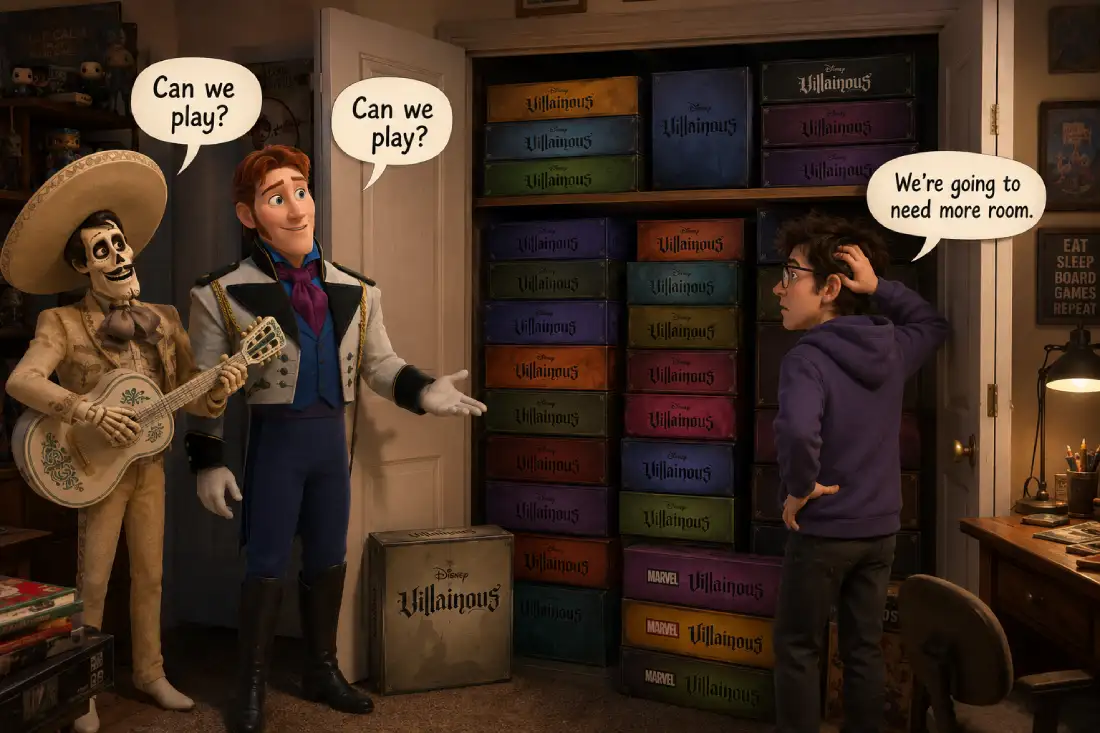
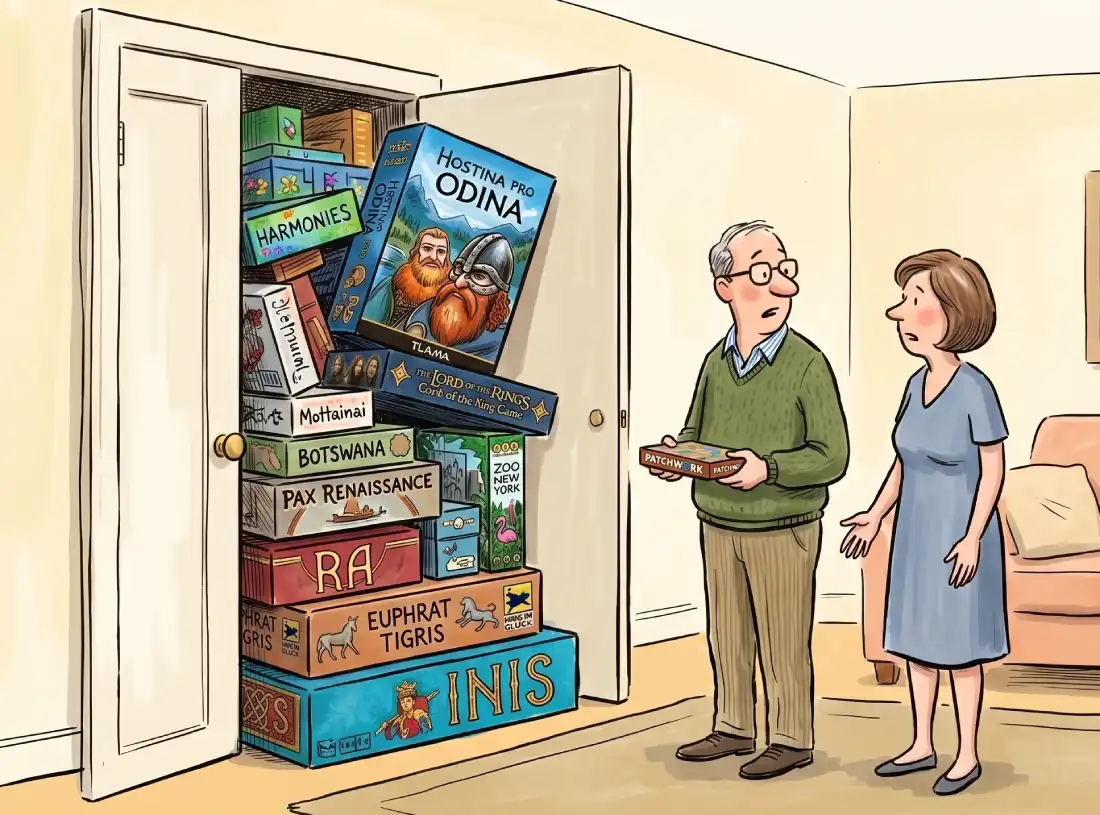
For nearly a decade, a board gamer’s social currency was measured in square footage. Towering wooden shelves, groaning under the weight of oversized, heavy crowdfunding “megaboxes” stuffed with plastic miniatures, were the ultimate badge of honor. On Instagram and Reddit, the “shelfie”—a proud photo of one’s massive, floor-to-ceiling cardboard library—reigned supreme as the hobby’s primary status symbol.
But a major shift is underway in both game design and how gamers think about board game storage. The era of the bloated, over-produced box is facing a serious industry-wide reckoning, making way for a movement enthusiasts are calling “The Death of the Shelfie.” Today’s market is rapidly transitioning toward high-density, low-footprint designs, and it’s forcing a lot of us to rethink how much shelf space this hobby actually deserves.
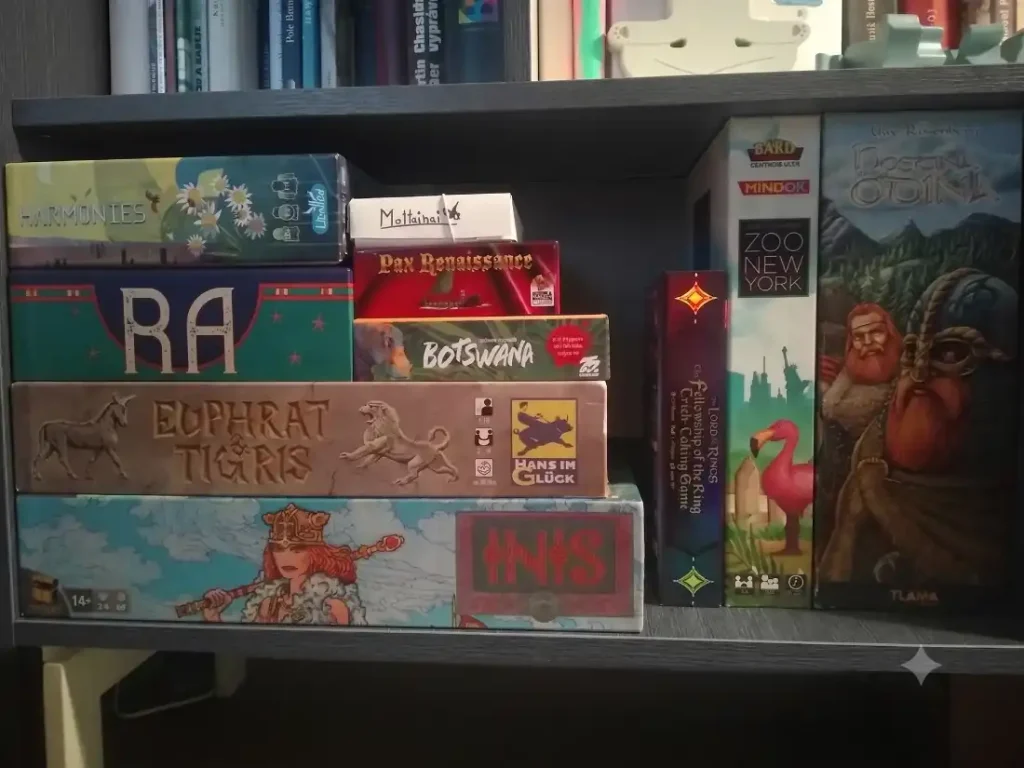
The Industry Facts: Why Tabletop Is Shrinking
This trend away from massive boxes isn’t just a matter of changing aesthetic tastes; it’s driven by hard economic, environmental, and logistical realities.
1. The Cost of “Wasted Air” and Giant Packaging
During the crowdfunding boom of the late 2010s, publishers competed in an “arms race” of physical scale. However, rising ocean freight rates and global shipping costs have made transporting oversized boxes incredibly expensive. Publishers pay for shipping by volume (cubic meters), meaning that shipping a giant box filled mostly with plastic vacuform inserts and empty air severely cuts into profit margins. Compressing box sizes is a survival strategy for modern publishers.
Even beloved, highly popular cooperative games like Ravensburger’s Horrified come in incredibly chunky, deep square boxes. While the game is fantastic, storing a box that massive—which is mostly holding a flat map board, a couple of plastic monster miniatures, and some cards—is becoming a luxury that players are actively pushing back against.
2. The Azul Problem and the Rise of “Mini” Editions
A perfect case study of this trend is Next Move Games’ abstract classic, Azul. The original Azul is famously a box filled almost entirely with empty space, meant only to store player boards and a bag of plastic tiles. It takes up a massive square chunk on any shelf.
Because of this physical footprint, the publisher was eventually forced to release Azul Mini. Designed specifically for portability, it shrinks the tiles down and introduces plastic overlay trays to keep the pieces from sliding around, packing the entire, brilliant strategy experience into a tiny, travel-friendly pouch.
3. Urban Real Estate Constraints
According to global housing data, average living spaces in major urban areas have shrunk over the past decade. For city dwellers, apartment renters, and younger gamers, dedicating an entire room or wall to host a few dozen massive board games is a physical luxury they simply cannot afford.
So What Do You Actually Do With the Board Game Storage You’ve Already Got?
This is the part nobody wants to talk about, because it means admitting you probably own too many big boxes. I went digging through a couple of the bigger r/boardgames storage threads to see what people actually do once the shelf runs out, and the honest answer is: they argue about it, constantly, and nobody fully agrees.
Kallax gets recommended so often it’s basically the default answer, and there’s a real reason for it—the cubes swallow most standard boxes without custom foam inserts. But plenty of longtime collectors push back hard.
One thread had a flat “BESTA > Kallax” reply that picked up real traction, and the case for it gets specific: Besta’s shelves are adjustable, which matters the moment your collection ranges from something Gloomhaven-sized down to something the size of Clever, because Kallax’s fixed cubes don’t flex for that spread—you either waste space around the small boxes or the big ones don’t fit at all.
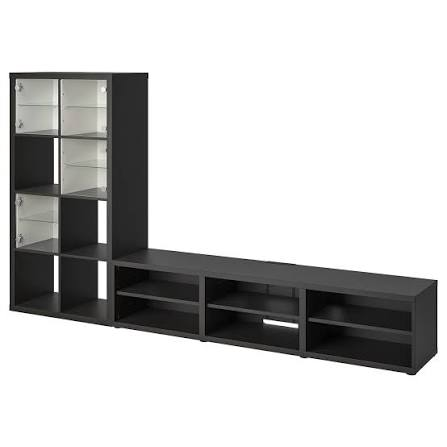
Someone else did the actual math and argued Billy bookcases beat both of them on raw density, since you can set shelf height in roughly one-inch increments instead of eating dead space in a fixed cube—by their count, two Billy bookcases held about 120 games against roughly 100 for a stacked Kallax setup of comparable footprint, for less money.
Meanwhile a gamer with a wall of industrial wire shelving argued Kallax isn’t even attractive and is “a huge pain in the ass” to actually use compared to open shelving you can grab an armful off of (apparently Tom Vasel runs the same setup on camera).
There’s no consensus box here—just tradeoffs between density, looks, and how fast you can grab tonight’s game. And worth a gut check before you sink money into any of it: more than one person in these threads had already filled a wall of shelving and was back to stacking overflow on the floor. Shelving doesn’t solve a collection that’s still growing faster than your walls are.
The sharper argument is about what to do once the shelf is actually full. The most upvoted comment in one thread wasn’t a shelving hack at all—it was “being honest to myself about what will actually get played.” That’s the real fix, and it’s also the one nobody wants.
A blunter commenter put it less kindly, essentially arguing that needing storage hacks in the first place is a sign you own too many games and should just get rid of some. It’s harsh, but it’s not wrong, and it lines up with the “if it doesn’t fit on the shelf, something else has to go” rule a few people mentioned running in their own households.
Then there’s the fight over the boxes themselves. A genuinely contested tactic: gut the box entirely—repackage components into a folded organizer, fold the expansion into the base game’s box, and throw the original packaging away. One user shrank Abyss from three boxes to one this way.
It’s controversial for good reason (someone replied “hold on there, Satan”), and it comes with its own trap—once you own an organizer built for an expansion, you’re more likely to buy that expansion just because you now have somewhere to put it. If you go this route, the general rule that held up across threads was: keep an insert only if it actually speeds up setup, not because it came in the box.
Worth noting if you’re an OP trying the ziplock-bag route: multiple commenters flagged that bags of loose components often take up more room than a well-fitted small box, not less, because the bags balloon with trapped air. If you’re going to bag components anyway, snip a corner of each bag to let the air out before you seal it. And if you store anything vertically for long stretches, keep an eye on board warping—it’s a real complaint, not a theoretical one.
The games worth keeping in bulky form are the ones where the box size does something—chunky insert trays that make setup faster, or minis you genuinely display. Everything else is a candidate for downsizing, repackaging, or replacing outright with a compact edition when the publisher offers one.
Comparing the Eras: Megabox vs. Compact
To see just how drastically the physical profile of a tabletop game has changed, look at the specifications of the two eras side-by-side:
| Feature | The Crowdfunded “Megabox” Era | The Modern “Compact” Era |
|---|---|---|
| Physical Weight | $3.6\text{ kg}$ to $6.8\text{ kg}$ ($8\text{ lbs}$ to $15\text{ lbs}$) | $0.4\text{ kg}$ to $1.3\text{ kg}$ ($1\text{ lb}$ to $3\text{ lbs}$) |
| Setup & Teardown | $20$ to $45\text{ minutes}$ of sorting components | $5$ to $10\text{ minutes}$ max |
| Portability | Requires a dedicated, reinforced duffel bag | Slips easily into a standard backpack or purse |
| Storage Impact | Occupies a full shelf cube per 1-2 games | Stackable, fits in drawers or compact cupboards |
| Average Price | $100$ to $200+$ USD | $20$ to $50$ USD |
My Take: Why My Back (and Baggage Allowance) Is Glad It’s Over
Now, if you’ll let me step away from the industry data for a second and speak as a gamer with a very cozy, modest flat: thank goodness this downsizing is happening.
I don’t have a dedicated “board game room,” and I definitely don’t want my living room looking like a commercial warehouse. For me, the death of the shelfie has saved my social life and my travel sanity.
We have all experienced “The Backpack Burden.” A friend calls you on a Friday night and says, “Hey, bring over a couple of games!” Instantly, your shoulders start to ache. If you want to bring something like Horrified or original Azul, you have to commit to lugging a heavy, specialized, heavily padded backpack that makes you look like a pack mule hiking Mount Everest.
And don’t even get me started on traveling.
If I want to jump on a Ryanair flight to go visit my parents or my significant other for the weekend, packing a standard big-box game is flat-out impossible. Ryanair’s free small personal bag is strictly capped at a tiny $40 \times 30 \times 20\text{ cm}$ ($16 \times 12 \times 8\text{ in}$).
If you try to slip just one classic box in your bag, it physically hogs the entire space. You are left making a tragic life decision: do I bring this one game, or do I bring clean underwear, a toothbrush, and a spare t-shirt?
Even if you pay to upgrade to a cabin bag, you are still restricted to a $10\text{ kg}$ ($22\text{ lbs}$) weight limit. A couple of chunky boxes will easily blow past that limit before you’ve even packed a single sock!
This is exactly why travel board games and travel-size board games have quietly become their own category worth paying attention to, rather than an afterthought tacked onto a “best of” list. With the rise of modern, ultra-compact designs, I can slip Azul Mini and two or three other highly strategic travel-size board games into a tiny handbag or the front pocket of a backpack. I can fly across the continent, sit down at a pub table with my family, and have an incredible, deep gaming experience without paying a single extra baggage fee.
I’ll admit the habit that got me into this piece in the first place: whenever the shelf situation gets bad, I end up scrolling r/boardgames at midnight looking for a solution, half-convinced someone out there has finally cracked the code.
It’s the same instinct as browsing gear reviews for a hobby you already have all the gear for—you’re not really shopping, you’re just hoping the “next best thing” exists and will make the problem disappear without you having to get rid of anything.
It never does. Every thread just turns into the same argument between Kallax loyalists and Besta converts, and I come away with three new bookmarked shelving systems and the same 50 games I started with.
And here’s the part I have to be honest about, because it undercuts my own argument a little: those big boxes are genuinely cool. That’s the actual dilemma, not some fake both-sides framing. There’s a real reason people build shelfies in the first place—chunky minis, oversized boards with real production value, an insert that makes a game feel like an event before you’ve placed a single piece.
Nobody builds a wall of Kallax cubes to hold something they don’t love looking at. The downsizing trend isn’t a rejection of that feeling; it’s an admission that most of us can’t actually afford the square footage it demands, however good it looks on a shelf.
I’m about to find that out the hard way. My significant other lives in a 32-square-meter flat in Paris, and we’re talking about moving in together, which means my roughly 50-game collection is about to collide with roughly 344 square feet of shared space that also needs to fit a bed, a kitchen, and two humans. There’s no Kallax wall in that math.
So here’s my actual plan, not a hypothetical: the megaboxes get the hardest look first, because they’re the ones eating the most volume for the least frequent use, and if I haven’t played something in the last year it’s the first thing to get sold rather than moved. Whatever survives the cull gets consolidated—expansions folded into base game boxes where they’ll fit, no duplicate packaging kept “just in case.”
And the collection that actually makes the move leans hard into the compact and travel-size end of this whole piece: games like Azul Mini aren’t a compromise in a 32-square-meter flat, they’re the only realistic way to keep the hobby at all. It’s a smaller collection than I’d like. It’s also one that will actually fit in the apartment instead of living in a storage unit I’m paying for out of sentimentality.
Ultimately, stripping away the physical bloat is making the tabletop hobby feel human again. We are finally prioritizing the dynamic, shared experience on the table over the dusty, heavy cardboard box on the shelf. And it turns out, the best things really do come in small packages.