Category: Family

Family board games have one job: keep everyone at the table. Not just the competitive adult who reads strategy guides, and not just the eight-year-old who wants to knock pieces over. Everyone, at the same time, for the whole game. That’s a harder brief than it sounds, and most games fail it quietly. They’re either too simple to hold adult attention past the second round, or complex enough that the youngest player spends most of the game waiting for someone to explain what just happened.

The games that crack that problem are worth talking about, because they don’t all do it the same way.

Chaos as a leveler

Some of the best family board games work precisely because they refuse to reward experience. A racing game like Magical Athlete is a good example. Every racer has a special ability that can rewrite the standings in a single turn: teleport past the finish line, swap places with the leader, force everyone ahead of you to move backward. The person in last place three turns from the end has won this game before. The person who’s been ahead for the entire race has lost it.

Kids handle that kind of volatility better than adults do, which is either the game’s best feature or its most infuriating one depending on who’s sitting across from you.

That’s not a design flaw. It’s a deliberate choice to keep the outcome genuinely open until it isn’t, and it’s one of the reasons games like this keep getting pulled off the shelf. Nobody checks out when they still have a chance.

When imagination does the work

Not every family game earns its place through chaos. Dixit takes the opposite approach. It’s a game about communication and interpretation, where you’re describing a card from your hand with a word, a sound, a phrase, anything you want, and the goal is to be just ambiguous enough. Too obvious and everyone guesses correctly; too cryptic and nobody does. Either way you score nothing.

What makes it work across age groups is that the skill it rewards has nothing to do with experience or strategy. It rewards knowing how the people across from you think. A ten-year-old who’s been watching the adults at the table all evening will beat a competitive adult playing too literally every single time.

The dreamlike artwork helps: strange, open-ended illustrations that don’t force an interpretation, just invite one. It’s one of those rare family friendly board games where the gap between the youngest and oldest player effectively disappears, not because the game dumbs itself down, but because it’s measuring something that doesn’t correlate with age.

Games that reward coming back

The best family game nights aren’t one-off events. They’re habits. And habits require games that don’t wear out after the third play. That’s a higher bar than it sounds, and it’s where a lot of otherwise solid games fall short.

Disney Villainous clears it by giving every player a completely different game to play. Each villain has their own board, their own deck, their own win condition, and their own logic. Maleficent is trying to curse the entire kingdom. Ursula is trying to recover her stolen contract. They don’t interact with the game the same way, which means mastering one character doesn’t make you good at another.

The first session is spent mostly figuring out your own puzzle. The second session is when the interference starts. By the third, people are building actual strategies around disrupting each other, and the game opens up in a way it couldn’t on night one.

That’s exactly what fun family board games should do: get better as the people playing them get better.

Catan earns its reputation differently. The board changes every game, the resource distribution shifts, and the entire middle section is built on negotiation that never resolves the same way twice.

It’s not the deepest game on the shelf. Anyone who tells you it rewards genius-level strategy is romanticizing it. But it’s one of the few games where the social dynamics at the table become part of the game itself: who trades with whom, who holds a grudge from last round, who’s been quietly building toward a port nobody else noticed.

A family that’s played it five times is playing a fundamentally different game than one playing it for the first time, and that gap has nothing to do with age.

What actually makes a family game work

There’s a version of this question that gets answered with bullet points about play time and player count, and that version is correct but not very useful. The honest answer is that a good family game works when everyone at the table has a real reason to care about what happens next.

Not because the rulebook forces them to pay attention, but because something is actually at stake for them personally.

That looks different depending on the game. In Magical Athlete it’s the standing that can flip any turn. In Dixit it’s the read you’ve been building on the person across from you. In Villainous it’s the win condition you’re three moves from completing. In Catan it’s the trade you need and the question of whether anyone will give it to you.

There’s also a separate question that comes up a lot: what about board games for families where the kids are older, or where adults are the primary audience and the younger players are along for the ride? Family board games for adults exist in a slightly different register.

Catan and Villainous both sit comfortably there. The decisions are real, the social layer is genuinely interesting, and nobody feels like they’re playing a children’s game. That’s a harder balance to strike than it looks, and it’s worth knowing which games actually manage it before you show up to a game night with the wrong box.

The games worth recommending for families are the ones where an eight-year-old and a forty-year-old are both leaning forward in the last round, for completely different reasons, both convinced they might actually win. That’s not easy to design. The games that manage it tend to stick around.

If the group skews younger and you need something with a lower age floor, the kids games category covers that end of the spectrum.

For evenings where the energy is higher and the group is bigger, party games are built for exactly that.

What to look for in a family board game:

  • Teaches in under ten minutes, even to a mixed-age group
  • Plays in 30 to 90 minutes without anyone losing interest
  • Gives every player real decisions, not just dice rolls
  • Works with three players or six
  • Gets better the more you play it, not worse
  • Your First Strategy Board Games: Eight That Teach You to Think Ahead

    Your First Strategy Board Games: Eight That Teach You to Think Ahead

    Most beginner lists pick games because they’re easy. That’s half the job. A good first strategy game should also teach you something you’ll use in every heavier game afterwards: how to build an engine, how to deny your opponent, how to know when to stop being greedy.

    So every game below comes with the one skill it drills into you. Learn all eight lessons and nothing on a heavier shelf will feel foreign. Each one takes under 15 minutes to teach, and all but Arnak play in under an hour. Five of them (Carcassonne, Ticket to Ride, Kingdomino, Azul and Cascadia) won the Spiel des Jahres, the award that has quietly shaped what “beginner-friendly” means for decades.

    GameThe skill it teachesPlayersPlay time
    SplendorBuilding an engine2-430 min
    AzulDenying your opponents2-430-45 min
    Ticket to RideWeighing risk against reward2-545-60 min
    CarcassonneManaging limited pieces2-535-45 min
    KingdominoTrading now for later2-415-20 min
    CascadiaPlanning around scoring goals1-430-45 min
    7 Wonders DuelWatching several win conditions230 min
    Lost Ruins of ArnakJuggling several systems at once1-460-120 min

    Splendor Is the Clearest Lesson in Compounding

    You’re a Renaissance gem merchant. On your turn you take gem tokens, reserve a card, or buy a card. First to 15 prestige points ends the round.

    Every card you buy gives you a permanent gem discount on future purchases, so cards that cost seven tokens early on cost two or three later.

    That’s an engine in its purest form. The first ten minutes feel slow and a little pointless, then suddenly you’re buying a card every turn. The lesson here is when to stop investing and start scoring, and every new player gets it wrong at least once.

    Reserving is the sneaky part. Reserving a card hides it in your hand and gives you a gold wildcard, which means you can snatch the card your opponent was clearly saving up for. The first time someone does that to you, you’ll understand why people call Splendor deceptively mean.

    Azul Teaches You to Hurt People Politely

    Azul looks like a tile-matching puzzle. Players take tiles from shared displays to fill rows on their own boards. The catch: you must take every tile of one color from a display, and anything you can’t place falls onto your floor line for minus points.

    Once that sinks in, Azul becomes a different game. You start taking tiles you don’t need so nobody else gets them. You leave five red tiles sitting in the center because you know the next player has nowhere to put them. That’s hate drafting, a skill that shows up in nearly every drafting game you’ll ever play. Grabbing first from the center pile costs you a point but makes you first player next round, a small decision that’s really a lesson in tempo.

    Greed Has a Price in Ticket to Ride

    You collect colored train cards and spend them to claim railway routes between cities. Secret destination tickets score big if you connect their two cities by game end, and cost the same amount if you don’t.

    That’s the lesson: every ticket is a bet. Take three extra tickets late in the game and you might win outright or sink yourself. Newer players hoard cards forever. Better ones claim a key route early, because the other player might need it too, a quiet introduction to blocking that’s sharpest with three to five players. At two, the map opens up and nobody gets boxed in.

    Carcassonne and the Meeple Budget

    You draw a landscape tile, add it to the growing map, and can place one of your seven followers on a road, city or monastery. When that feature is finished, you score it and get your follower back.

    Seven followers sounds like plenty. It isn’t. Park too many on sprawling cities that never close and you’ll spend the last third of the game with nothing to place. Carcassonne teaches you that your pieces are a resource, not decoration.

    It also teaches you to steal. Two players’ followers can end up on the same city if you connect them, and whoever has more takes all the points. Sliding a tile in to join a city your opponent thought was safe is Carcassonne’s great small cruelty. Farmers, scored at the end, are the advanced layer. Teach them in the second game, not the first.

    Kingdomino Puts a Price on Going First

    A 15-minute game where you build a five-by-five kingdom from domino-style tiles, scoring each connected terrain area’s size multiplied by the crowns in it. The tile draft is the brilliant bit: dominoes are numbered, and the better the tile you take this round, the later you pick next round. Every choice is a trade between now and later, and plenty of heavy games are built on that same tension. Kingdomino just makes it obvious within one play.

    Cascadia Rewards Plans That Bend

    Each turn you take a habitat tile and a wildlife token as a pair, and add both to your personal landscape. Scoring cards change every game: one set rewards bears in pairs, another wants long lines of salmon, another pays for hawks that are kept apart.

    The skill is planning around goals you can’t fully control. The pair you want is rarely on offer, so you learn to keep two or three plans alive at once and pivot without panicking. Nature tokens let you break the pairing rule, and choosing when to spend them is Cascadia’s quiet decision point.

    Nobody attacks anybody, so it’s a good fit for groups who dislike direct conflict but still want to think. More picks in that spirit sit in the family games category.

    Three Ways to Lose in 7 Wonders Duel

    This one’s two-player only. Cards are laid out in a pyramid, some face down, and you take them in turns, which often reveals a new card for your opponent. You’re always asking what your pick opens up for them.

    It also has three ways to win: military, science, or points. Your opponent can end the game suddenly if you ignore the first two, so you learn to check every threat each turn, not just your own plan. That habit transfers directly to games like Twilight Struggle later on.

    Lost Ruins of Arnak, the Bridge to Heavier Games

    Arnak is the heaviest game here and the step between gateway games and the real thing. You explore an island with a small deck of cards and two archaeologists, sending them to dig sites, fighting guardians, and racing up a research track over five rounds.

    It combines deck building, worker placement and resource management. Each of those shows up alone in lighter games. Arnak teaches you to juggle all three without drowning. If your group handles Arnak comfortably, you’re ready for anything in the mid-weight range.

    Habits That Help You Win Your First Few Games

    Play your first game of anything to learn, not to win. Ask how the game ends before you ask how turns work, then keep that end condition in your head every turn. It’s the most common beginner mistake by far.

    Spend your resources. Tokens, cards and money left over at game end are almost always wasted, and new players hoard. Watch what the leader is doing, and ask what you can do to slow them down, not only how you can speed yourself up.

    Most of all, replay the same game three or four times before moving on. The second play is where strategy appears. The first is just rules.

    Where to Go After These Eight

    Once these feel comfortable, two games extend directly from what’s above. Catan adds trading and negotiation, the one skill missing from this list, though a bad run of dice can still sink a good player, a tension I get into in my full breakdown of Catan. Wingspan builds on what Splendor taught you, with a longer, more varied engine and almost none of the direct conflict.

    For the full step up, including economic games, head-to-head duels, co-ops and six-hour epics, see my guide to the best strategy board games for adults, sorted by the kind of pressure each one puts on you.

    Not every table wants that much weight, and that’s fine. Strategy is a spectrum, not a test.

    If your group wants a wider mix that includes party and co-op games instead, start with a lighter spread of picks in five board games every beginner should try.

    Still don’t know? Take our test and see for yourself which game is right for you:

    Which Beginner Strategy Game Should You Start With?

    Which Beginner Strategy Game Should You Start With?

    Four quick questions. One real pick.
    • The Death of the “Shelfie”: Why Board Game Storage Is Shrinking

      The Death of the “Shelfie”: Why Board Game Storage Is Shrinking

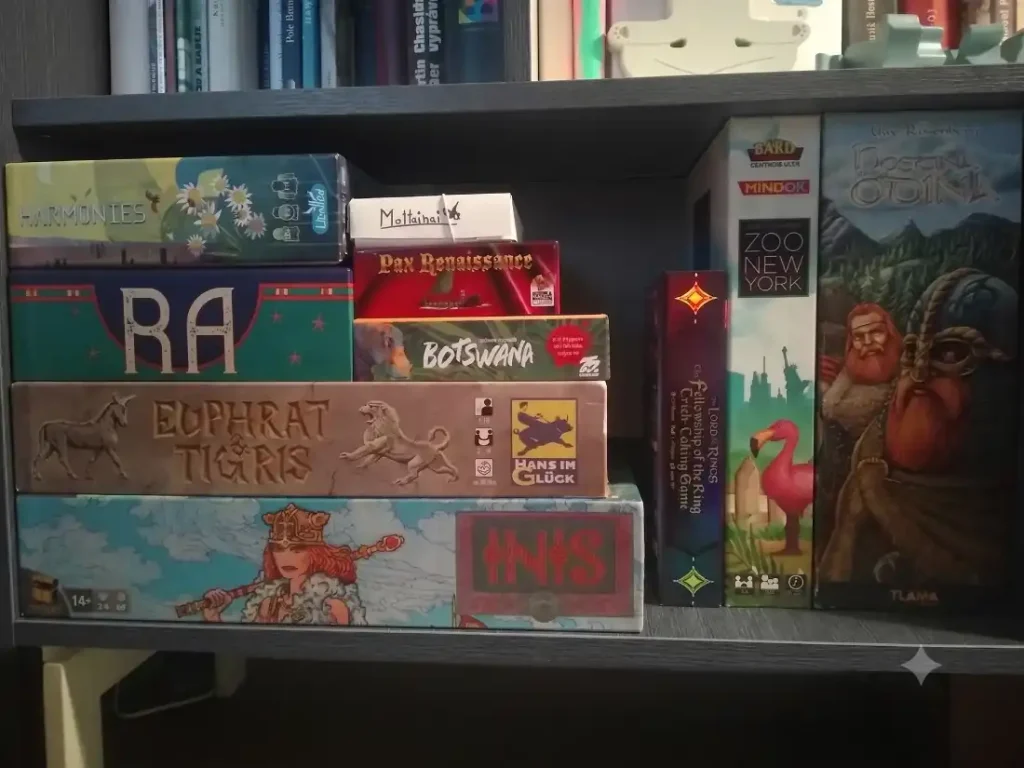
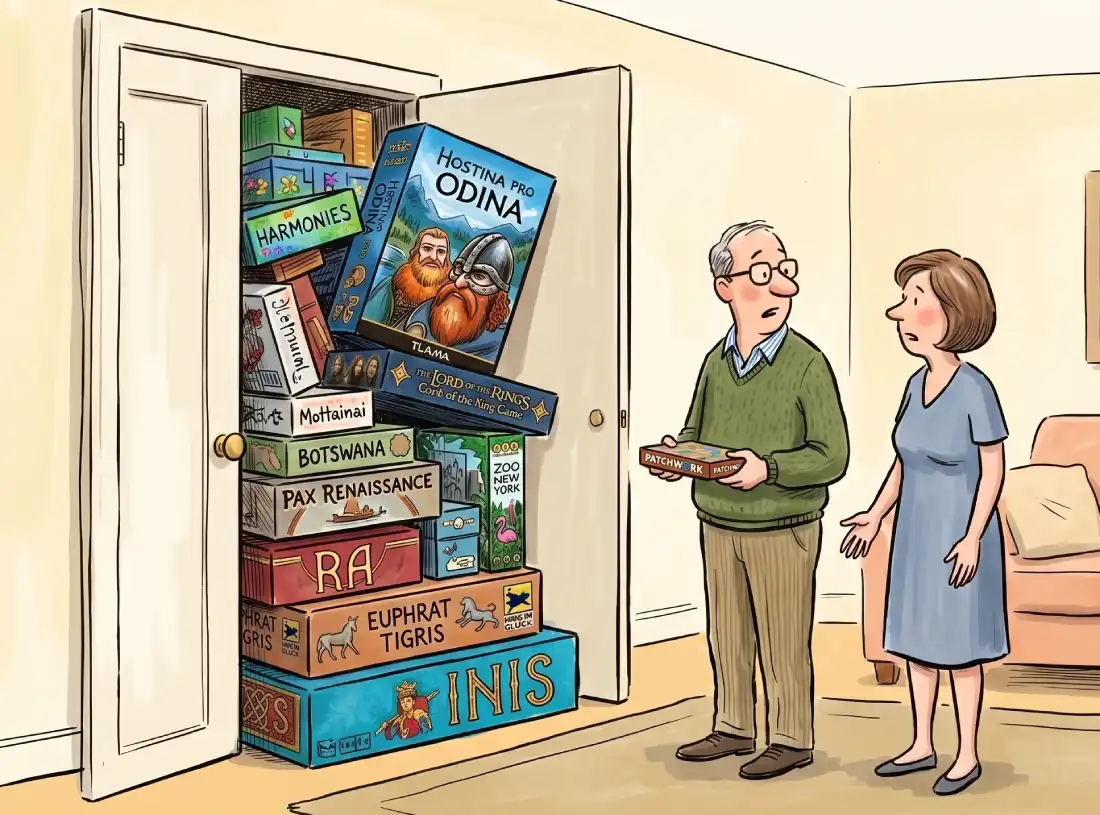
      For nearly a decade, a board gamer’s social currency was measured in square footage. Towering wooden shelves, groaning under the weight of oversized, heavy crowdfunding “megaboxes” stuffed with plastic miniatures, were the ultimate badge of honor. On Instagram and Reddit, the “shelfie”—a proud photo of one’s massive, floor-to-ceiling cardboard library—reigned supreme as the hobby’s primary status symbol.

      But a major shift is underway in both game design and how gamers think about board game storage. The era of the bloated, over-produced box is facing a serious industry-wide reckoning, making way for a movement enthusiasts are calling “The Death of the Shelfie.” Today’s market is rapidly transitioning toward high-density, low-footprint designs, and it’s forcing a lot of us to rethink how much shelf space this hobby actually deserves.

      The Industry Facts: Why Tabletop Is Shrinking

      This trend away from massive boxes isn’t just a matter of changing aesthetic tastes; it’s driven by hard economic, environmental, and logistical realities.

      1. The Cost of “Wasted Air” and Giant Packaging

      During the crowdfunding boom of the late 2010s, publishers competed in an “arms race” of physical scale. However, rising ocean freight rates and global shipping costs have made transporting oversized boxes incredibly expensive. Publishers pay for shipping by volume (cubic meters), meaning that shipping a giant box filled mostly with plastic vacuform inserts and empty air severely cuts into profit margins. Compressing box sizes is a survival strategy for modern publishers.

      Even beloved, highly popular cooperative games like Ravensburger’s Horrified come in incredibly chunky, deep square boxes. While the game is fantastic, storing a box that massive—which is mostly holding a flat map board, a couple of plastic monster miniatures, and some cards—is becoming a luxury that players are actively pushing back against.

      2. The Azul Problem and the Rise of “Mini” Editions

      A perfect case study of this trend is Next Move Games’ abstract classic, Azul. The original Azul is famously a box filled almost entirely with empty space, meant only to store player boards and a bag of plastic tiles. It takes up a massive square chunk on any shelf.

      Because of this physical footprint, the publisher was eventually forced to release Azul Mini. Designed specifically for portability, it shrinks the tiles down and introduces plastic overlay trays to keep the pieces from sliding around, packing the entire, brilliant strategy experience into a tiny, travel-friendly pouch.

      3. Urban Real Estate Constraints

      According to global housing data, average living spaces in major urban areas have shrunk over the past decade. For city dwellers, apartment renters, and younger gamers, dedicating an entire room or wall to host a few dozen massive board games is a physical luxury they simply cannot afford.

      So What Do You Actually Do With the Board Game Storage You’ve Already Got?

      This is the part nobody wants to talk about, because it means admitting you probably own too many big boxes. I went digging through a couple of the bigger r/boardgames storage threads to see what people actually do once the shelf runs out, and the honest answer is: they argue about it, constantly, and nobody fully agrees.

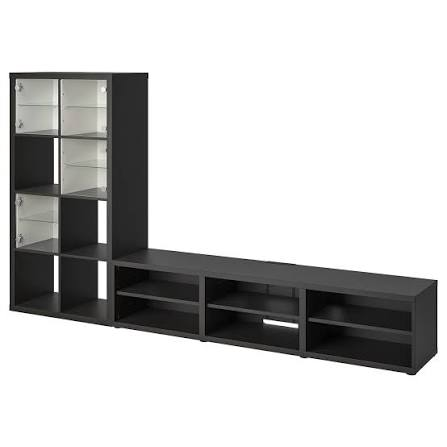
      Kallax gets recommended so often it’s basically the default answer, and there’s a real reason for it—the cubes swallow most standard boxes without custom foam inserts. But plenty of longtime collectors push back hard.

      One thread had a flat “BESTA > Kallax” reply that picked up real traction, and the case for it gets specific: Besta’s shelves are adjustable, which matters the moment your collection ranges from something Gloomhaven-sized down to something the size of Clever, because Kallax’s fixed cubes don’t flex for that spread—you either waste space around the small boxes or the big ones don’t fit at all.

      Someone else did the actual math and argued Billy bookcases beat both of them on raw density, since you can set shelf height in roughly one-inch increments instead of eating dead space in a fixed cube—by their count, two Billy bookcases held about 120 games against roughly 100 for a stacked Kallax setup of comparable footprint, for less money.

      Meanwhile a gamer with a wall of industrial wire shelving argued Kallax isn’t even attractive and is “a huge pain in the ass” to actually use compared to open shelving you can grab an armful off of (apparently Tom Vasel runs the same setup on camera).

      There’s no consensus box here—just tradeoffs between density, looks, and how fast you can grab tonight’s game. And worth a gut check before you sink money into any of it: more than one person in these threads had already filled a wall of shelving and was back to stacking overflow on the floor. Shelving doesn’t solve a collection that’s still growing faster than your walls are.

      The sharper argument is about what to do once the shelf is actually full. The most upvoted comment in one thread wasn’t a shelving hack at all—it was “being honest to myself about what will actually get played.” That’s the real fix, and it’s also the one nobody wants.

      A blunter commenter put it less kindly, essentially arguing that needing storage hacks in the first place is a sign you own too many games and should just get rid of some. It’s harsh, but it’s not wrong, and it lines up with the “if it doesn’t fit on the shelf, something else has to go” rule a few people mentioned running in their own households.

      Then there’s the fight over the boxes themselves. A genuinely contested tactic: gut the box entirely—repackage components into a folded organizer, fold the expansion into the base game’s box, and throw the original packaging away. One user shrank Abyss from three boxes to one this way.

      It’s controversial for good reason (someone replied “hold on there, Satan”), and it comes with its own trap—once you own an organizer built for an expansion, you’re more likely to buy that expansion just because you now have somewhere to put it. If you go this route, the general rule that held up across threads was: keep an insert only if it actually speeds up setup, not because it came in the box.

      Worth noting if you’re an OP trying the ziplock-bag route: multiple commenters flagged that bags of loose components often take up more room than a well-fitted small box, not less, because the bags balloon with trapped air. If you’re going to bag components anyway, snip a corner of each bag to let the air out before you seal it. And if you store anything vertically for long stretches, keep an eye on board warping—it’s a real complaint, not a theoretical one.

      The games worth keeping in bulky form are the ones where the box size does something—chunky insert trays that make setup faster, or minis you genuinely display. Everything else is a candidate for downsizing, repackaging, or replacing outright with a compact edition when the publisher offers one.

      Comparing the Eras: Megabox vs. Compact

      To see just how drastically the physical profile of a tabletop game has changed, look at the specifications of the two eras side-by-side:

      FeatureThe Crowdfunded “Megabox” EraThe Modern “Compact” Era
      Physical Weight$3.6\text{ kg}$ to $6.8\text{ kg}$ ($8\text{ lbs}$ to $15\text{ lbs}$)$0.4\text{ kg}$ to $1.3\text{ kg}$ ($1\text{ lb}$ to $3\text{ lbs}$)
      Setup & Teardown$20$ to $45\text{ minutes}$ of sorting components$5$ to $10\text{ minutes}$ max
      PortabilityRequires a dedicated, reinforced duffel bagSlips easily into a standard backpack or purse
      Storage ImpactOccupies a full shelf cube per 1-2 gamesStackable, fits in drawers or compact cupboards
      Average Price$100$ to $200+$ USD$20$ to $50$ USD

      My Take: Why My Back (and Baggage Allowance) Is Glad It’s Over

      Now, if you’ll let me step away from the industry data for a second and speak as a gamer with a very cozy, modest flat: thank goodness this downsizing is happening.

      I don’t have a dedicated “board game room,” and I definitely don’t want my living room looking like a commercial warehouse. For me, the death of the shelfie has saved my social life and my travel sanity.

      We have all experienced “The Backpack Burden.” A friend calls you on a Friday night and says, “Hey, bring over a couple of games!” Instantly, your shoulders start to ache. If you want to bring something like Horrified or original Azul, you have to commit to lugging a heavy, specialized, heavily padded backpack that makes you look like a pack mule hiking Mount Everest.

      And don’t even get me started on traveling.

      If I want to jump on a Ryanair flight to go visit my parents or my significant other for the weekend, packing a standard big-box game is flat-out impossible. Ryanair’s free small personal bag is strictly capped at a tiny $40 \times 30 \times 20\text{ cm}$ ($16 \times 12 \times 8\text{ in}$).

      If you try to slip just one classic box in your bag, it physically hogs the entire space. You are left making a tragic life decision: do I bring this one game, or do I bring clean underwear, a toothbrush, and a spare t-shirt?

      Even if you pay to upgrade to a cabin bag, you are still restricted to a $10\text{ kg}$ ($22\text{ lbs}$) weight limit. A couple of chunky boxes will easily blow past that limit before you’ve even packed a single sock!

      This is exactly why travel board games and travel-size board games have quietly become their own category worth paying attention to, rather than an afterthought tacked onto a “best of” list. With the rise of modern, ultra-compact designs, I can slip Azul Mini and two or three other highly strategic travel-size board games into a tiny handbag or the front pocket of a backpack. I can fly across the continent, sit down at a pub table with my family, and have an incredible, deep gaming experience without paying a single extra baggage fee.

      I’ll admit the habit that got me into this piece in the first place: whenever the shelf situation gets bad, I end up scrolling r/boardgames at midnight looking for a solution, half-convinced someone out there has finally cracked the code.

      It’s the same instinct as browsing gear reviews for a hobby you already have all the gear for—you’re not really shopping, you’re just hoping the “next best thing” exists and will make the problem disappear without you having to get rid of anything.

      It never does. Every thread just turns into the same argument between Kallax loyalists and Besta converts, and I come away with three new bookmarked shelving systems and the same 50 games I started with.

      And here’s the part I have to be honest about, because it undercuts my own argument a little: those big boxes are genuinely cool. That’s the actual dilemma, not some fake both-sides framing. There’s a real reason people build shelfies in the first place—chunky minis, oversized boards with real production value, an insert that makes a game feel like an event before you’ve placed a single piece.

      Nobody builds a wall of Kallax cubes to hold something they don’t love looking at. The downsizing trend isn’t a rejection of that feeling; it’s an admission that most of us can’t actually afford the square footage it demands, however good it looks on a shelf.

      I’m about to find that out the hard way. My significant other lives in a 32-square-meter flat in Paris, and we’re talking about moving in together, which means my roughly 50-game collection is about to collide with roughly 344 square feet of shared space that also needs to fit a bed, a kitchen, and two humans. There’s no Kallax wall in that math.

      So here’s my actual plan, not a hypothetical: the megaboxes get the hardest look first, because they’re the ones eating the most volume for the least frequent use, and if I haven’t played something in the last year it’s the first thing to get sold rather than moved. Whatever survives the cull gets consolidated—expansions folded into base game boxes where they’ll fit, no duplicate packaging kept “just in case.”

      And the collection that actually makes the move leans hard into the compact and travel-size end of this whole piece: games like Azul Mini aren’t a compromise in a 32-square-meter flat, they’re the only realistic way to keep the hobby at all. It’s a smaller collection than I’d like. It’s also one that will actually fit in the apartment instead of living in a storage unit I’m paying for out of sentimentality.

      Ultimately, stripping away the physical bloat is making the tabletop hobby feel human again. We are finally prioritizing the dynamic, shared experience on the table over the dusty, heavy cardboard box on the shelf. And it turns out, the best things really do come in small packages.