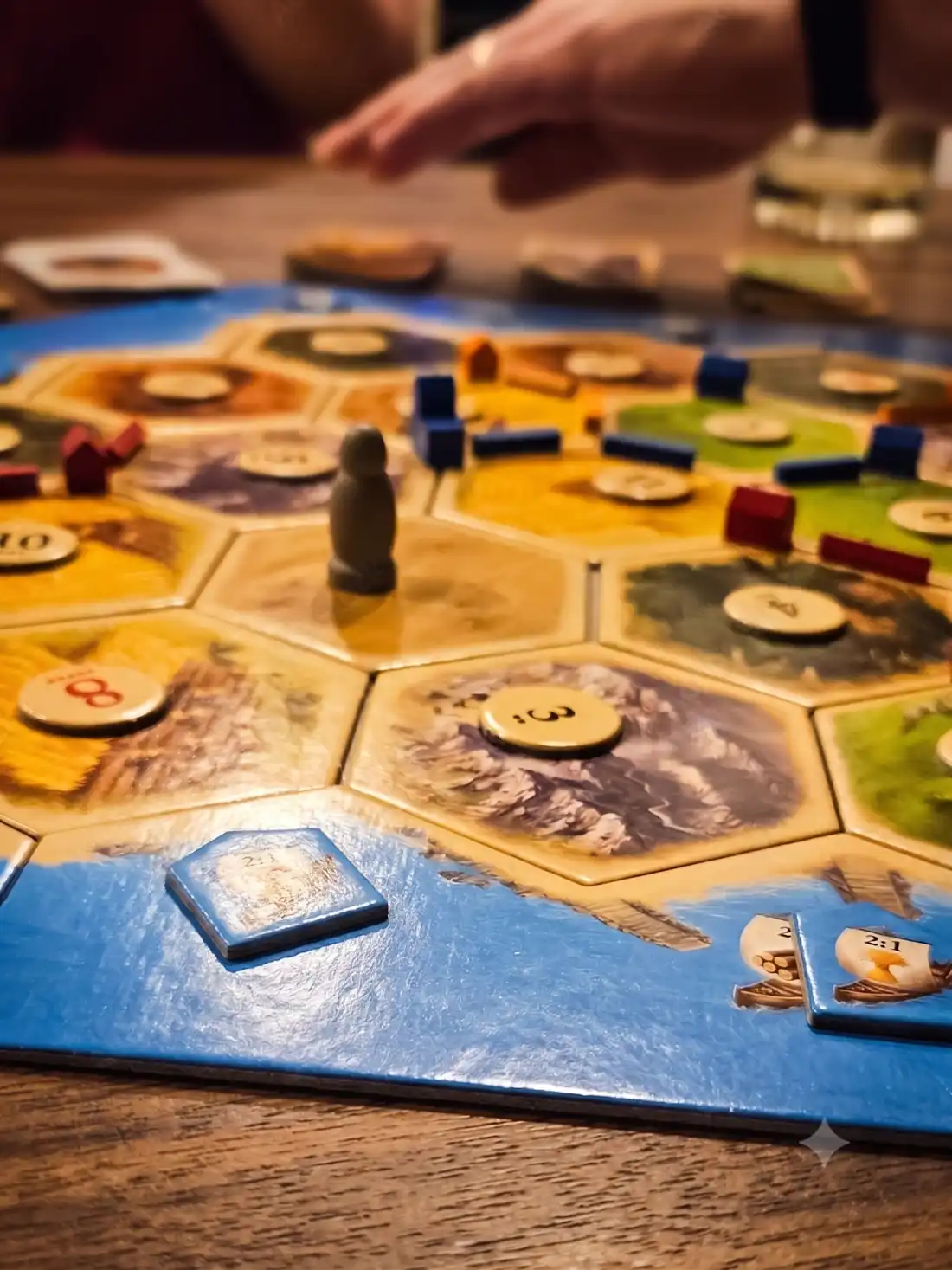
My first few games of Catan were a mess. It starts fast, people are rolling dice, grabbing resources and you are still starting at the board not knowing what’s happening. Someone will tell you “here are your sheep”, and you start to think you have a whole farming career ahead of you.
I built settlements wherever there was open space instead of checking which numbers actually got rolled, I hoarded resources instead of trading them, and I got wiped out by players who understood the board better than I did without ever quite figuring out why. I remember one game where I put a settlement on a lonely 2 and a 12, the two least likely rolls on both dice combined, because the spot looked open and nobody had claimed it yet.
I sat there for an hour producing almost nothing while the rest of the table built cities around me. I blamed the dice for a solid year of losses before I noticed the same three people kept winning, game after game, regardless of who got the “lucky” seats.
What changed things was paying attention to what happens at the table instead of what’s printed on the box. The box sells resource management. What you’re really managing, once you know what you’re doing, is who’s still willing to deal with you.
I started reading the pips on the board before placing a single settlement, weighting 6s and 8s over the corners nobody wanted, and my results improved almost immediately just from that one habit. But the bigger shift wasn’t strategic, it was social.
I started noticing that the robber almost never lands on hexes at random once players get good, it lands on whoever’s winning, every time, because punishing the leader is the only comeback move this game has.
I’ve had the robber parked on my best hex for three consecutive turns by three different opponents who never once discussed it out loud, and I’ve done the same thing to other players without needing to say a word either. It’s a language everyone at a Catan table learns without being taught.
Learning to Read the Table
Trading stopped being a math problem and started being a read on the table. A refusal isn’t a rules interaction, it’s a message, and I’ve watched a leader get frozen out for turns at a stretch over something that had nothing to do with the board in front of them, an old grudge from a different game night, a joke that landed wrong, whatever it was. Once I understood that, I started winning a lot more, and enjoying the losses more too, because I could finally see the actual game happening underneath the resource cards. The version of Catan I play now barely resembles the one I learned on. Same board, same dice, completely different game once you know where to look.
Two Players Is a Different, Worse Game
None of that improvement matters at two players. Without a third party to trade with, or against, every decision collapses into arithmetic: I know what you need, you know what I need, and neither of us is giving it up. The reads, the grudges, the social pressure that makes a four-player game interesting just aren’t there, because there’s no one else at the table to read, and no coalition to build or break.
I’ve played two-player Catan more times than I’d like to admit, usually late at night with one other person and nobody else around, both of us too tired to set up anything bigger. It never once felt like the same game I got good at.
The robber loses its teeth too, since there’s only one person it can ever target, so even that mechanic collapses into a formality instead of a threat. If you’re set on playing at two, look at a dedicated 2-player variant of Catan itself rather than forcing the base game to do something it wasn’t built for.
Disney Villainous is worth a look too, it scales cleanly from two players all the way up to four without losing what makes it work, which is more than I can say for Catan at the low end. This one wants a crowded table and the mess that comes with it.
And if you grew up calling it Settlers of Catan, you’re not misremembering. Klaus Teuber’s game launched in Germany in 1995 as Die Siedler von Catan, sold in English as The Settlers of Catan, and got rebranded to just Catan in 2015, one clean name across the whole product line, expansions and spinoffs included. Same game, same designer, same rules underneath, just a tidier shelf of boxes for the publisher to sell.
Why I still keep the Catan app on my phone
I still play the official app more than the physical board most weeks, mostly for speed when I can’t wrangle four people into a room on short notice. It’s convenient, the setup is instant and the rules enforce themselves, but it strips out the exact negotiation that made me better at the strategy game in the first place.
You also can play online so it’s great for airplane flights, even though you will end up hating Candamir, I warn you. And besides, you can’t read a grudge through a phone screen the way you can across a table.
That’s the case for why Catan holds up after two decades of me playing it. Here’s how it actually plays.