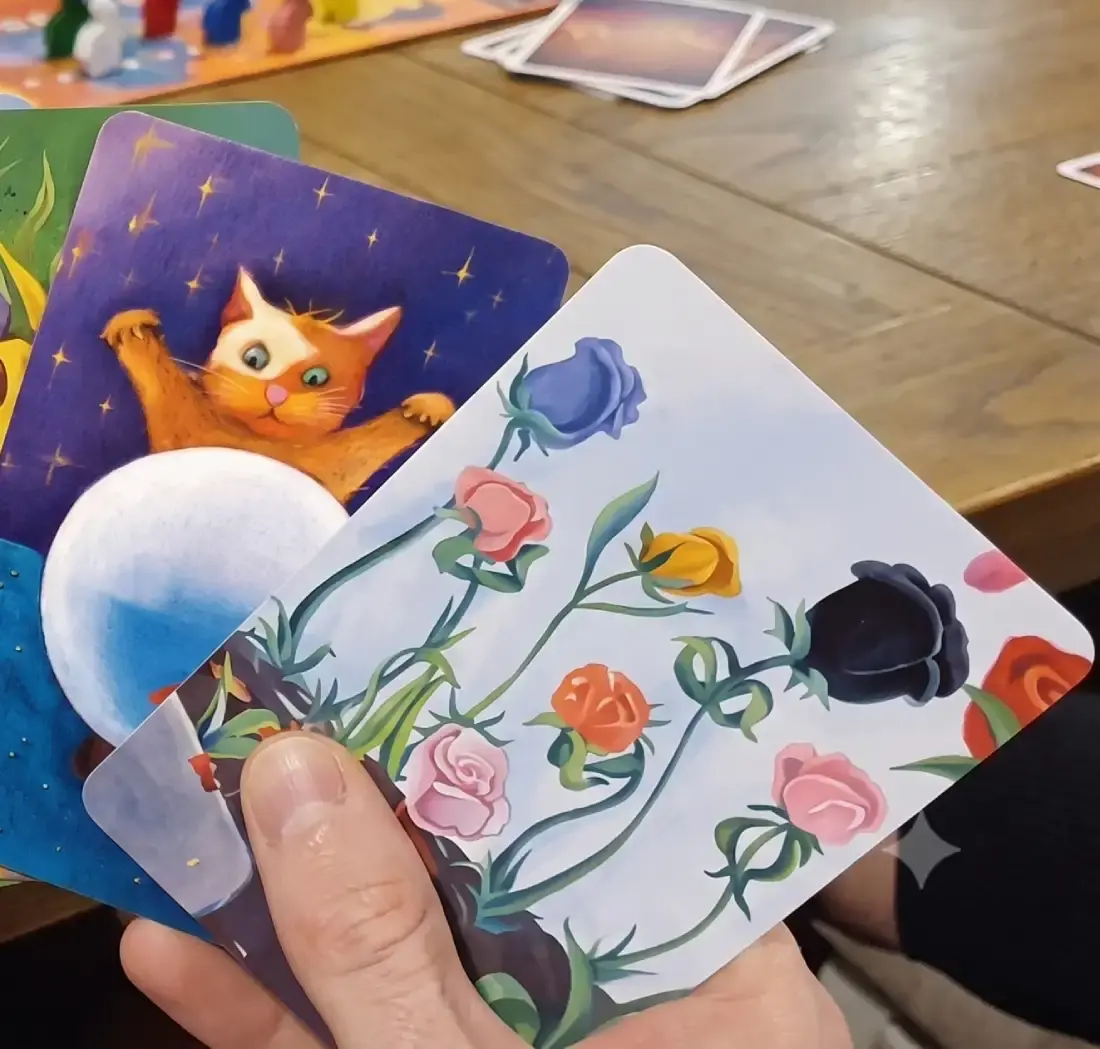
In Dixit you become a storyteller, but with a little help: you have the image, you just need a story. And when I say a story, not an entire story, a word, a sound, something that will help you fool some but not all of the players.
Some players find it hard to understand, so, just think about this:
You only need to fool someone else, that’s the entire game. Make one of the other players guess wrong, don’t overthink it.
What makes this game cool is that you get to see what is in your friend’s or family member’s mind when choosing cards. It’s one of the best family board games precisely because it hasn’t been dumbed down — it works on everyone at the table regardless of how many games they’ve played. You will have one turn where you pick a card for the others to guess and then you’ll be guessing the others’ cards. That’s it, this is Dixit.
Released in 2008 by French publisher Libellud, designed by Jean-Louis Roubira with illustrations by Marie Cardouat, Dixit went on to win the 2010 Spiel des Jahres (the Academy Award of board games, yes, it sounds nerdy, sorry), the hobby’s most important award.
It became one of the definitive gateway party games, simple enough to teach in two minutes yet open-ended enough that no two rounds play alike and a great opportunity for that friend who thinks is amazing at Tarot do her thing. More than 15 years and a long line of expansions later, it still earns its spot on the shelf.