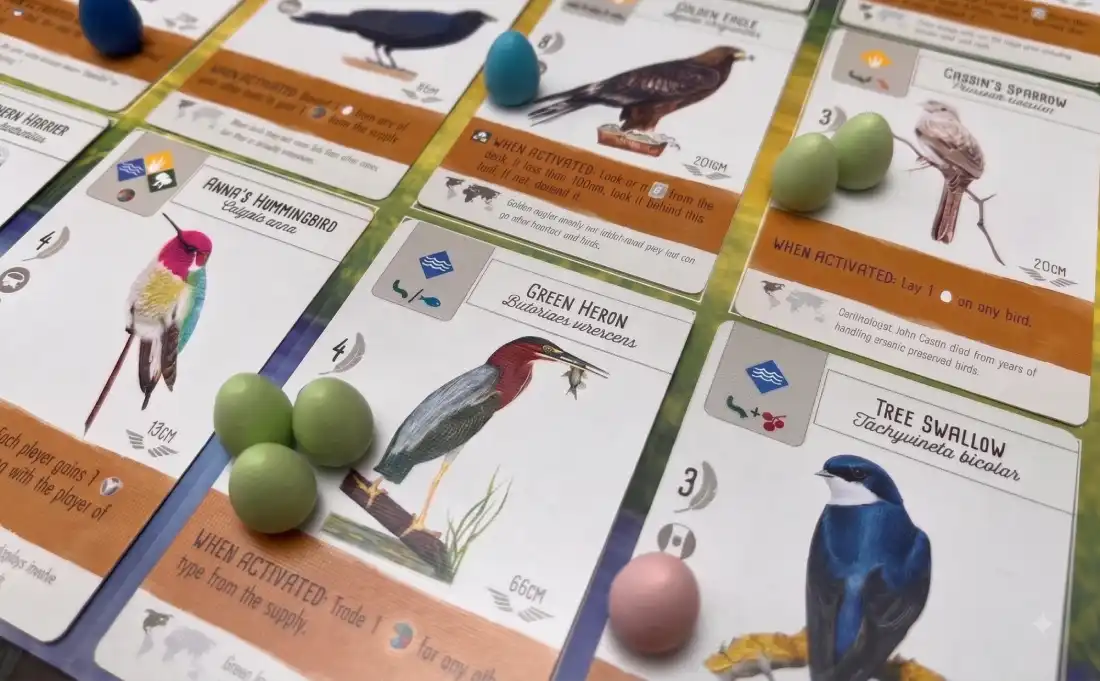
Most reviews stop at how the artwork looks, treating genuinely well-made pieces and a tense game like wallpaper, which is why a fuller, balanced take is worth your time first.
This review starts somewhere less flattering: eleven turns into my first game, I had a plan. A red-shouldered hawk on my tableau let me discard a card to draw two others whenever I played a bird, feeding a nest full of raptors I’d been slowly collecting.
I placed my cube for the draw, expecting something useful, going in confident. The tray coughed up a chickadee, a heron, and a duck. Nothing that fed the plan. I drew blind from the deck instead and got a card that didn’t fit either. That was the moment I understood what this game actually is underneath the birdsong and the watercolor art: a machine that hands you fewer and fewer tools to keep your birds fed, and never once offers a way to force better luck.
That’s the part the “relaxing bird game” reputation leaves out. Wingspan hands you eight cubes in round one and takes one away every round after, so by the end you’re making five decisions where you used to make eight, and your tableau has gotten expensive to run in the meantime. I love how unforgiving the math gets once you’re a few turns in. Every bird beyond the first in a row costs an egg on top of its usual price, which sounds like a minor detail until you’re staring at an empty egg supply with three grassland birds you can’t afford to place.
The best decision most rounds is the one you can’t afford to make. None of this is explained as a threat in the rulebook. It just quietly closes in on you, a little more each time, while the birds on the table keep looking prettier.
This is fundamentally about building, not luck; every choice strengthens or stalls what you’re building. That tension is also the answer to whether it’s fun, not just pretty. It is. But it’s fun the way a tight logistics puzzle is fun, not the way a chaotic party game is fun, and that distinction matters more than the box art suggests.
Solo, Two-Player, and the Full Table
Wingspan scales from one to five, and it holds up better across that range than most tableau games manage. Solo play runs against Automa, an AI opponent driven by its own bird deck, introduced with the Oceania expansion, and it’s a legitimate way to learn the engine before facing humans, not a watered-down afterthought. I still love watching new players hit that same wall I did. With two, the game tightens rather than loosens, since there’s less competition for the face-up bird tray, which ironically softens the “no way to refresh your options” problem. What playing at five feels like differs from playing at two. At four or five, competition for the cards gets real, and the birds you were counting on will occasionally vanish before you get to them. If you’re new to hobby games entirely, Wingspan is at its best in the middle of the table range, and it still scales down to a great, welcoming teach for someone new to rules explanations; if you’ve been doing this a while, the tightest, most interesting version of Wingspan is closer to two or three than a full table. It’s a great way in, and the challenge only sharpens from there.
The Expansions: What’s Actually Worth Adding
Stonemaier has released three expansions, and they’re not interchangeable. The European Expansion (2019) is the most conservative of the 3, more birds and more bonus cards in the same shape as the base, a safe pickup for more variety without changing how the game feels. Oceania (2020) is the one that matters most, since it introduced Automa for solo and cooperative play, plus a “duet” mode built specifically for two. If you’re only adding one expansion, it’s this one. Asia (2022) is built around a ruleset focused on two, raising tension between opponents instead of softening it, for people who already find the base too polite. None of the 3 are required to enjoy the core experience, just you and your birds. Wingspan’s expansions are worth it in that order, not as a package deal.
If Everdell or Lost Ruins of Arnak are familiar, and you liked the feeling of a tableau slowly clicking into place, Wingspan sits comfortably in that same family, just with a cleaner, more mathematical spine, closer to genre standards than most newer titles. It’s a good entry point into that whole strategy genre, and for a lot of people it’s the one that gets them hooked on the rest of it. Here’s the mechanical engine underneath all of that, the part most reviews skip, and the part this review actually cares about, written to hold up whether you’re new to the table or years into it.