Every July, a handful of German board game critics get together and announce a winner. And somewhere, a small publisher’s print run quietly triples overnight. That’s Spiel des Jahres in one sentence.
But the actual mechanics behind it are stranger, and honestly more interesting, than “board game Oscar,” which is the lazy comparison most outlets reach for when they don’t want to explain it properly.
The Short Answer
Spiel des Jahres is German for “game of the year.” It’s an annual award, founded back in 1978 by a small panel of board game critics and journalists in Germany. Here’s what it isn’t, though: it’s not a sales award, it’s not a public vote, and no publisher is buying their way onto that stage. A jury plays through hundreds of new releases every single year and picks one winner they think best represents what a great board game should be. No entry fee. No submission process a publisher can grease. Games get sent in, the jury plays them, and most of them just… lose.
Why It Isn’t a Popularity Contest
The jury’s stated criteria sound almost boring on paper: rules you can teach in a few minutes, a box that doesn’t lie about what’s inside, components that hold up to actual use, and a game that stays fun on repeat plays with people who aren’t hobbyists. That last part is the whole ballgame, honestly. Think about it this way: Spiel des Jahres has never been chasing the game with the deepest strategy or the most ambitious rulebook. It’s chasing the game a family can crack open on a Tuesday night without anyone needing to read sixteen pages first.
That’s earned the award a reputation among hardcore hobbyists as a bit soft, rewarding “gateway” games over anything with real teeth. And look, that reputation is mostly deserved. But it’s also kind of the entire point. The jury isn’t trying to crown the best game in the hobby. It’s trying to crown the best game to hand a total stranger.
Three Awards, Not One
Most people who’ve only half followed this know the big one. But there are actually three separate prizes handed out the same night, each judging a different weight class.
Award
Started
What It Rewards
Spiel des Jahres
1978
Family-weight games, easy to teach, broad appeal
Kennerspiel des Jahres
2011
Heavier “connoisseur” games with more strategic depth
Kinderspiel des Jahres
2001
Games built specifically for children
Kennerspiel got added because the jury kept running into excellent games that were just too complex to hand a non-gamer, and they wanted a way to recognize those without watering down what the main award stands for. Kinderspiel exists for the same reason at the other end. Games built around a six-year-old’s attention span, not an adult’s.
What Wins, and What Doesn’t
Look at the winners list across five decades and a pattern falls out fast. The award loves games that make an unlikely group of people feel briefly like they’re good at something together. Here’s what I mean: Catan, which took the prize in 1995 back when it was still called Die Siedler von Catan, is maybe the clearest example of what a win can do to a game’s trajectory. It went from a clever German trading game to a fixture in living rooms that had never bought a board game before. Dixit won in 2010 on the strength of being playable by people who’d swear up and down they’re bad at “creative” games. And Sky Team, the two-player cooperative flight-deck game I’ve reviewed and rated a 4.8 out of 5, took the win in 2024. Part of a run of cooperative titles the jury favored three years running, before this year’s ceremony finally broke the streak with a party game instead.
None of these are the most mechanically interesting games on a shelf full of hobbyist darlings. That’s not a knock, to be clear. It’s just a different job than the one a Kickstarter darling with forty custom miniatures is trying to do.
Why Winning Actually Matters
This is where the award stops being trivia and starts being commercially real. A Spiel des Jahres win can multiply a game’s sales tenfold or more in the months after the ceremony, largely because German retail treats the winner as the default gift recommendation heading into Christmas… which is the biggest sales window in the entire hobby. Toy stores that never stock hobbyist board games will carry the winner. That’s a kind of mainstream retail placement most publishers simply can’t buy, and it’s a big reason why every publisher in Germany is quietly hoping their game gets noticed by five people most of the public has never heard of.
I’m not going to pretend the award doesn’t have blind spots, either, because it does, and they’re worth naming instead of politely skipping over. It’s historically rewarded a fairly narrow, Eurocentric idea of what a “family game” looks like.
And the pool of designers it draws from has been overwhelmingly male for as long as anyone’s been tracking it. Neither fact makes the award meaningless. It just means it’s judging a specific, narrower question than “what’s the best game,” and that’s worth knowing before you treat the winner’s sticker on a box as gospel.
Three years running, the Spiel des Jahres jury handed the big trophy to a cooperative game. Dorfromantik, then Sky Team, then Bomb Busters. I’d started assuming co-op was just what won now, the way a genre calcifies once a few voters decide they like the shape of it. Then this year the jury picked a word association party game instead, and the streak is dead.
How JinxO Won Spiel des Jahres 2026
The winner is JinxO, designed by Martin Ang and published in Germany through Game Factory as Dito!. It beat out Corey Konieczka’s Cozy Stickerville and Markus Slawitscheck’s Morty Sorty Magic Shop, and it’s only the fourth word game to win the award in its 47-year history, after Barbarossa, Codenames, and Just One. That’s a short list, and it tells you something about how hard it is to make a party game the jury takes seriously instead of just enjoys at a table for twenty minutes and forgets by dinner.
Why JinxO Came Out of Indonesia, Not Germany
What actually matters here isn’t that a party game won. Party games have always been in the mix. It’s where this one came from. Ang is based in Indonesia, and until last year’s win for Hisashi Hayashi’s Bomb Busters, an Asian designer had never taken the Spiel des Jahres at all.
Ang was straightforward about the game’s roots at the ceremony: Indonesians love party games, and JinxO grew out of that, not out of trying to guess what a German jury wants. Association chairman Harald Schrapers called out the same gap on stage, that the jury has had nominees from Japan and New Zealand before but never a winner from what he termed the global south, and floated the idea that a game from Africa or South America might be next.
Worth noting in the same breath: the jury looked at a record 571 games this year, and 94% of them came from male designers. Just 2.3% came from women. That number was 2% last year and 2.6% the year before. Geography is opening up. The gender gap hasn’t moved.
Reiner Knizia’s Rebirth Wins Kennerspiel des Jahres 2026
The bigger personal story of the night belongs to Reiner Knizia, whose tile-laying game Rebirth won Kennerspiel des Jahres, the prize for heavier games. That win made him the first designer ever to complete the full set: Spiel des Jahres, Kennerspiel des Jahres, and Kinderspiel des Jahres, the last of which he picked up back in 2008 for the kids’ game Whoowasit? alongside a Spiel win that year for Keltis. Nobody else has all three.
Markus Slawitscheck came close to joining him this year too, having already won Kennerspiel for Challengers! in 2023 and Kinderspiel for Magic Keys in 2024, but Morty Sorty Magic Shop’s runner-up finish means Knizia keeps the record to himself for now.
Knizia’s acceptance speech ran long and was mostly about everyone except Knizia, which tracks for a designer who’s been doing this since before most of the current jury was born. He thanked his wife Margaret, then spent real time on his playtesting group in Munich, making the point that no amount of experience replaces actually running a design through real players over and over.
He also gave credit to Rebirth’s graphic designers and to Mighty Boards, the small Malta-based publisher that put out the original edition before Frosted Games brought it to Germany, a pairing he used to make a broader point about how localization now matters more than where a publisher happens to be headquartered. His closing line was aimed at anyone tempted to stop paying attention to the field once a winner’s announced: buy the other nominees, play them, and give the people behind them the same respect as the winners.
Kinderspiel des Jahres 2026 Goes to Mooki Island
The Kinderspiel des Jahres, the category for kids’ games, went to Florian Sirieix’s Mooki Island, ahead of his own co-design with Benoit Turpin, Boo Party, and a French-Canadian localization called Verflixt Verzaubert.
What a Spiel des Jahres Win Is Actually Worth
None of this is small money for the winners. Pegasus Spiele’s co-founder has said before that a Spiel des Jahres win can multiply a game’s sales tenfold or more heading into the German Christmas retail season, which is the single biggest commercial window in the hobby. Game Factory picked up its first Spiel des Jahres win with JinxO after eighteen years in business, on top of an existing Kinderspiel win for Magic Keys in 2024. That’s a real turning point for a publisher, not just a nice line for a press release.
What the Broken Streak Actually Tells You
If you’re wondering why the co-op streak ending is worth caring about beyond trivia, it’s because it says something about what the jury was rewarding those three years running, which wasn’t co-op as a genre so much as games that made a table full of strangers feel like a unit working toward one outcome. Sky Team, still one of the sharpest two-player co-ops on the market and a 4.8/5 in my own Skyteam review, did that with just two players and a cockpit. JinxO does something closer to the opposite: it’s a party game, built for a crowd, built to be loud. Different mechanism, same instinct from the jury to reward games engineered around a room, not a rulebook.
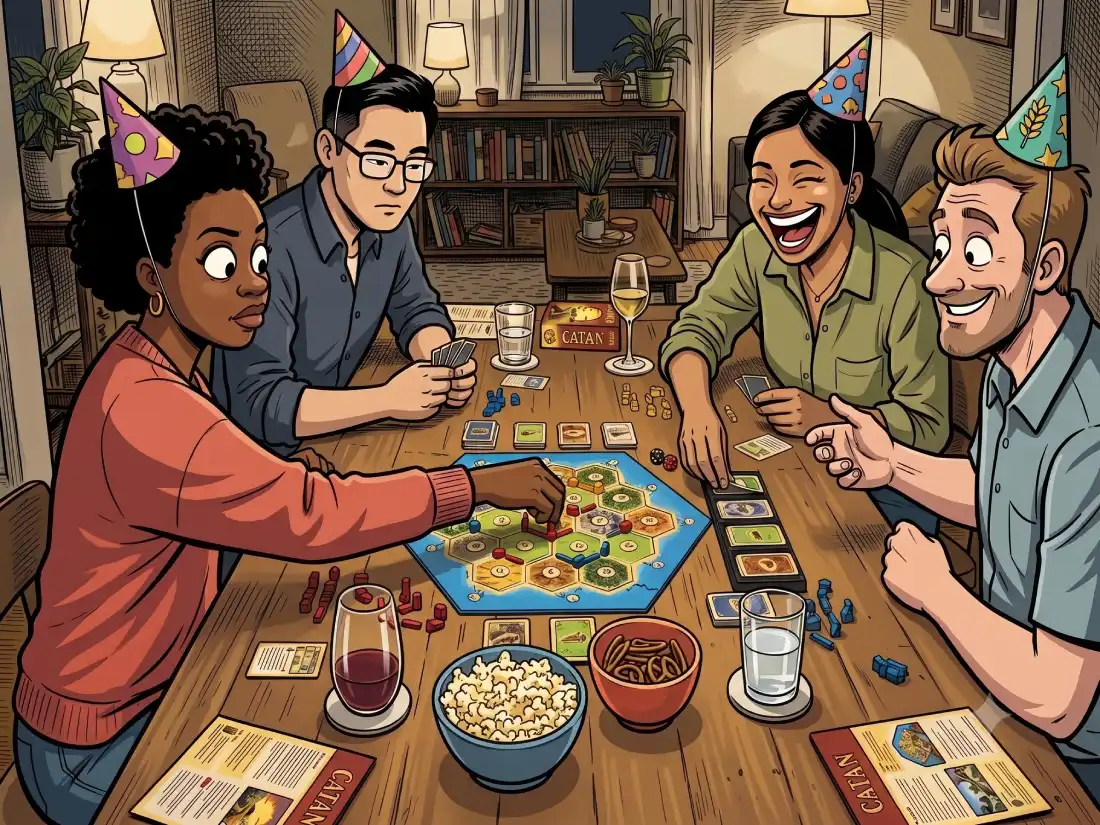
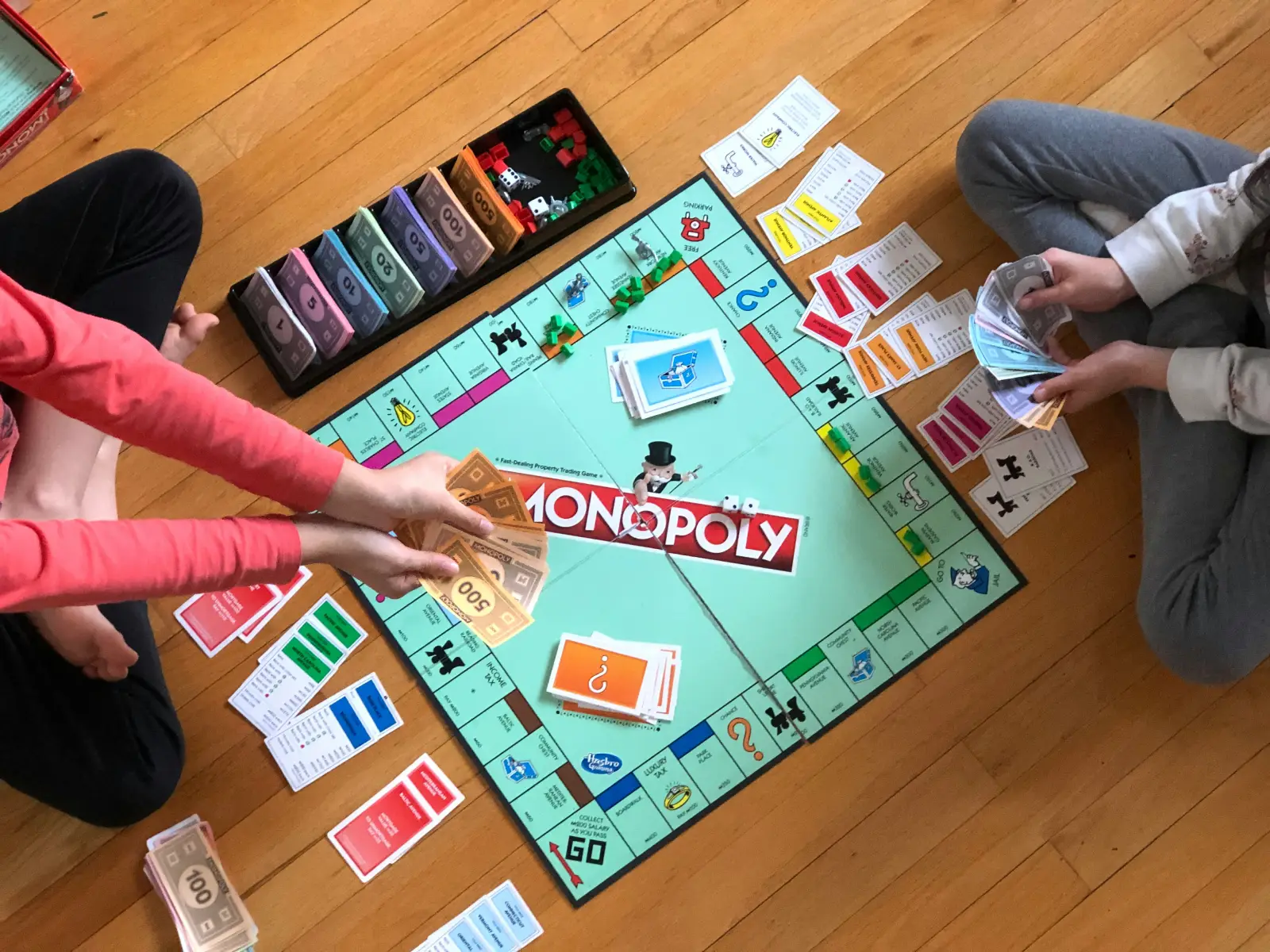
The base Catan box is built for 3 to 4 players, full stop, that’s what’s printed on the box and it’s also the honest answer once you’ve played it enough times to notice why. Go under that range and the game changes shape in ways most people don’t expect until they’ve tried it.
Go over it and you’re not playing Catan anymore unless you own the right add-on. Here’s what happens at every player count you might be considering, and which ones are worth the trouble.
The Official Range Is 3 to 4 Players
Every rule in the base rulebook, from harbor placement to the 19-hex board itself, is tuned around three or four settlers competing for the same handful of good intersections. The box only ships four sets of settlements, cities, and roads for exactly that reason, this game was never meant to seat a fifth person without help. Four is where it runs best, and it’s not a marginal difference.
Trading has enough participants that refusing someone costs you real options instead of just mildly inconveniencing them, the robber has enough targets that it functions as a genuine check on whoever’s ahead instead of a coin flip, and the board fills up at close to the right pace to make the late-game land grab feel tense instead of empty.
With four people fighting over roughly nineteen hexes, good spots run out fast, and that scarcity is where most of the game’s real tension lives.
Three works too, it’s a slightly quieter version of the same experience. You’ll have fewer trade partners and fewer grudges forming at once, and the board has a bit more breathing room since there’s one fewer set of settlements competing for the same intersections.
I still recommend three over two without hesitation, it’s a different tier of experience entirely even though it’s just one player short of the ideal count. The dynamics that make Catan worth playing, reading who’s willing to deal and who isn’t, are already present at three, just quieter than at four.
Two Players Is Technically Legal, Rarely Recommended
Nothing in the rulebook stops two people from sitting down and playing. It just isn’t the same game once you do. I’ve written before about why I don’t recommend Catan at two players, and the short version holds up every time I test it again, trading collapses into pure arithmetic when there’s only one other person to deal with, since you both know exactly what the other needs and neither of you has any reason to give it up.
The social pressure that makes four-player Catan interesting, the grudges, the reads, the quiet decision to freeze someone out for three turns because of something that happened last game night, simply has nowhere to live with just two people at the table. There’s no third party to read, no coalition to build or break, and no one to punish except the person sitting across from you, which makes every interaction feel personal in a way that isn’t more interesting, just more awkward.
The board still works mechanically at two players. Roads get built, cities go up, someone eventually hits ten points. It just stops feeling like Catan somewhere along the way, and starts feeling like two people doing parallel arithmetic on the same table, each one calculating exactly how much the other needs before deciding whether to help.
I’ve tried it more nights than I’d like to admit, usually when a third person cancelled last minute, and it’s never once produced the kind of tense trading standoff that makes a full table memorable. If you’re determined to play at two anyway, look at a dedicated 2-player variant built for that format rather than forcing the base game to do something it was never designed to do.
Five or Six Players Needs the Extension
If you want more people at the table, you need the official 5-6 Player Extension, not a house-ruled workaround using spare pieces from another copy. The extension adds extra terrain hexes, more number tokens, and additional roads and settlements for each new player, and it genuinely reshapes the board’s geometry, more coastline, more harbors, more usable intersections so a bigger group has anywhere to actually settle.
Trying to cram five or six players onto the standard 19-hex board without it produces a cramped, resource-starved mess where half the table can’t find a single legal spot by the third settlement round. The extension isn’t optional at this player count, it’s the only way the game holds together once you’re past four.
Budget your evening accordingly if you’re going this route. Setup takes noticeably longer with the extra pieces, turns take longer once six people are all fielding trade offers, and a full six-player game can easily run past two and a half hours once the negotiating gets serious.
It’s worth it for the right group, a bigger table means more simultaneous alliances and more chances for someone to get quietly ganged up on, but it’s a bigger commitment than a standard game night, plan for it rather than discovering it mid-session.
Buy the extension carefully, especially secondhand or from a third-party seller online. Catan has gone through enough print runs over the years that component sizes and even hex art have shifted between editions, and a mismatched extension can be more than a cosmetic annoyance.
My own base set is an older printing, and the extension I eventually bought for it has terrain hexes a couple of shades darker than the rest of my board, noticeable enough that a few people I play with genuinely can’t stand looking at the mismatch once it’s laid out.
Card and tile dimensions have also changed slightly between printings, so an extension bought without checking the edition can end up not fitting cleanly into the same box, or sitting oddly next to your existing pieces at the table. Check that you’re buying an extension matched to your specific edition before you click purchase, not just the one with the right name on the box.
One thing that trips people up: the base 5-6 Player Extension only covers the base game. If you also own Seafarers or Cities & Knights and want to play either of those at five or six players, you need that expansion’s own dedicated 5-6 extension, they’re sold separately and they aren’t interchangeable with the base extension’s pieces.
I’ve seen people buy the base extension, assume it covers everything on their shelf, and find out mid-setup that their Seafarers box still tops out at four.
Check which expansions you actually own before assuming one extension purchase covers your whole collection.
Player Count at a Glance
Players
✓ Best For
✗ Watch Out For
2
A quick fix when a third person cancels
Trading collapses into pure math, no real social tension
3
A solid backup when you’re one short
Quieter game, fewer trade partners and grudges
4
The count the whole game is designed around
Nothing, this is the target experience
5-6
Longer, louder, more chaotic in a good way
Requires the official extension, plus a separate one per expansion you own; turns and setup both take longer
The Best Player Count, If You’re Choosing
If you’re picking a number specifically to get the best version of the game, go with four. It’s not close. Three is a perfectly good backup when you’re short a player, the game just runs a touch flatter with fewer trade partners in the mix, still worth playing, just not the peak experience.
Five or six with the official extension is a genuinely great time for a bigger group, longer, louder, and more chaotic in the best way, but it asks for a full evening and a table big enough to actually fit the expanded board.
Two is the one player count I’d steer people away from outright unless you already own the base game and have no other option that particular night.
Catan was built around a crowd large enough to have real opinions about each other, form real alliances, and hold real grudges across turns. Every player count question on this game ultimately comes down to how much of that social friction you actually want in the room, and the honest answer is: as much as you can fit around the table.
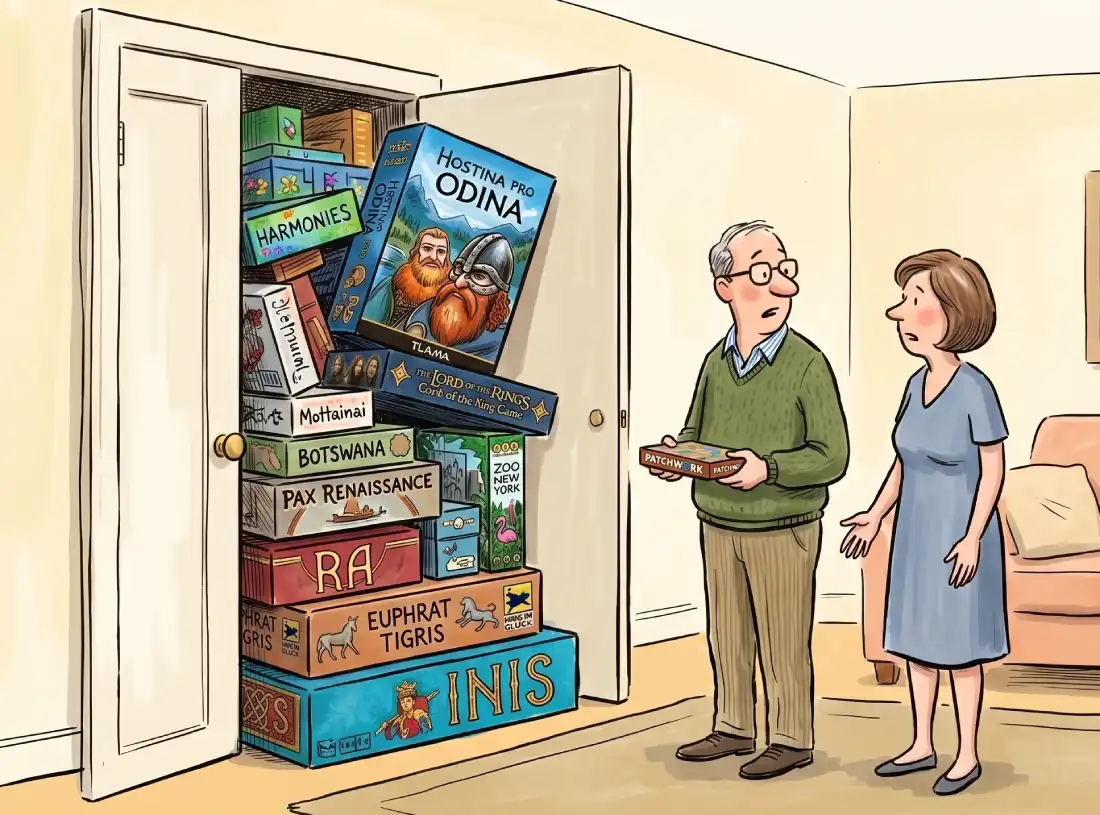
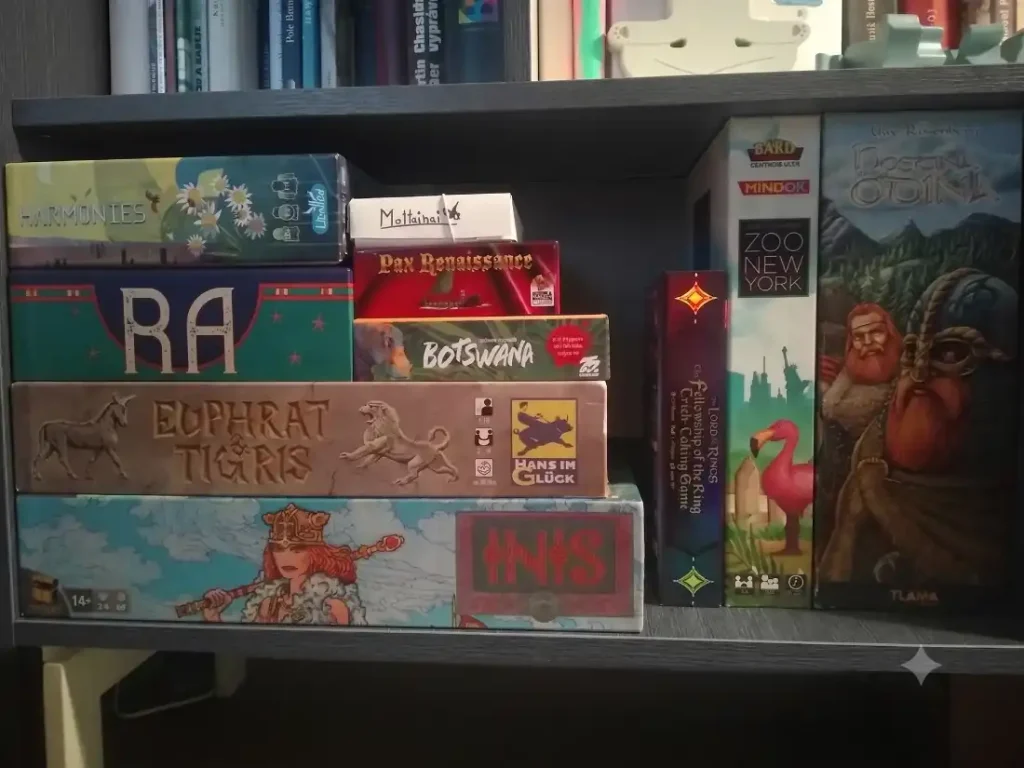
For nearly a decade, a board gamer’s social currency was measured in square footage. Towering wooden shelves, groaning under the weight of oversized, heavy crowdfunding “megaboxes” stuffed with plastic miniatures, were the ultimate badge of honor. On Instagram and Reddit, the “shelfie”—a proud photo of one’s massive, floor-to-ceiling cardboard library—reigned supreme as the hobby’s primary status symbol.
But a major shift is underway in both game design and how gamers think about board game storage. The era of the bloated, over-produced box is facing a serious industry-wide reckoning, making way for a movement enthusiasts are calling “The Death of the Shelfie.” Today’s market is rapidly transitioning toward high-density, low-footprint designs, and it’s forcing a lot of us to rethink how much shelf space this hobby actually deserves.
The Industry Facts: Why Tabletop Is Shrinking
This trend away from massive boxes isn’t just a matter of changing aesthetic tastes; it’s driven by hard economic, environmental, and logistical realities.
1. The Cost of “Wasted Air” and Giant Packaging
During the crowdfunding boom of the late 2010s, publishers competed in an “arms race” of physical scale. However, rising ocean freight rates and global shipping costs have made transporting oversized boxes incredibly expensive. Publishers pay for shipping by volume (cubic meters), meaning that shipping a giant box filled mostly with plastic vacuform inserts and empty air severely cuts into profit margins. Compressing box sizes is a survival strategy for modern publishers.
Even beloved, highly popular cooperative games like Ravensburger’s Horrified come in incredibly chunky, deep square boxes. While the game is fantastic, storing a box that massive—which is mostly holding a flat map board, a couple of plastic monster miniatures, and some cards—is becoming a luxury that players are actively pushing back against.
2. The Azul Problem and the Rise of “Mini” Editions
A perfect case study of this trend is Next Move Games’ abstract classic, Azul. The original Azul is famously a box filled almost entirely with empty space, meant only to store player boards and a bag of plastic tiles. It takes up a massive square chunk on any shelf.
Because of this physical footprint, the publisher was eventually forced to release Azul Mini. Designed specifically for portability, it shrinks the tiles down and introduces plastic overlay trays to keep the pieces from sliding around, packing the entire, brilliant strategy experience into a tiny, travel-friendly pouch.
3. Urban Real Estate Constraints
According to global housing data, average living spaces in major urban areas have shrunk over the past decade. For city dwellers, apartment renters, and younger gamers, dedicating an entire room or wall to host a few dozen massive board games is a physical luxury they simply cannot afford.
So What Do You Actually Do With the Board Game Storage You’ve Already Got?
This is the part nobody wants to talk about, because it means admitting you probably own too many big boxes. I went digging through a couple of the bigger r/boardgames storage threads to see what people actually do once the shelf runs out, and the honest answer is: they argue about it, constantly, and nobody fully agrees.
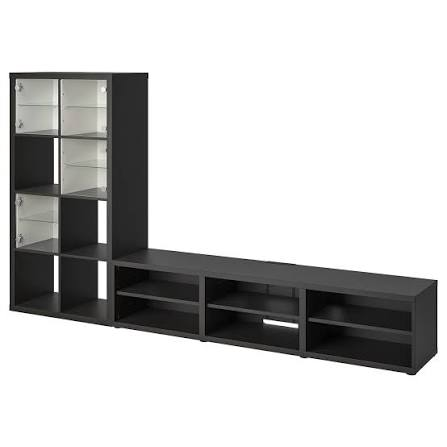
Kallax gets recommended so often it’s basically the default answer, and there’s a real reason for it—the cubes swallow most standard boxes without custom foam inserts. But plenty of longtime collectors push back hard.
One thread had a flat “BESTA > Kallax” reply that picked up real traction, and the case for it gets specific: Besta’s shelves are adjustable, which matters the moment your collection ranges from something Gloomhaven-sized down to something the size of Clever, because Kallax’s fixed cubes don’t flex for that spread—you either waste space around the small boxes or the big ones don’t fit at all.
Someone else did the actual math and argued Billy bookcases beat both of them on raw density, since you can set shelf height in roughly one-inch increments instead of eating dead space in a fixed cube—by their count, two Billy bookcases held about 120 games against roughly 100 for a stacked Kallax setup of comparable footprint, for less money.
Meanwhile a gamer with a wall of industrial wire shelving argued Kallax isn’t even attractive and is “a huge pain in the ass” to actually use compared to open shelving you can grab an armful off of (apparently Tom Vasel runs the same setup on camera).
There’s no consensus box here—just tradeoffs between density, looks, and how fast you can grab tonight’s game. And worth a gut check before you sink money into any of it: more than one person in these threads had already filled a wall of shelving and was back to stacking overflow on the floor. Shelving doesn’t solve a collection that’s still growing faster than your walls are.
The sharper argument is about what to do once the shelf is actually full. The most upvoted comment in one thread wasn’t a shelving hack at all—it was “being honest to myself about what will actually get played.” That’s the real fix, and it’s also the one nobody wants.
A blunter commenter put it less kindly, essentially arguing that needing storage hacks in the first place is a sign you own too many games and should just get rid of some. It’s harsh, but it’s not wrong, and it lines up with the “if it doesn’t fit on the shelf, something else has to go” rule a few people mentioned running in their own households.
Then there’s the fight over the boxes themselves. A genuinely contested tactic: gut the box entirely—repackage components into a folded organizer, fold the expansion into the base game’s box, and throw the original packaging away. One user shrank Abyss from three boxes to one this way.
It’s controversial for good reason (someone replied “hold on there, Satan”), and it comes with its own trap—once you own an organizer built for an expansion, you’re more likely to buy that expansion just because you now have somewhere to put it. If you go this route, the general rule that held up across threads was: keep an insert only if it actually speeds up setup, not because it came in the box.
Worth noting if you’re an OP trying the ziplock-bag route: multiple commenters flagged that bags of loose components often take up more room than a well-fitted small box, not less, because the bags balloon with trapped air. If you’re going to bag components anyway, snip a corner of each bag to let the air out before you seal it. And if you store anything vertically for long stretches, keep an eye on board warping—it’s a real complaint, not a theoretical one.
The games worth keeping in bulky form are the ones where the box size does something—chunky insert trays that make setup faster, or minis you genuinely display. Everything else is a candidate for downsizing, repackaging, or replacing outright with a compact edition when the publisher offers one.
Comparing the Eras: Megabox vs. Compact
To see just how drastically the physical profile of a tabletop game has changed, look at the specifications of the two eras side-by-side:
Feature
The Crowdfunded “Megabox” Era
The Modern “Compact” Era
Physical Weight
$3.6\text{ kg}$ to $6.8\text{ kg}$ ($8\text{ lbs}$ to $15\text{ lbs}$)
$0.4\text{ kg}$ to $1.3\text{ kg}$ ($1\text{ lb}$ to $3\text{ lbs}$)
Setup & Teardown
$20$ to $45\text{ minutes}$ of sorting components
$5$ to $10\text{ minutes}$ max
Portability
Requires a dedicated, reinforced duffel bag
Slips easily into a standard backpack or purse
Storage Impact
Occupies a full shelf cube per 1-2 games
Stackable, fits in drawers or compact cupboards
Average Price
$100$ to $200+$ USD
$20$ to $50$ USD
My Take: Why My Back (and Baggage Allowance) Is Glad It’s Over
Now, if you’ll let me step away from the industry data for a second and speak as a gamer with a very cozy, modest flat: thank goodness this downsizing is happening.
I don’t have a dedicated “board game room,” and I definitely don’t want my living room looking like a commercial warehouse. For me, the death of the shelfie has saved my social life and my travel sanity.
We have all experienced “The Backpack Burden.” A friend calls you on a Friday night and says, “Hey, bring over a couple of games!” Instantly, your shoulders start to ache. If you want to bring something like Horrified or original Azul, you have to commit to lugging a heavy, specialized, heavily padded backpack that makes you look like a pack mule hiking Mount Everest.
And don’t even get me started on traveling.
If I want to jump on a Ryanair flight to go visit my parents or my significant other for the weekend, packing a standard big-box game is flat-out impossible. Ryanair’s free small personal bag is strictly capped at a tiny $40 \times 30 \times 20\text{ cm}$ ($16 \times 12 \times 8\text{ in}$).
If you try to slip just one classic box in your bag, it physically hogs the entire space. You are left making a tragic life decision: do I bring this one game, or do I bring clean underwear, a toothbrush, and a spare t-shirt?
Even if you pay to upgrade to a cabin bag, you are still restricted to a $10\text{ kg}$ ($22\text{ lbs}$) weight limit. A couple of chunky boxes will easily blow past that limit before you’ve even packed a single sock!
This is exactly why travel board games and travel-size board games have quietly become their own category worth paying attention to, rather than an afterthought tacked onto a “best of” list. With the rise of modern, ultra-compact designs, I can slip Azul Mini and two or three other highly strategic travel-size board games into a tiny handbag or the front pocket of a backpack. I can fly across the continent, sit down at a pub table with my family, and have an incredible, deep gaming experience without paying a single extra baggage fee.
I’ll admit the habit that got me into this piece in the first place: whenever the shelf situation gets bad, I end up scrolling r/boardgames at midnight looking for a solution, half-convinced someone out there has finally cracked the code.
It’s the same instinct as browsing gear reviews for a hobby you already have all the gear for—you’re not really shopping, you’re just hoping the “next best thing” exists and will make the problem disappear without you having to get rid of anything.
It never does. Every thread just turns into the same argument between Kallax loyalists and Besta converts, and I come away with three new bookmarked shelving systems and the same 50 games I started with.
And here’s the part I have to be honest about, because it undercuts my own argument a little: those big boxes are genuinely cool. That’s the actual dilemma, not some fake both-sides framing. There’s a real reason people build shelfies in the first place—chunky minis, oversized boards with real production value, an insert that makes a game feel like an event before you’ve placed a single piece.
Nobody builds a wall of Kallax cubes to hold something they don’t love looking at. The downsizing trend isn’t a rejection of that feeling; it’s an admission that most of us can’t actually afford the square footage it demands, however good it looks on a shelf.
I’m about to find that out the hard way. My significant other lives in a 32-square-meter flat in Paris, and we’re talking about moving in together, which means my roughly 50-game collection is about to collide with roughly 344 square feet of shared space that also needs to fit a bed, a kitchen, and two humans. There’s no Kallax wall in that math.
So here’s my actual plan, not a hypothetical: the megaboxes get the hardest look first, because they’re the ones eating the most volume for the least frequent use, and if I haven’t played something in the last year it’s the first thing to get sold rather than moved. Whatever survives the cull gets consolidated—expansions folded into base game boxes where they’ll fit, no duplicate packaging kept “just in case.”
And the collection that actually makes the move leans hard into the compact and travel-size end of this whole piece: games like Azul Mini aren’t a compromise in a 32-square-meter flat, they’re the only realistic way to keep the hobby at all. It’s a smaller collection than I’d like. It’s also one that will actually fit in the apartment instead of living in a storage unit I’m paying for out of sentimentality.
Ultimately, stripping away the physical bloat is making the tabletop hobby feel human again. We are finally prioritizing the dynamic, shared experience on the table over the dusty, heavy cardboard box on the shelf. And it turns out, the best things really do come in small packages.
Another Horrified Expansion? Ok, everything looks convincing but, is it worth it?
The monster lineup is legitimately good. You get Strahd Von Zarovich, Baba Lysaga in her walking hut, the Gulthias Tree, and a Carrionette — that last one being the unsettling puppet-like figure Ravensburger teased back in January and the thing that made half the internet briefly lose their minds. Each gets its own miniature. Five new playable characters come in the box alongside them. The expansion requires the base Horrified: D&D game to play.
The Case For It
The original Horrified: D&D launched in August 2025 set in Undermountain, with a Beholder, Mimic, Displacer Beast, and Red Dragon. That’s a perfectly solid monster roster, but Undermountain has never been Ravensburger’s richest thematic territory. Ravenloft is a different situation.
The Domains of Dread are built entirely around gothic horror, which is where the Horrified formula — cooperative monster management, item collection, escalating dread — fits most naturally. Strahd is one of D&D’s most iconic antagonists for a reason.
Baba Lysaga’s walking hut adds the kind of visual spectacle that makes the miniature worthwhile on the shelf alone. Timing is deliberate too: the D&D Season of Horror initiative runs April through June 2026, and a July release puts the expansion in stores just as that wave of interest crests into summer.
The Case Against It
The base game shipped with four monsters. Universal Monsters shipped with six (seven minis if you count the Bride separately). That gap matters more than it sounds because monster pairing is where Horrified’s replayability actually lives.
With four monsters in Undermountain, the community quickly discovered the viable two-monster combinations collapse fast: Mimic and Displacer Beast is too easy, Beholder and Red Dragon is punishing to the point of feeling broken, which leaves Displacer, Mimic, and Beholder as the only sensible three-monster game. The expansion adds four more monsters, which should finally open that combination space up — but it took a $30 add-on to get there.
There’s also the design lineage issue. Universal Monsters was designed by Prospero Hall. Everything after had a new team, and the community has noticed. The sequels understand what makes Horrified work well enough to produce competent games, but not well enough to avoid the fiddliness that crept into later monster mechanics. Ravenloft won’t change who designed the engine.
Whether the Ravenloft monster defeat conditions are more elegantly constructed than the Red Dragon’s — which players consistently describe as overwhelming — is the actual question this expansion needs to answer.
The D20 ability mechanic remains divisive too. Some players like the unpredictability. Others call it a light dusting of D&D theme over what is still fundamentally a Horrified game, and they’re not wrong.
Cross-game mixing with other Horrified titles is technically supported but practically cumbersome: icon mismatches, shared card decks that don’t account for theme, and enough workarounds that most players don’t bother. Strahd on the Universal Monsters board is a headache, not a feature.
If you bounced off the base D&D game because it felt thin, four new Ravenloft monsters probably fixes the combination problem. It doesn’t fix the engine.
Worth Buying?
The monster selection is the best thematic fit the Horrified franchise has found for the D&D license, and four new monsters should finally crack open the combination problem that made the base box feel claustrophobic. The BGG community was already building fan-made monsters to compensate for the original’s thin roster — which tells you everything about the demand. Ravenloft addresses that directly.
What it won’t fix is where the design stands relative to Universal Monsters. That gap is real, it’s been consistent across every sequel, and it’s not something a Ravenloft coat of paint resolves.
If this is your first Horrified game, start with Universal. If you already own D&D Undermountain and want a reason to table it again, this is exactly that reason. Early play reports aren’t in yet, but the bones are better than the base box gave us to work with.
Stonemaier Games dropped its May update and buried the lead a little: Finspan is getting an expansion, and by the sound of it, this is the one the base game has been quietly waiting for.
Finspan: Sharks & Reefs adds 75 new cards built around two new systems sharks and coral reefs and both of them sound like they’re doing real mechanical work rather than just padding the card pool.
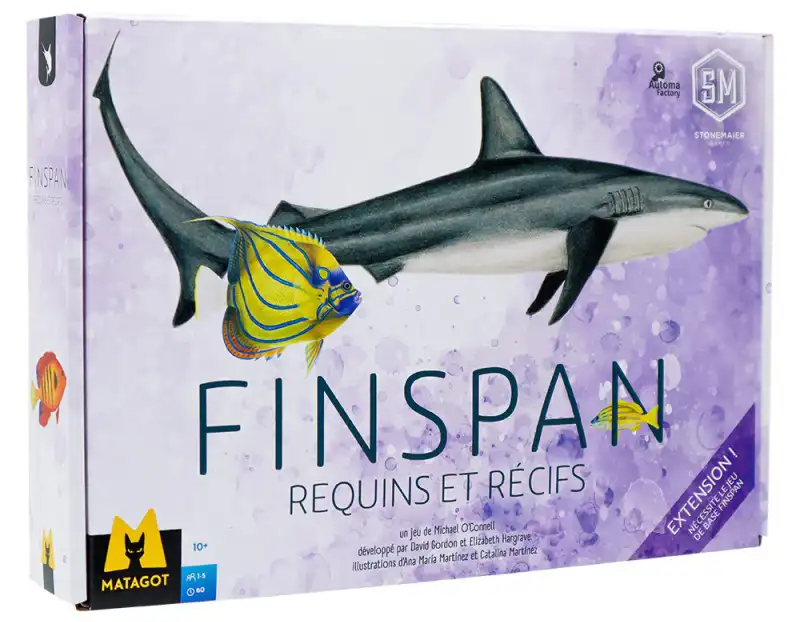
French version of the game, shark on the box, of course.
What the Expansion Actually Adds
The reef system is the bigger change. Each player’s ocean mat gets a new overlay with three dive sites, and you can now nurture coral reefs across all three. Building a reef costs something an egg, a young, or a card depending on the area but each reef token scores a point, and completing a reef unlocks bonus points on top of that. Fill all three rows across all three reefs and you’re looking at a potential 37 points from the reef system alone, which is not a small number in a Finspan game.
The sharks work differently. Instead of sitting static in your ocean, they scatter schools of young to form new schools elsewhere and leave behind food scraps that any fish in your ocean can consume. It’s a ripple effect built into the card, which is a clever way to make predators feel predatory without blowing up the game’s pacing.
On top of that, there are new fish that specifically love reefs, new iconography for weekly goals, and new fish actions scattering a school to generate four young in one move being one of the more eyebrow-raising examples.
Stonemaier’s Post-Wingspan Tightrope
It’s worth remembering where Stonemaier stands right now. Wingspan was a phenomenon, a game that crossed over from hobby shops into mainstream retail and introduced an enormous number of people to modern board gaming. That’s a difficult act to follow, and the attempts have been mixed. Wyrmspan, the dragon-themed spiritual successor, arrived with enormous expectations and left a lot of players cold.
It wasn’t a bad game, but it felt like Wingspan with dragons swapped in for birds, chasing the same magic without enough new ideas to justify the box. Finspan fared better the underwater setting gave it a distinct identity but the lighter weight kept it in Wingspan’s shadow for players who wanted the full experience.
Sharks & Reefs is the first release in this run that sounds like it’s genuinely solving a problem rather than creating a new product. That matters.
Should You Buy Finspan: Sharks & Reefs?
Finspan has always had a reputation problem with one specific group: players who love Wingspan and find Finspan a touch thin by comparison. The engine is elegant, the turn structure is clean, but the weight sits noticeably lower than its bird-based sibling. That’s not a flaw exactly it’s a design choice but it does mean Finspan sometimes gets shelved in favour of the heavier experience.
Sharks & Reefs looks like a direct answer to that. The reef overlay adds a parallel scoring system that demands real decisions about resource allocation.
Do you spend that egg on a new fish or commit it to a reef? That’s the same kind of opportunity cost that makes Wingspan sing, and if it lands the way the early BGG reactions suggest, Finspan stops feeling like the lighter alternative and starts feeling like its own complete thing.
The Wingspan Oceania comparison is already circulating in the community, and it’s apt. Oceania didn’t just add cards it added Nectar as a resource and rebalanced how the entire game felt. Sharks & Reefs sounds like it’s swinging for the same target: not more of the same, but a genuine upgrade to the experience that makes going back to the base game feel incomplete.
What We Know So Far
The expansion requires the Finspan core game to play. Beyond that, Stonemaier hasn’t announced a wide retail release date yet, so check their site and the BGG page for availability as it comes. If you’re already a Finspan player who has wanted a bit more to chew on, this one looks worth watching closely.
Early word from players who have gotten hands on it is strong enthusiastic, even. The kind of strong where people say they’ll never go back to the base game alone. That’s a good sign. It’s also exactly what Stonemaier needed Finspan’s expansion to be.
There was a time when the tabletop gaming industry was tightly controlled by an elite group of traditional publishers. If a designer had a brilliant, quirky, or avant-garde game concept, they had to pitch it to executives, navigate corporate gatekeeping, and hope a company was willing to risk millions of dollars on printing and distribution.
Then came Kickstarter.
The crowdfunding revolution completely decentralized the industry, turning everyday gamers into venture capitalists. It allowed weird, niche, and highly ambitious designs to bypass the traditional pipeline and go straight to the people who would actually play them. While thousands of projects have launched on the platform, a select few didn’t just meet their funding goals—they exploded into massive international phenomena, forever changing the landscape of modern board gaming.
Here is a deep-dive look at three legendary Kickstarter campaigns that turned indie dreams into global tabletop empires.
1. Exploding Kittens: The Viral Masterclass in Strategic Simplicity
In 2015, a project hit Kickstarter with a deceptively simple premise: it was essentially Russian Roulette, but with weaponized, hyperactive felines. Created by Elan Lee, Shane Small, and Matthew Inman (the creative mind behind the wildly popular webcomic The Oatmeal), Exploding Kittens became an instant masterclass in how to leverage internet culture and viral marketing into crowdfunding gold.
Campaign Metric
Exploding Kittens Statistics
Initial Funding Goal
$10,000
Total Amount Raised
$8,782,571
Total Backers
219,382 backers
The Secret to Its Massive Success
The campaign reached its modest $10,000 goal in just eight minutes. By the time the campaign closed, it had shattered records to become the most-backed Kickstarter project in history at the time.
The secret was accessibility wrapped in relatable, internet-friendly humor. While hardcore gamers were busy backing complex miniatures games, Exploding Kittens targeted the casual market. It was a fast-paced party game that anyone could learn in two minutes, but it possessed just enough take-that strategy—using Defuse cards, See the Future cards, and forced phase skips—to keep people coming back.
Today, Exploding Kittens is a household name, lining the shelves of major retail giants globally, and has spun off into an entire ecosystem of expansions, mobile apps, and merchandise.
The video that changed it all
2. Gloomhaven: Dismantling the Traditional Retail Paradigm
If Exploding Kittens captured the casual party crowd, Isaac Childres’ Gloomhaven did the exact opposite: it took the hardcore, dedicated euro-gaming community by absolute storm. Launched in 2015 with a modest initial print run, this massive, twenty-pound box of dark fantasy dungeon-crawling redefined what players expected from a campaign-driven legacy game.
Campaign Metric
Gloomhaven (First & Second Print)
Initial Funding Goal
$70,000
Total Combined Raised
Over $4.3 Million (Across Print Runs)
BoardGameGeek Rank
#1 Rated Game (2017–2022)
The Secret to Its Massive Success
Traditional publishers would have looked at Gloomhaven and scoffed at the production costs. The game featured nearly 100 scenarios, dozens of unlockable character classes hidden inside sealed tuckboxes, and a deeply tactical, card-driven combat system that completely eliminated the randomness of dice rolling. It was an enormous financial risk.
But Childres utilized Kickstarter to prove the market existed. The first print run earned a passionate cult following. Word-of-mouth spread across the internet like wildfire, praising the game’s staggering depth and mechanical brilliance. When the second printing hit Kickstarter in 2017, it raised a staggering $3.9 million from over 40,000 backers who were desperate to get their hands on the elusive behemoth.
Gloomhaven went on to spend years unseated as the number-one ranked board game on BoardGameGeek, spawning the accessible prequel Jaws of the Lion, a critically acclaimed digital adaptation, and the massive sequel Frosthaven.
3. Frosthaven: The Pinnacle of Crowdfunding Excess
You cannot talk about Kickstarter success stories without looking at the spiritual successor to the previous entry. In 2020, Isaac Childres returned to the crowdfunding well with Frosthaven, a standalone campaign set in the same universe but featuring an entirely new narrative, refined mechanics, and an intricate town-building system.
The resulting campaign didn’t just succeed; it completely re-wrote the record books for what a tabletop project could achieve.
Campaign Metric
Frosthaven Campaign Statistics
Initial Funding Goal
$500,000
Total Amount Raised
$12,969,608
Total Backers
83,739 backers
The Secret to Its Massive Success
Frosthaven benefited from a perfect storm of community goodwill, premium brand authority, and a captive global audience looking for immersive, long-form entertainment at home. The campaign generated millions of dollars within its first few hours, ultimately cementing itself as the highest-funded tabletop game in Kickstarter history.
By treating backers as part of the developmental journey—providing detailed production updates, revealing stretch goals that directly enhanced the component quality, and offering exclusive modular add-ons—Cephalofair Games demonstrated the absolute peak of community-driven design. It proved definitively that dedicated hobbyists are more than willing to pay premium prices upfront for a guaranteed piece of cultural tabletop history.
The Ultimate Crowdfunding Legacy
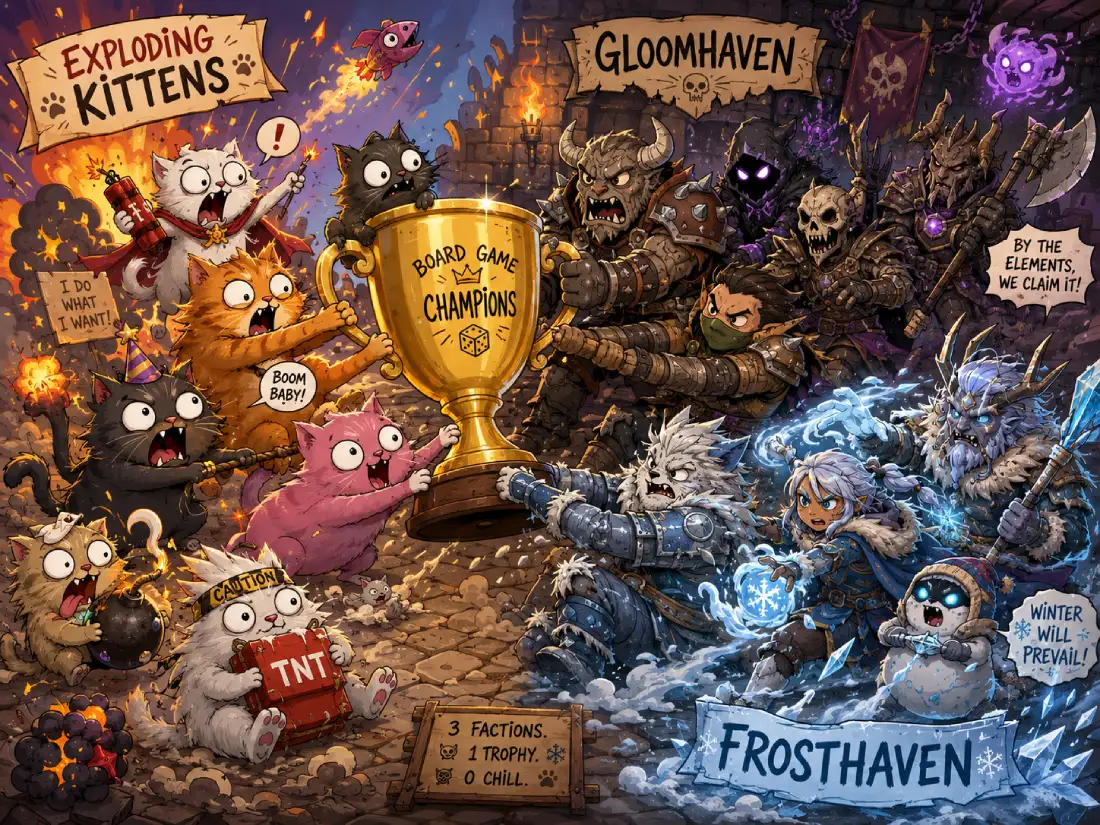
The jaw-dropping success of projects like Exploding Kittens, Gloomhaven, and Frosthaven completely changed the power dynamics of the board game industry. They proved that with the right hook, an authentic relationship with the community, and airtight mechanical design, indie creators can build global franchises right from their living rooms.
The next time you open a massive, component-heavy box or slide a quirky party game across the table on game night, take a close look at the box lid. There’s a very high chance you are looking at a game that wouldn’t even exist without the collective backing of thousands of passionate strangers on the internet.
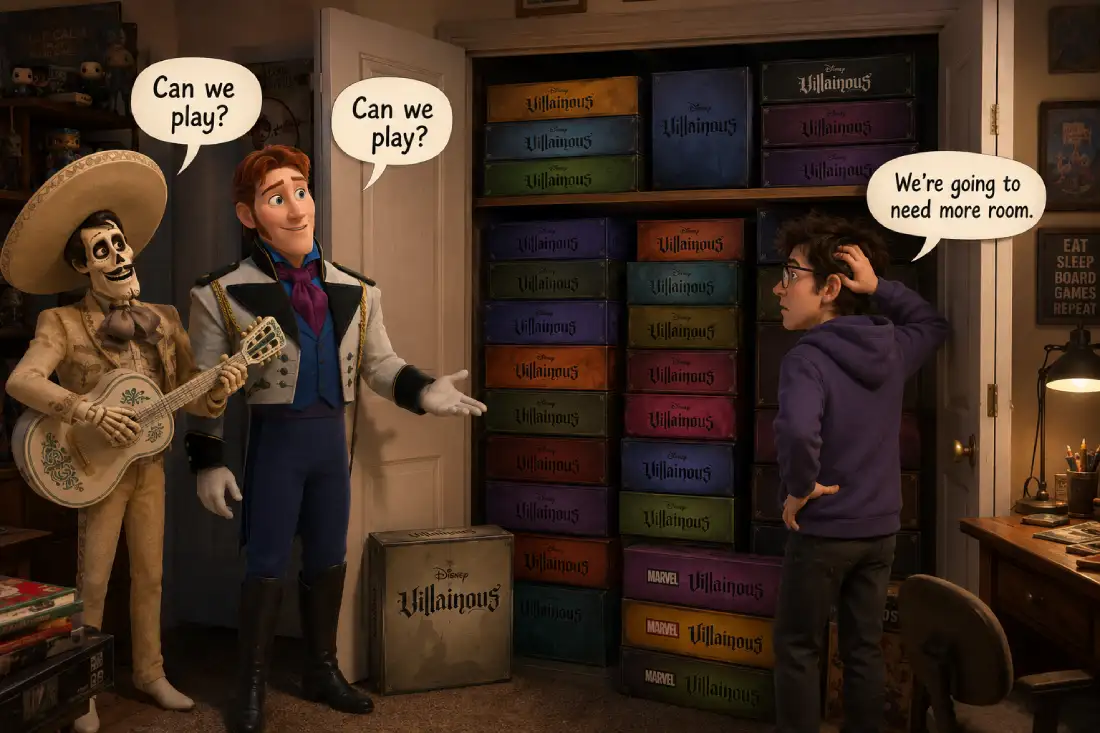
Let’s be entirely honest with ourselves for a moment. We need to talk about the hyper-inflated, box-bloated shelf space that is the Disney Villainous franchise. Yes, we got excited when the first expansion came out. I remember the days when I joined a Villainous Reddit board to speculate which other villains would be amazing to play with, but now, years later, it’s starting to get old.
Ravensburger just announced its latest lineup, headlined by the upcoming July release of Success at Any Cost, bringing Prince Hans and Ernesto de la Cruz to the table. And later this year? They are conjuring Come, We Fly! to add the Sanderson Sisters from Hocus Pocus.
Don’t get me wrong—the game is a mechanical masterpiece of asymmetrical strategy, and the Target-exclusive papel picado packaging is gorgeous eye candy. Papel picado rocks! But look at what is actually happening to our game nights. We have crossed into a territory of utter expansion exhaustion.
We started with a beautiful, self-contained green box. Now, if you want a complete roster, you need a literal storage unit. We have gone through Wicked to the Core, Evil Comes Prepared, Perfectly Wretched, Despicable Plots, Bigger and Badder, Sugar and Spite, Treacherous Tides, single-character impulse buys like Filled with Fright, and streamlined reboots like Introduction to Evil and Unstoppable!.
We aren’t just collecting a board game anymore; we are funding a real estate empire for tiny plastic movers.
Disney Villainous Roster Bloat: The Problem with the 2-Player “Expandalone” Meta
The most frustrating shift in the modern Villainous ecosystem is the death of the classic 3-character expansion format. Ravensburger has fundamentally altered the deal, pivoting hard into the 2-player “expandalone” box model.
While it lowers the barrier to entry for casual duels out of the box, it hits long-time fans right in the wallet. You are paying practically the same premium retail price, but getting 33% less content per box. By shrinking the rosters down to pairings like Hans and Ernesto, or King Candy and Shere Khan in Sugar and Spite, the competitive meta is getting chopped up into tiny, commercialized fragments.
If you want to host a chaotic, epic 4-to-6-player board game night, you are forced to buy multiple fractured boxes, smash them together, and figure out how to elegantly store an absolute mountain of individual cauldron tokens, power supplies, and separate fate decks.
Modern Disney Villainous Expansion Checklist: The Endless Release Timeline
If you are a completionist trying to maintain a cohesive collection without losing your mind, keeping up with Ravensburger’s production schedule has become a full-time job.
Expansion Title
Format Type
The Community Rant Verdict
Treacherous Tides
2-Character Box
Introduced live-action with Davy Jones. Brilliant, but signaled the absolute death of 3-character sets.
Unstoppable!
Standalone Variant
A streamlined, faster version nobody asked for that just clogged up retail shelves.
Success at Any Cost
2-Character Box
Launching July 2026. Hans and Ernesto are great, but the $29.99 entry point for two movers hurts.
Come, We Fly!
Hocus Pocus Box
Arriving Autumn 2026. Splitting three sisters into one playable slot is mechanical madness.
Are We Buying Success at Any Cost in July?
Look, let’s be entirely realistic. Elizabeth Hargrave gave birdwatchers an amazing sandbox with Wingspan, and Ravensburger did the exact same thing here for Disney fans. The core engine of Villainous—moving to a location, executing actions, and strategically discarding cards—remains one of the tightest tabletop experiences available.
But the continuous release model is testing consumer patience. When Success at Any Cost drops on July 5th, I will be standing in line at Target to grab the special edition box with the fancy finish on Ernesto’s mover. I will complain the entire time, my wallet will weep, and I will have to completely rearrange my game closet just to squeeze it in—but I will buy it.
Ravensburger knows they have us hooked. We just need them to slow down the release train before the sheer weight of our board game boxes causes our shelves to collapse entirely.
Let’s be entirely honest with ourselves for a moment. We need to talk about the massive, featherless elephant in the birdwatching room, or if you want, picture an elephant with tiny wings, that is also cool. Stonemaier Games recently updated their product roadmap, and once again, the African continent has been completely, inexplicably left out.
Instead of giving us the Maasai Mara, the Congo basin, or the rich wetlands of the Okavango Delta, what did we get? We got the Americas Expansion, which, I know, America is an amazing nature filled continent, we got the hummingbird, and hummingbirds rock, credit where credit is due, the expansion is fantastic. The hummingbird overlay track is an amazing mechanical twist, and the card art is gorgeous like always.
But that’s not the point, it wouldn’t be a rant if this were the point. But when they released the calendar, I found an expansion for Finspan, really? Finspan? We are literally getting a standalone game about sharks, coral reefs, and marine biology before we get a single African avian species. And please, let’s not argue if sharks are cooler than birds, because, yes, they probably are, but can sharks fly? Can you imagine sharks flying? Ok, getting off topic.
We are getting literal fish before we get the most mechanically rich, aesthetically striking, and historically significant bird continent on the planet.
According to the official Stonemaier pipeline tracker, Wingspan Expansion 5 is listed as “in the design and art phase” with an unannounced launch date. We all know what that means in board game publishing lingo: Africa is being held hostage until at least late next year, if not further out. Not cool, Stonemaier, not cool.
Wingspan Africa Expansion Gameplay: New Board Game Mechanics We Desperately Need
The most frustrating part of this delay isn’t just that we want pretty new cards to look at (but also yeah), it’s that the African ecosystem offers a goldmine of mechanical innovation that Wingspan desperately needs to keep the engine-building genre fresh and fun. Every previous expansion brought a distinct structural shift to the table: Europe introduced end-of-round powers, Oceania revolutionized the economy with nectar and flightless bird bonuses, Asia gave us the brilliant Duet mode for couple play, and the Americas introduced the hummingbird infrastructure, already mentioned but, you can never have enough hummingbird mentions. That is a bird fact.
Africa has the potential to introduce mechanics that could fundamentally redefine how we interact with the board and each other. Here is what Stonemaier is leaving on the table while they design fish cards:
1. Mega-Eggs and Communal Nesting
Africa is home to extreme avian architecture and biology. Consider the Social Weaver. These tiny birds build massive, multi-generational communal nests that look like giant haystacks dropping out of acacia trees. They house hundreds of birds at once, like those apartment buildings in Hong Kong.
In Wingspan, this could easily translate to a Communal Nest Overlay. Imagine playing a Weaver card that allows you to tuck other birds underneath it to expand its nest capacity, or a mechanic where adjacent cards in a habitat can share egg tokens.
On the other end of the spectrum, we have the Ostrich—the undisputed heavyweight champion of the avian world. We don’t just need a regular egg on an Ostrich card; we need a Mega-Egg token. A token that takes up two standard nest slots on a playmat but yields triple the end-game victory points, creating a high-risk, high-reward strategy for players focusing on the Grassland habitat. As a tribute to the poor bird that has to lay that egg.
2. The Great Seasonal Migration Tracker
One of the most defining ecological features of the African continent is the massive, sweeping migration patterns driven by wet and dry seasons.
Currently, Wingspan is a relatively static game. Once you place a bird in a habitat, it stays there unless a very specific, rare card power allows it to migrate to an adjacent row.
An Africa expansion could introduce a shared, central Climate and Migration Board. As rounds progress, the “rains” move, shifting the global bonuses or changing the resource costs of specific habitats. Certain African migratory birds wouldn’t just sit in your Forest; they would actively shift to the Wetlands or the Grasslands depending on the global weather tracker, forcing players to dynamically pilot their engines rather than relying on the same repetitive action sequence every single turn. Wow, I am getting excited just thinking about this, for this I would wait, see?
Best Wingspan African Bird Cards: 4 Species Ready to Ruin Your Friends’ Strategy
The internet is filled with fan-made card designs, and the consensus is clear: the community wants the heavy hitters, and they want them to feel as powerful and unique as their real-world counterparts. If and when Stonemaier finally delivers this expansion, these four birds need to lead the pack, and their card powers need to be absolutely metal.
The Shoebill Stork: The Ultimate Intimidation Engine
Look at a Shoebill Stork and tell me it isn’t a dinosaur. It stands five feet tall, has a beak shaped like a Dutch clog, and stares with an unblinking, prehistoric gaze that can terrify apex predators. It literally eats baby crocodiles for breakfast. Google it, I dare you, it’s scary, and have you heard the sound it does? Incredible. And actually, it’s not a stork.
The Desired Power: The Shoebill cannot just have a standard “roll a die, see if you get a fish” predator power. It needs a brutal, psychological Pink Power (Opponent’s Turn). When an opponent activates a hunt power or gains a fish resource, the Shoebill triggers, forcing that player to reveal their hand and allow you to discard a card of your choice out of pure intimidation. It should be the ultimate counter to card-hoarding strategies.
The Secretary Bird: The Serpent Slayer in High Heels
The Secretary Bird looks like a high-fashion supermodel, but it makes its living by walking through the savanna and stomping venomous snakes to death with a force five times its own body weight. It is an absolute assassin.
The Desired Power: A specialized hunter mechanic. Instead of checking the bird deck for a small rodent symbol, the Secretary Bird should interact directly with the food supply. A Brown Power (When Activated) that allows you to convert any rodent or reptile food token in the global birdfeeder directly into a massive 3-point cache on the card, clearing the feeder and forcing your opponents to reset their resource plans.
The Greater Honeyguide: The Symbiotic Trader
The Honeyguide is famous for its literal partnership with humans and honey badgers. What’s not to love? It cannot break into a beehive on its own, so it flies around, finds a mammal, makes a distinct calling sound to guide them to the hive, waits for the mammal to bust it open, and then swoops in to eat the leftover wax and larvae.
The Desired Power: This card screams for a cooperative, table-wide trade mechanic—something Wingspan has experimented with but never perfected. When activated, you and an opponent of your choice both gain an invertebrate token from the supply, but you get to draw a card from their hand or the face-up tray as a “finder’s fee.” It introduces politics to a game that is traditionally played in solo silos.
The African Sacred Ibis: The Mythological Engine
Steeped in ancient Egyptian lore as the living embodiment of the god Thoth, the patron of wisdom and writing, the Sacred Ibis is historically iconic.
The Desired Power: This should be a Yellow Power (Game End). True to its association with wisdom and recording history, the Ibis could score bonus points based on the variety of different nest types present across your entire reserve, or grant points for every fully completed column on your player mat, rewarding a balanced, intellectual approach to grid-building.
African Birds Expansion Speculation Matrix
Avian Species
Real-World Ecological Niche
Predicted Gameplay Mechanic
Social Weaver
Builds massive, multi-generational communal hay nests.
Multi-card overlay that shares egg resource capacities across rows.
Ostrich
Lays the largest eggs on the planet.
Exclusive 3VP “Mega-Egg” token that occupies two mat spaces.
Feeder starvation mechanics by aggressive rodent caching.
Wingspan Expansion Tier List: Why Stonemaier Games Needs to Prioritize the Savanna
Look, let’s be realistic. Elizabeth Hargrave has created one of the greatest modern board games in history. The ecosystem of Wingspan is a masterpiece of game design, blending educational taxonomy with tight, satisfying engine-building.
And yes, when the lightweight standalone version comes out, I will buy it. When the shark-themed marine expansion drops, I will absolutely buy that too, because I am weak and my completionist brain demands a full Nesting Box.
But Stonemaier, please. Stop teasing us with fan surveys and regional queries. Stop making us wait while we watch other niche spin-offs take center stage.
Give us the sweeping savanna, give us the brutal predators, give us the migratory weather tracks, and let us finally play a Shoebill Stork to completely ruin our friends’ day. It is time to bring Wingspan home to the richest bird continent on Earth.
Walking into a board game store for the first time can be overwhelming. Thousands of titles, complex rules, and passionate hobbyists throwing around terms like “worker placement” and “engine builder” can make the hobby feel impenetrable. The good news? The best gateway games are designed to be welcoming, simple to learn, and genuinely fun from the very first play.
We’ve rounded up five board games that consistently turn newcomers into lifelong fans. Every game on this list can be taught in under 15 minutes, plays in an hour or less, and scales well for 2–4 players.
1. Ticket to Ride
Ticket to Ride is the quintessential gateway game. Players collect colored train cards and claim railway routes across a map of North America, scoring points for completing specific city-to-city connections. Turns are simple — draw cards, place trains, or take new tickets — and each game takes about 45 minutes. The rules fit on a single page, but the strategic choices run deep.
2. Catan
Catan revolutionized board gaming when it was released in 1995 and still holds up today. Players build settlements and roads on a modular island, trading resources with each other to expand their civilizations. The constant negotiation and the randomness of dice rolls make every game a different story.
3. Codenames
Codenames is the perfect party game for mixed groups. Two teams of spies race to identify their secret agents on a 5×5 grid of words, with spymasters giving cryptic one-word clues. It plays 4–8 people, teaches in two minutes, and creates hilarious “how did you get that from THAT clue?” moments.
4. Azul
Azul is a tactile, visually stunning tile-laying game that won the Spiel des Jahres in 2018. Players draft colorful ceramic tiles to decorate a palace wall, trying to score patterns while avoiding penalty points. The rules are beautifully simple, and the chunky components make every turn satisfying.
5. Pandemic
Pandemic introduces cooperative gameplay — instead of competing, everyone works together as a team of disease-fighting specialists trying to save the world. The tension builds as outbreaks spread, and the shared victory (or defeat) creates memorable group moments.
Where to Go From Here
Once you’ve tried a few of these, you’ll start to discover what you like. Love the trading in Catan? Try 7 Wonders Duel. Enjoy the puzzle of Azul? Check out Wingspan. The modern board game world is enormous, and these five games are just the first doorway in. Welcome to the hobby.